
Compared to my usual anime analyses, a critical analysis takes much more care in identifying and discussing the flaws of an anime. The goal of a critical analysis is not to be hateful toward the series, but to exercise a bit more criticism than normal. I started my critical analysis of Future Diary in 2022 on my Wix blog, WordPress wasn’t working for me. If you would like to see the previous entries in this post series, follow the link below. And now, we’ll finish up this critical analysis with my notes on the last two episodes.
Disclaimer: I did not write recaps, but only my responses to the events.
Link: Previous post in this series
Episode 25: Reset
As I watched this episode, it occurred to me that I will never have a fully perfect analysis of Future Diary. The amount of material to analyze, consider, and discuss is immense in a well-produced anime like this one. So, all I can offer is my current best analysis of a given episode or anime. For this post, of course, I will only be touching on a few positives and then a few issues, rather than doing the more exhaustive analysis of everything I personally liked and wanted to comment on. Anyway, let’s start with three positives from episode 25: visual quality, music, and character psychology.
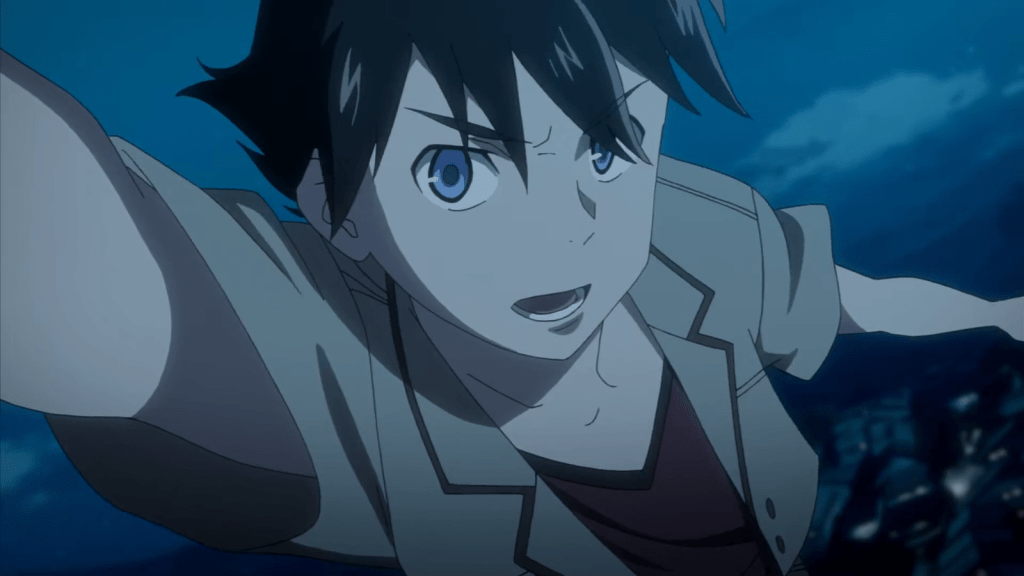
The visuals shine in this episode with the inclusion of so much action. In particular, the intense fighting animations of Minene and Murmur look really damn good. The OST for Future Diary is, in my opinion, a masterpiece. It shows in episode 25, since some of the best tracks are used here, including the slow instrumental version of the first ending song, “Blood Teller.” The exploration of the two main characters in Future Diary has been great throughout the series, and this episode was no different. The narrative did a good job showing their powerful emotions – Yuno with her growing reluctance to kill Yukki, and Yukki with his courageous commitment to saving her and putting things to rights.
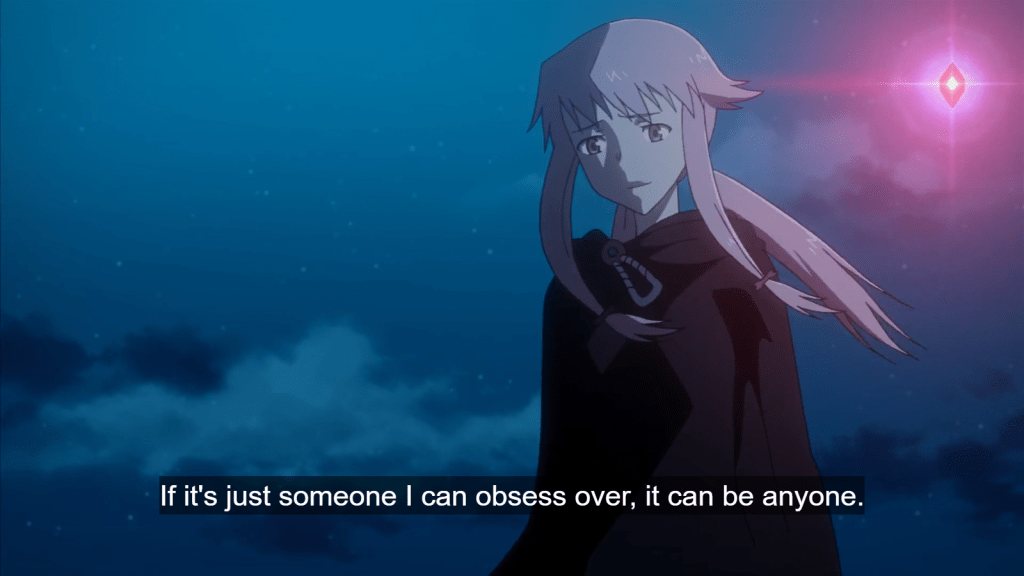
Episode 25 also contains the scene where Yuno “breaks up” with Yukki before trapping him in an illusionary world. This scene is key to the psychology of Yuno, since it’s where she admits that all she needs is someone to obsess over. Even if it’s not the Yukki she knows and loves, she can survive by obsessing over the new one in the next world. “I need a Yukki,” she says. In contrast to Yuno, we also see Yukki’s disagreement that all he needs is a person protecting him. He only wants Yuno; nobody else will do. There’s a lot to unpack in these couple of scenes, but I believe I touched on the most important aspects.
As for the problems, there are three that seem rather small when compared to the strengths of this episode. When Yukki and Yuno leap to the third world, it causes the path of that world to change. It starts going in a different, more positive direction than it did in the first and second worlds. I wonder how that could happen when the third world also has a Deus who is alive and well at this point. Wouldn’t he notice the causality shifting around and the changing of fate? What is Deus doing? This is just nitpicking on my part, since it’s not information that’s vital to the story. Still, I thought it might be worth pointing out.
The next issue goes into a little bit of what was discussed in part 12 of my critical analysis (episode 24). Future Diary is vague and inconsistent about the use of divine powers by Yuno and Murmur. This shows in episode 25, when Yuno takes command of the core of Deus from the second world, and it responds to her. I thought Deus’ power wouldn’t go anyone until there was one survivor left. Yukki and Yuno are still alive, so why is the last of Deus’ power obeying Yuno? Does she have god powers or not?
Finally, the third issue is the frankly absurd fan-service of Yukki’s classmate, Wakaba, in the illusionary world. Wakaba is shown undressing and then we see her naked breasts jiggle as she removes her top. Wow. For a second there, I lost all respect for this anime. Even if Wakaba was an adult character, putting fan-service in this particular scene would still have been a terrible choice. It doesn’t match the emotional tone at all. What the fuck, Future Diary! That’s all for episode 25.
Episode 26: Initialize
This episode is difficult because I can hardly think of any issues with it. It really is an amazing final episode. After re-watching it, however, I did find two potential problems. However, before we get to those points, let us first review the praiseworthy aspects of episode 26. For starters, there were a number of emotional and powerful moments that show good writing and character psychology. One such instance was when Yukiteru broke free of the illusionary world. He chose his love for Yuno – and his own death for that cause – over the world filled with his desires. When he shouts Yuno’s name and shatters the sky, it’s a beautiful moment.

Another significant and moving scene was when Yuno speaks with her younger self from the third world. Young Yuno’s strong love for her parents and belief that she would be fine is absolutely shocking to older Yuno, whose story turned out to be tragic. Once Yuno realizes that there is hope in this world for her other self, she seems to have mixed feelings about it, smiling though her voice quakes with emotion. But she still moves forward with her plan to try to kill the young girl.
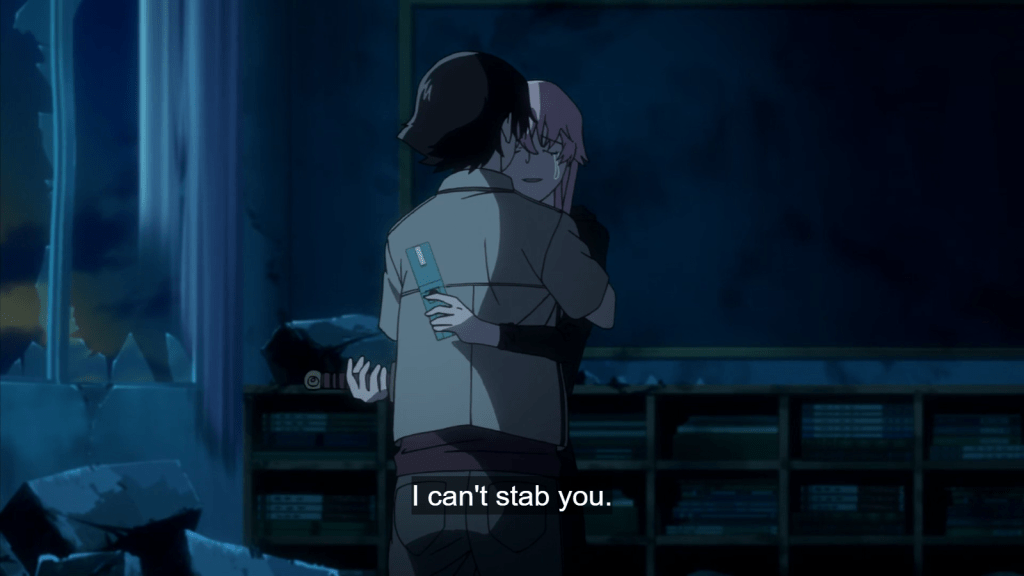
While we’re on the subject of Yuno, I believe her choice to stab herself was ultimately the most fitting conclusion for her character arc across the series. I won’t spend a long time debating this point, but my main argument is that the original Yuno was far too scarred and burdened to ever be able to accept hope without Yukiteru. She couldn’t kill her other self from the third world, and she couldn’t kill Yukki. The only option in her mind was to end herself. Future Diary foreshadowed this when it revealed that Yuno killed her other self from the second world. In short, Yuno’s story was always going to end with “killing herself.”
The last strength of this episode is the way it tied off all the loose ends. Future Diary actually went above and beyond with this. The presence of Akise in the third world is an excellent example. At first, I wondered why Akise was there, since a servant of Deus has no business enjoying life among human friends. But the anime explains that the third world’s Deus sent Akise to monitor the changes brought about by interference from another timeline. As long as Akise exists and has some independence, I have no doubt that he will one day assert his free will once again. On a related note, it was really satisfying to see what all the characters were doing in the third world and how none of them needed to die.
Now we come to the first potential problem with this episode. How exactly did Yukiteru change all of causality? There is hope for the third world third world because of the interference of another timeline, mostly brought about by Yukiteru (though Minene and Yuno also contributed.) I understand how their actions changed the life of young Yuno. But how, for example, did Yukki’s actions in any effect the cult of Tsubaki’s family? In the first and second worlds, Tsubaki’s parents are murdered by the old man who wanted power over the group. In the third world, for some reason, the murder is prevented.

There is an answer to this problem. You can chalk up the differences in the third timeline to the butterfly effect. Remember that the mayor from the third world foresaw the survival game ending with timeline interference. That caused the mayor to cancel the use of Future Diaries. If Yuno and Yukki didn’t mess around with the timelines, this never would have happened. Another point is that most of the characters in Sakurami city were disturbed that night by the attack on the school, which was caused by Yuno. This put everyone on guard and made them reevaluate their plans. In short, small changes effect each other one after another like dominoes. Eventually, the future becomes completely different.
Last of all, the other potential issue is the direction of Yukiteru’s character toward the end of the episode. Following Yuno’s death, he becomes the new god of the second world and falls into a deep depression. It lasts for ten thousand years. The anime does not confirm whether or not Yukiteru made any attempt to save the rest of the world from destruction once he became god. But I doubt he did. After all, everyone he knew was dead already. The world he’s in seems completely empty. When Murmur begs Yukiteru to create something, it seems to suggest that he hasn’t created anything for ten thousand years.

Needless to say, this is positively maddening. Just when we thought Yukiteru had developed some nerve and sense of responsibility, he crashed and became worse than ever. It’s quite tempting to hate this character. In the OVA sequel, Future Diary Redial, Yukiteru finally recovers because the third world’s Yuno comes to see him. But that doesn’t change the fact that he did nothing but wallow and be a terrible god for multiple millennia. I think this was a bad move on the part of the writers of Future Diary, as it risks frustrating the audience enough to make them hate Yukiteru forever.
Conclusions
While there were some issues with the last two episodes, they were excellent overall. At least in my mind, the positives outweighed the negatives. The main issues were tasteless fan-service in episode 25, Yukiteru’s disappointing ending in episode 26, and problems with consistency and clarity in a few areas in both episodes. The strengths of these episodes included well-written character psychology, effective tying off of loose ends for all the characters, and great visuals and music.
I hope I’ve succeeded in creating a solid critical analysis for Future Diary over the course of these 13 blog posts. I will probably write a summary post for all the key points some time soon. For reading my work today, I offer you my most sincere thanks.
Thank you for reading~
 Anime Rants