
Thanks for stopping by Anime Rants! I’m quite excited about starting this new blog series, but before I jump right into it, a few things need to be explained. I’ll remind people of these disclaimers in most posts of my Penguindrum Analyses. After that, we’ll begin the first round of discussions.
1) The Penguindrum project will be categorized under episode reviews, but it won’t work the same way as my usual episode reviews. Each entry in this blog series will cover 1-3 episodes of Penguindrum rather than a single episode. Additionally, there won’t be any detailed recaps of the events – only discussion of the episode.
2) The Penguindrum project will contain spoilers and information acquired from seeing the end of the anime. This kind of information can appear at any point in the blog series, so if you haven’t seen the entire anime yet, be aware.
3) The actual title of this anime is Mawaru Penguindrum, but I will refer to it as just Penguindrum. For your your information, mawaru means “to rotate” or “to revolve.” In this anime, cycles are important thematic elements – thus, the revolving Penguindrum.
Episode 1: The Bell of Fate Tolls
Early in the first episode, two young boys are seen walking by the Takakura house and discussing Night On The Galactic Railroad (also known as Night On The Milkyway Railroad). This famous Japanese fantasy novel was written by Kenji Miyazawa, and it inspired an anime movie version in 1985. The creator of Penguindrum, Kunihiko Ikuhara, apparently appreciated this work of fiction so much that he went out of his way to leave a reference in his own anime.
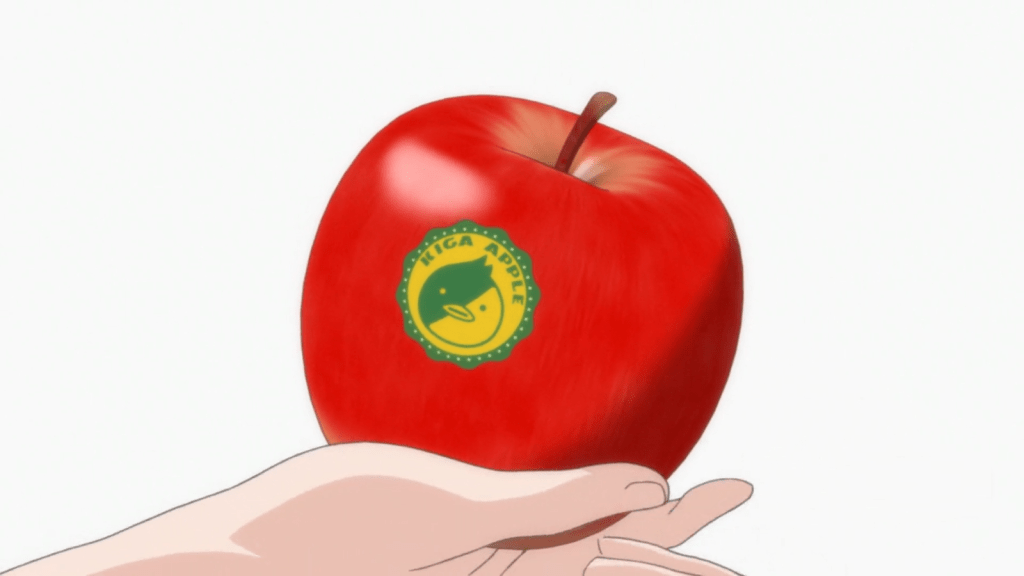
It’s clear that Night On The Galactic Railroad was an inspiration for certain elements found within Penguindrum. For example, there’s the apple that contains the universe, which is slightly similar to the fruit of fate. I used to wonder if what the boys said had any explanatory power for Penguindrum. I now think the answer is no. These are just boys discussing another anime within an anime. What they say about the apple and the reward for love only applies to Night on the Galactic Railroad. I hope that makes sense.
Several story themes and visual motifs important to Penguindrum begin to appear as early as the first episode. For instance, there’s the subway train system (Tokyo Sky Metro). A lot of scenes in Penguindrum happen in transit on the city trainline. Trains are factors in the plot since the terrorist attack 16 years ago targeted the subway trainline. Also, trains run in repeating cycles, adding to the themes of cycles and rotations. There are also at least two other key story themes in the first episode: fate and punishment.
When Penguindrum talks about punishment, it’s referring to that inflicted by a deity or karma. The idea first surfaces after Himari is confirmed dead and Kanba calls it punishment. The Takakura boys believe they are cursed because of the crimes of their parents. (They were key figures in the terrorist attack.) They must know on a logical level that children are not to blame for parents’ actions. But on an emotional level, because the terrorism claimed so many lives, Kanba and Shouma feel like someone needs to be held responsible. The two boys are very different, but the way they blame themselves and believe in a punishing god is something they have in common.

Shouma and Kanba have a similar view of the concept of fate. Both believe that if fate is real, it is unfair, cruel, and takes away any point to their lives. In the same way, both boys mention god. While they are not remotely associated with any religion, they are open to the idea that someone is out there controlling fate. Such a deity would be cruel and unworthy of worship. Now, though Kanba and Shouma mostly agree on the idea of fate, their perspectives do differ slightly. To help make things clear, I will provide their quotes about fate in this episode – Shouma’s at the opening, and Kanba’s at the end.
“I hate the word ‘fate.’ Birth, encounters, partings, success and failure, fortune and misfortune in life. If our lives are already set in stone by fate, then why are we even born? There are those born to wealthy families, those born to beautiful mothers, and those born into the middle of war or poverty. If everything is caused by fate, then God must be incredibly unfair and cruel. Because ever since that day, none of us had a future . The only certain thing was that we would never amount to anything.”
~Shouma Takakura, Mawaru Penguindrum episode 1

“Why are people born? If people are created just to suffer, is it meant as some kind of punishment? Or a cynical joke? If that’s the case, animals that adhere to the survival strategies programmed in their DNA are far more elegant and simple. If there really is an existence worthy of being called a god, I want to ask him just one thing: Is there really fate in the world of humans? If a man ignored fate, instincts and DNA to love someone… God, is he really human? Just wondering. I hate the word ‘fate’.”
~Kanba Takakura, Mawaru Penguindrum episode 1
Shouma’s quote, especially at the end, expresses his hopelessness as someone from a broken family. The reason he hates fate is that it will prevent him from ever being valid as a person. That makes sense since Shouma is a character who deeply wants to feel worthy. Kanba’s quote is quite different, as it expresses his shame over loving Himari romantically. He knows his love is forbidden, and the fact that he can’t stop loving Himari makes him question his humanity. The reason Kanba hates fate is that he was fated to be Himari’s brother. As such, his love could never be acceptable. Needless to say, both brothers hate fate because Himari is fated to die.
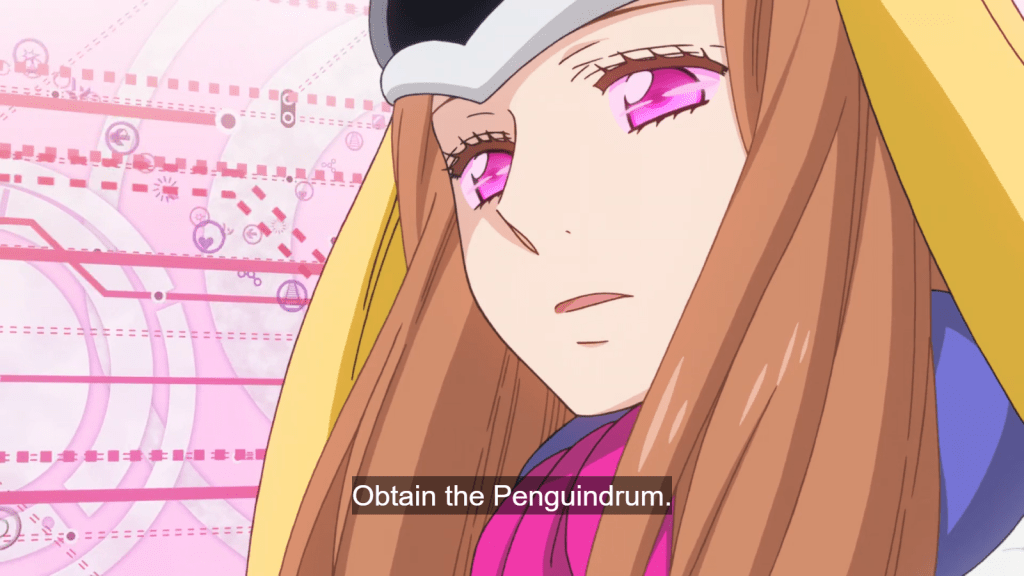
I have one other note related to the idea of fate. The being that dwells within the penguin hat – usually called the Princess of the Crystal – claims to be from “The Destination of Fate.” This has two meanings. First, in the Penguindrum universe, there are supernatural elements. That includes some kind of afterlife dimension, though not much is known about it. The Destination of Fate is thus the world after death. The second and more literal meaning is just death. All humans are fated to die. Hence, death is The Destination of Fate for literally everyone.
Moving on to a lighter topic, what about the penguins? There are various theories about how and why the penguin trio came to the humans. However, most fans agree that the penguins are magical beings from the Destination of Fate. (Personally, I think the Takakura parents asked Sanetoshi to send helpers to their children. Since Sanetoshi is also from the Destination of Fate, and brings other items and people from there, it would make sense. Given Sanetoshi’s research in Antartica while he was a living human, he probably loved penguins.)

It’s fairly obvious that the penguins are included for comic relief and cuteness. But in addition, the penguins are also there for the sake of being absurd. Ikuhara’s works are full of ridiculous concepts, creatures, and fantastical ideas. (And I love them!) Don’t think too hard about the meaning of these elements. Just know that Ikuhara loves absurdity, as it provides humor and charming fantasy aesthetics. Absurdity is also important in Ikuhara’s works because it shows how much he values imagination. Penguindrum is nothing if not imaginative. Maybe that’s why the Princess of the Crystal always shouts “Imagine!”
Episode 2: Risky Survival Strategy
“I love the word ‘fate.’ Because, you know how they talk about “fated encounters”? A single encounter can completely change your life. Such special encounters are not just coincidences. They’re definitely fate. Of course, life is not all happy encounters. There are many painful, sad moments. But this is what I think: sad and painful things definitely happen for a reason. Nothing in this world is pointless.”
~Ringo Oginome, Mawaru Penguindrum episode 2
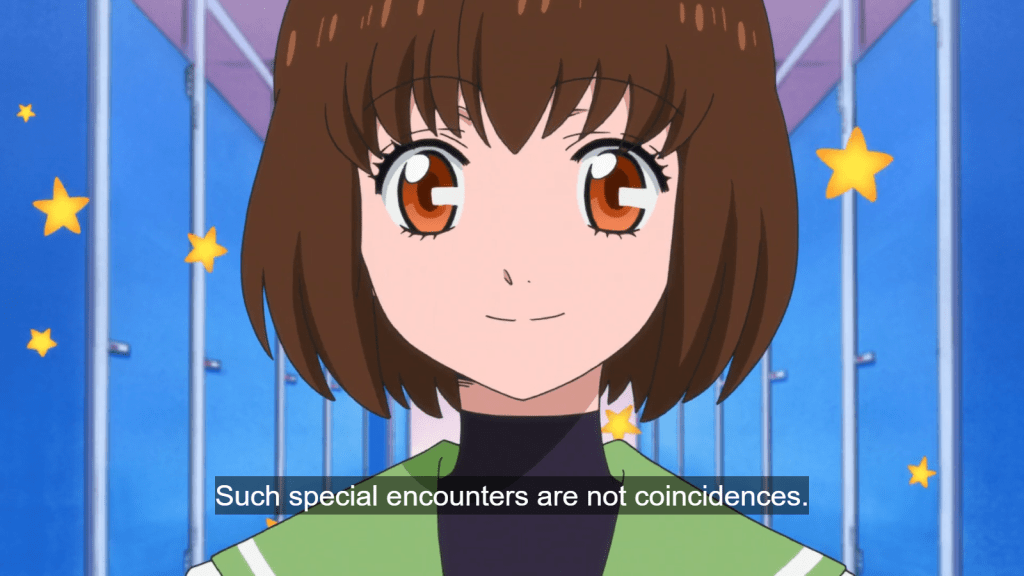
Episode 2 introduces Ringo and her idea of fate. In stark contrast to the Takakura brothers, Ringo has an overwhelmingly positive view. However, we shouldn’t take that to mean that her life is without trouble or that she is emotionally stable. Despite this episode’s more humorous outlook, Ringo is a serious character with serious concerns. Her thinking is screwed up in multiple ways and she has suffered emotional trauma in her family. So, for Ringo, clinging to a rosy view of destiny is actually a desperate survival strategy. (It’s interesting how all the characters are ultimately just trying to get by, initiating their own different survival strategies.)
The next topic is not a very comfortable one, but it needs to be addressed: it’s the sexual humor all throughout this episode. An example is when one of the penguin focused the camera looking up a girl’s skirt. Some of these moments were harmless and legitimately funny – such as when the penguins steal and wear sexualized lingerie. But mostly, the humor is somewhat problematic and unnecessary. Sneaking and watching girls is creepy and borderline voyuerism. We do not need to hypersexualize these characters, especially considering that they are highschool teenagers.

Now, I’ll give Penguindrum credit where it’s due. As far as what’s actually shown by the animation, it’s not bad at all. At one point, for instance, the boys see Ringo’s underwear, and Kanba comments that “she’s going all out with that triple lace.” But there is no actual shot of Ringo’s lingerie. Again, I’ll give Penguindrum a little credit. Good job, anime – you decided not to show panty shots of teenage girls! Damn, the bar is pretty low, isn’t it? After this episode, some level of sexual humor will persist, but it’s most pronounced in episode 2 and a few others.
We will discuss some character development shortly, but first, there is another reference to point out. Remember in episode 1 when the two young boys were talking about Night On The Galactic Railroad? The author of that book is Kenji Miyazawa. In episode 2, the radio broadcast Ringo listens to mentions something about “the hometown of Kenji Miyazawa.” The broadcast is about birds, so they were probably talking about some bird’s habitat in that author’s town. The fact that there is another Kenji Miyazawa reference suggests that this creator was quite significant to Ikuhara. I thought it was worth mentioning.

Penguindrum is proficient with developing its characters. Even early on, you can get a feel for the traits of the main characters. There are many ways in which an anime can develop characters, including good voice-acting, flashback scenes, and dialogue between characters. Penguindrum uses all of those methods and more. It also lets us get to know Kanba and Shouma by comparing and contrasting them. Showing the similarities and differences between characters is an effective method.
Kanba and Shouma are more different than similar. They are bound together by their love for Himari and their shame about their parents’ crimes. If not for that, they would probably never get along. Kanba is oriented toward action, sensory experiences, and other people. In contrast, Shouma is more thoughtful, introverted, and abstract in the way he thinks. While Kanba is confident, Shouma is often lacking in assertiveness. He is also more emotionally-oriented. On the plus side, this makes Shouma understanding and kind. However, at times, his emotional reasoning can prevent him from making good decisions. Kanba certainly has his share of emotions, but in general, he’s a more logical decision-maker.

Not all of these personality observations are obvious in the first two episodes. Still, there are some good moments that show differences between the boys. An example from episode 2 is when Shouma brings up the morality of sending the penguins to spy on Ringo. He knows it’s not right. Kanba convinces him that this is their only option, which might be true. But importantly, Shouma never backs off his stance that what they’re doing is wrong. He just commits to doing it anyway, for Himari’s sake.
In summary, this scene shows that Kanba does what needs doing regardless of its lawfulness or morality. He’s perfectly comfortable with the spying situation. On the other hand, Shouma’s empathetic nature makes him adhere to strict personal ethics. The Takakura brothers are quite different in terms of personality. Ringo is distinct from both of them, though of the two, she’s more similar to Shouma. We shall delve into Ringo’s personality another time. For now, that concludes my analysis of the second episode.

Final Notes
I have a few observations from the opening song (which is “Noru Niru” by Etsuko Yakushimaru Metro Orchestra). Impressively enough, there are hints about the characters in the visuals. Ringo’s animation shows her catching fire as she runs with Momoka’s diary. The act of desperately running is a metaphor for the way Ringo follows what’s written in the diary and makes it her purpose in life. The fire is foreshadowing for the punishment that happens when the spell from the diary is used. There are a few other tidbits, such as a bird in a cage behind Tabuki, or the more obvious image of the spinning fruit of fate at the end of the song.

There’s just one other topic that I think is important to mention. It’s another highly uncomfortable one. Penguindrum consistently sexualizes Himari, and she is only thirteen. Look at her ridiculous outfit as the Princess of the Crystal. Sure, Penguindrum may not be as bad as it could be, but any pronounced child sexualization is still a huge problem. All I wanted to do is point out this significant flaw in the series. I do think it’s possible to ignore this issue for the most part and appreciate the rest of the series. I just wish we didn’t have an industry that caters to pedophiles.
On that sober note, I will end part 1 of my Penguindrum Analysis. Thanks for much for reading my work and visiting my blog today.

Thank you for reading~
 Anime Rants
One thought on “Penguindrum Analyses Episodes 1 and 2”