Disclaimers:
1) This Penguindrum project will be categorized under episode reviews, but it won’t work the same way as my usual episode reviews. Each entry in this blog series will cover 1-3 episodes of Penguindrum rather than a single episode. Additionally, there won’t be any detailed recaps of the events – only discussion of the episode.
2) This Penguindrum project will contain spoilers and information acquired from seeing the end of the anime. This kind of information can appear at any point in the blog series, so if you haven’t seen the entire anime yet, be aware.
Episode 3: Then Devour Me Courageously
Compared to the first two episodes, the third installment does not require a lot of analysis. Nevertheless, I have come up with a few notes and comments on this episode. To start with, the episode title is supposed to be a pun that uses the word curry – “devour me curr-ageously.” Puns in Japanese don’t usually carry over very well into English, so I thought it was worth explaining.
Speaking of Japanese, their word for apple is ringo. I’m sure most of my readers are already aware of this fact, but I needed to mention it just in case. Apples are significant motifs in Penguindrum mostly because the fruit of fate looks like a red apple. So, it’s fitting that there’s a character whose name literally means apple. Additionally, apple jam and ground apple pieces are the secret ingredients behind the unique flavor of Ringo’s curry recipe. This may be a bad joke, but if you think about, Ringo sure does put herself into her cooking! Right?! Ha ha!

Ringo longs to eat curry with those she cares about, and this may seem a bit silly at first. But it’s because, to her, family curry day is an important ritual that expresses love. She also has a strong formative memory of being eleven and eating curry with Tabuki and her mother. We haven’t said much at all about Himari yet, so while we’re on the subject of curry, let’s take a moment to appreciate that Himari happily ate curry with Ringo. This was especially significant because Ringo’s mother was busy and her father had left the family – she didn’t have anyone else with whom to eat.
The fast friendship between Himari and Ringo surprised me when I first watched Penguindrum. I thought Ringo would be more stubborn and reluctant to open up to anyone new, and I thought Himari might be shy. Moreover, Ringo is three years older than Himari, and most teenagers don’t want to risk looking childish by associating with much younger people. Despite all this, the two girls get along swimmingly. They only knew each other for a few hours at most before Himari called Ringo her cherished friend.
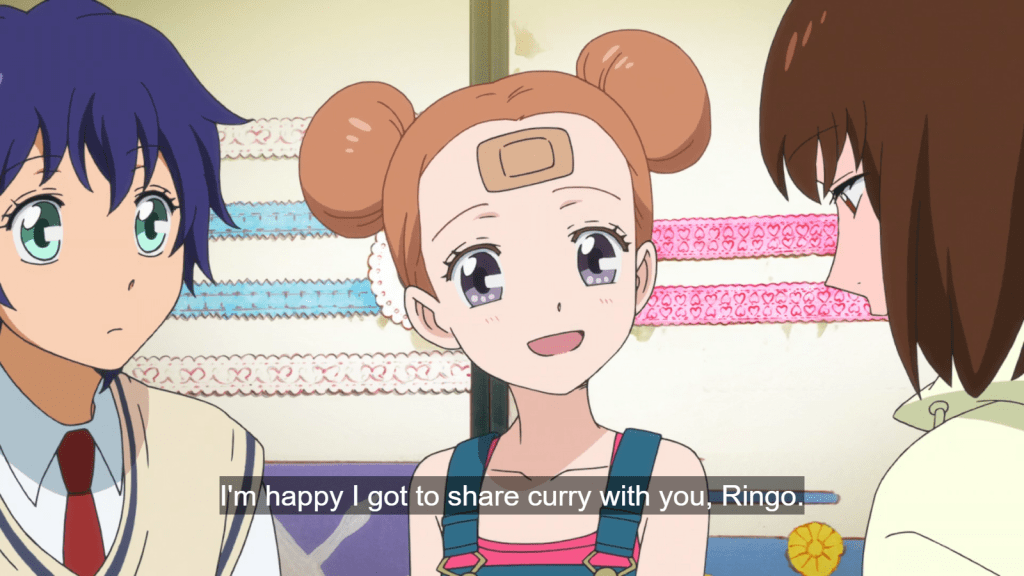
In my opinion, it was a bit of a cheap move to not actually show Himari and Ringo’s first few conversations and exactly what they bonded over. Instead, Kanba and Shouma came home to find that Himari was already with Ringo and calling her a friend. Still, it’s possible to infer a few things about the quick friendship. Himari spends a lot of time alone, either at the hospital or at home, and hasn’t been to school in a long time. She’s incredibly warm and loving by nature, and even if she was a bit shy, she must have been eager for a friend. That’s why Himari immediately loved Ringo.
For Ringo’s part, she was already in a place of great vulnerability and emotional exhaustion after her day with Tabuki didn’t go as planned. She was unlikely to put up walls at that point. Plus, Ringo is naturally warm and well-mannered, so it wouldn’t be awkward to walk home with Himari. Actually, in terms of the MBTI personality model, Himari and Ringo would probably be the same type (ISFJ). They are loyal caretakers who want nothing more than a secure life with their beloved families. It’s no wonder they get along when they share a lot of personality traits.

The third episode was important for several reasons. For one thing, it sets the tone and pattern of the next few episodes, with Ringo trying to fulfil the diary, and the boys keeping an eye on her. For another thing, we got to see Yuri for the first time, although she hasn’t been formally introduced to us yet.
Before we finish up this episode, I have one more quick note. I laughed at the part where the Princess of the Crystal was dressed in a cow suit and drinking milk. It goes back to what I was saying in part 1 of this analysis – that Ikuhara loves absurdity and goofiness. If you’ve seen his masterpiece anime, Revolutionary Girl Utena, then you may remember the episode where a girl turns into a cow. That’s what this moment reminded me of. That’s all for episode 3.

Episode 4: The Descension of a Princess
This is a memorable episode due to the amount of ridiculousness and comedy seen within. It’s easy to tell this is Ikuhara, not just from the artwork of fairytale castles and roses, but also from the absurd humor. A lot of it is animal-based. In Revolutionary Girl Utena, there were several comical episodes about a girl named Nanami who always has some kind of trouble with animals – be it turning into a cow or being stampeded by elephants. Penguindrum episode 4 follows the animal humor tradition with the inclusion of the skunk, the snake, and the caterpillar that all give hell to Ringo.
Much of the comedy was also musical in this episode. The stupid songs in Ringo’s imagination are hilarious, if a little weird. I honestly don’t know how the voice actresses for Yuri and Ringo recorded these sung lines without laughing. One other interesting thing about the humor of this episode is that it almost feels like Ikuhara is poking fun at his own style. The prince aesthetic, fairytale world, and original songs were all quite serious elements in Revolutionary Girl Utena. Yet in Penguindrum, they are purely silly. I’m always impressed when a confident creator can parody his own work.

Now we’ll get into the meat of the discussion for this episode. It’s Ringo’s self-proclaimed purpose in life to emulate her deceased sister until she eventually becomes Momoka, thus fixing the grief suffered by everyone who knew her. Ringo believes the diary contains instructions for her. Moreover, she believes that what is written there is fated to happen. But while the diary does have a magic spell hidden in it, there’s no clear answer on whether or not its other contents have magical power. Let me explain my thought process concerning this unclear issue.
Episode 4 suggests that Ringo’s take on the diary is incorrect. The diary says that Momoka has her first kiss with Tabuki by the lake. Ringo, on the other hand, nearly drowns and gets CPR from Shouma as a result. Mouth-to-mouth CPR while unconscious is not a kiss, and even if it was, Tabuki wasn’t the one to do it. In the previous episode, things didn’t go exactly according to the diary, either. Tabuki did eat the curry made by Ringo, but the two of them didn’t eat together as the diary ordered.

It seems like Momoka’s diary has no magic power to predict Ringo’s fate. Even when the outcome loosely resembles the events in the diary, it’s only because Ringo bent over backwards to force it to happen. As long as she can twist the events to make the diary seem true, Ringo is satisfied. This leads us to an interesting notion: perhaps what we think is a fated outcome is actually a self-fulfilled prophecy. Having already decided that her fate is to be Momoka, Ringo is demonstrating the power of choice. (Whether or not free will truly exists, I think we can agree that we still make choices. We just don’t know if that choice was always meant to happen or not.)
Shouma and Kanba are no different. They have also decided their destiny: they are fated to be punished and amount to nothing. Whatever happens to them will become their “proof” that it’s true. There are many different themes and meanings in Penguindrum, and one of them is probably that our choices do have power. Sure, there are some things we can’t change, but nothing at all will be accomplished if we give up too early.

Importantly, I don’t think Kanba and Shouma have given up. They are breaking their backs trying to save Himari even while believing that her death is their deserved punishment. Although they are using flawed thinking and self-fulfilled prophecies, the Takakura boys are still resisting what they perceive as fate by continuing to make choices. Their psychological survival strategy is to struggle to the end. As for Ringo, her survival strategy is also to fight, but in the opposite direction. Instead of resisting it, she is fighting to force her perceived fate to happen.
The last part in episode 4 shows one of Kanba’s ex-girlfriends, Asami Kuho, getting pushed down a long, steep set of escalators. This scene is confusing to me, so I want to make sense of what I can by writing it out. Momoka’s diary mentions there is a “girl with red shoes” at Akasaka-Mitsuke station. Asami is at Akasaka-Mitsuke station and is wearing red heels when she is pushed. It seems like the diary was instructing Ringo to harm the girl with red shoes. Is that really what happened?
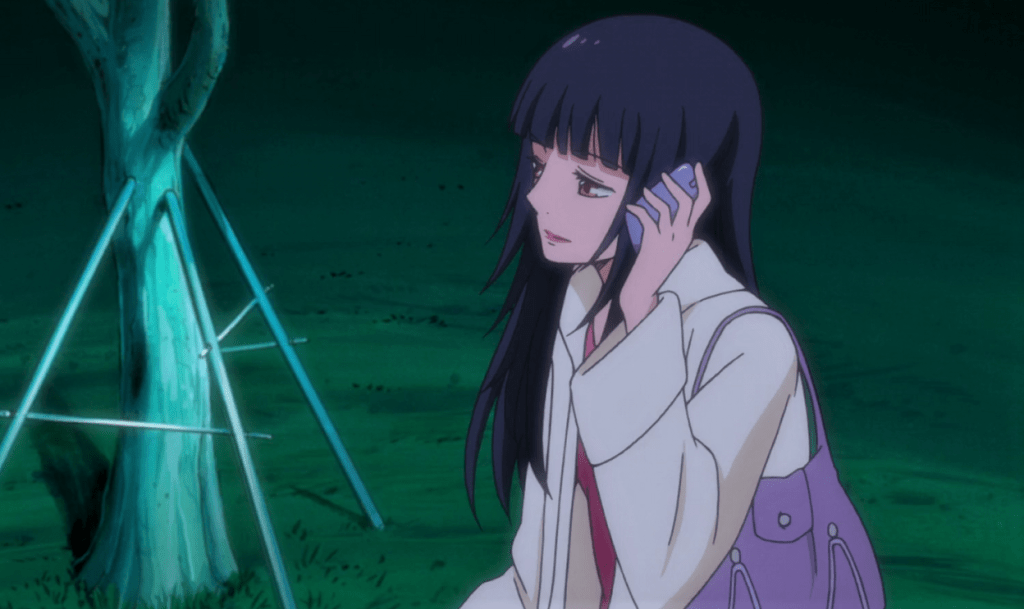
This development makes no sense to me. Based on what we know about Momoka from later episodes, she would never have harmed a random girl. The diary probably just said that she saw a girl with red shoes. But if all she did was notice the girl, then why in the world would Ringo interpret it so violently? Stalking is one thing, and it’s a serious crime, but acts of significant violence toward innocent people is another thing entirely. Has Ringo lost her mind?
Maybe Masako was the one who pushed Asami. She has more motive, since she’s jealous of anyone Kanba dated. However, a moment ago, Asami was talking to Masako on the phone from her fancy house. If Masako was the one who pushed her, how did she get from her house to the station so fast? Either Masako did it and her speed is never explained, or Ringo did it without a motive for violence. Which is it?

I tried looking for information online, but the Fandom Wiki for Penguindrum offered no help. For now, there is no answer to this problem. There might be clues in later episodes, but I don’t remember them at the current time. As unsatisfying as it may be, we cannot say who pushed Asami Kuho. I’ll end my analysis here for today.
Thank you for reading~
 Anime Rants
One thought on “Penguindrum Analyses Episodes 3 and 4”