
Has there ever been an anime that deeply moved your emotions and spoke to your heart despite not actually being a great series? If you’re reading here at Anime Rants, you probably like anime – but it could be any form of story, such as a book or a live-action movie. Objectively, you know there is nothing particularly outstanding about this story, but no matter how many years pass, you find subjective appreciation and comfort within it.
There are probably multiple anime series that fit this description for me. For most of the others, however, I would probably try to argue that the anime is exceptionally good or well-made. (Haibane Renmei is a good example.) Plastic Memories is genuinely not a great anime, but it is still close to my heart. Today at Anime Rants, I’m ranting and rambling about my personal experience with Plastic Memories.
Warning: This Article Contains Spoilers For Plastic Memories

Part 1: Background Information
Note: My hope is that readers can grasp most of this article even if they haven’t seen Plastic Memories. To help with that, I’ve included some basic information about the anime.
Plastic Memories is a drama/sci-fi/romance anime that aired in Spring 2015. Although two light novels would be released following the start of the anime, this story was an original idea for TV created by Naotaka Hayashi. Most of the time, I enjoy sci-fi with elements of dystopia, philosophy, and intense plot twists. But Plastic Memories isn’t that kind of anime. It’s much more of a Slice-of-Life than a thriller or something more psychological. Although it won’t effect everyone the same way, Plastic Memories is widely regarded as a “tear-jerker anime” in the same domain as Ano Hana, Your Lie in April, or Angel Beats.
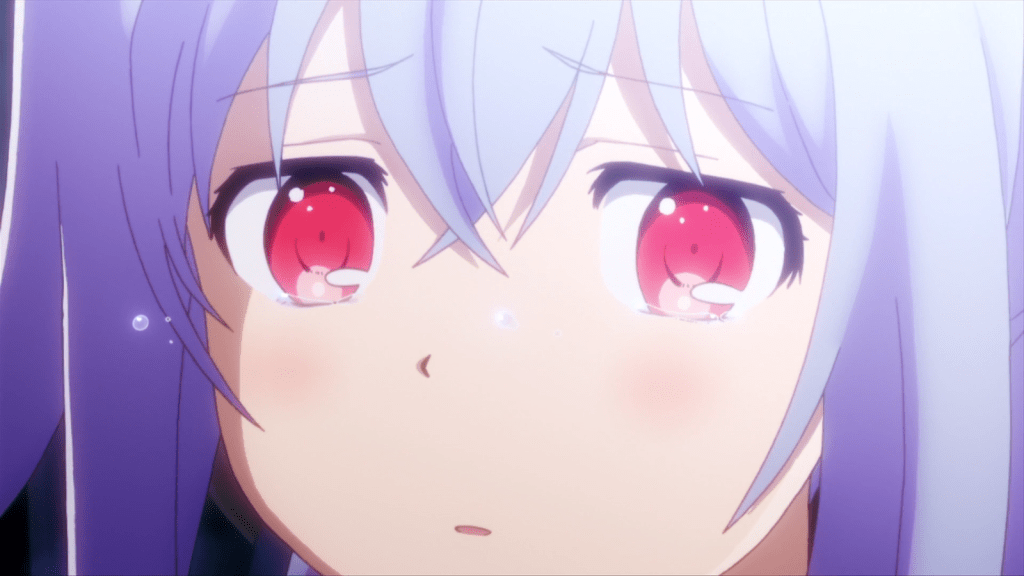
Set in the not-so-distant future, Plastic Memories explores the concept of Giftias: androids who are so lifelike they are pracitcally indistinguishable from humans. These Giftias have emotions, consciousness, and intelligence equal to humans, but there are still a few differences – the most notable one being the lifespan of the Giftias. They only “work” for nine years maximum before having to be reset with a new mind or “retired” permanently.
In Japan, there is an agency called SAI that has the most advanced Giftias. SAI employs the Terminal Service, a group of humans and Giftias whose job it is to collect worn-down Giftias from their homes before their minds begin to break. Our male protagonist is Tsukasa, the newest human member of Terminal Service One. He is paired up to work with our female protagonist and love interest, Isla the Giftia. Thus, the emotional tale begins.

When I first watched Plastic Memories in the summer of 2015, I believe I rated it 8/10. Now, however, I would put it somewhere in the 6 range – maybe 7 to be generous. The point is, while this anime isn’t terrible, it’s not that good. Since this is a rant and not a technical review, I won’t spend too much time explaining the positives and negatives of the production. But I have provided three quick examples of issues below.
The first issue could be “romantic elements” that are sappy, overused, and frankly stupid. An example is in the first episode, when Tsukasa’s narration claims that he fell in love with Isla at first sight without knowing anything about her. A second issue might be ethical and/or character-age-related concerns. For example, if Giftias can only live for nine years, is it acceptable for an adult human to have a romantic relationship with them?

As for the third issue, it’s the unoriginal way the characters are written and designed. Tsukasa is an extremely boring main character with an overused design. The rest of the characters are mostly one-dimensional tropes – like the fiery tsundere (Michiru), the femboy (Zack), the bossy career woman (Kazuki), and the dandere (Isla). Despite these problems with Plastic Memories, I still enjoy it, and will now explain its personal significance to me.
Part 2: What Plastic Memories Did For Me
There were a lot of elements of Plastic Memories that I liked, including the memorable opening song. That beautiful intro still gives me a strange feeling in my chest when I hear it sometimes. It’s the emotional connection, I guess. But speaking more broadly, there were two things Plastic Memories did for me: 1) it provided entertainment with a lot of cuteness, and 2) it allowed me to find emotional release.

First, let me give some anime-related context. My memories are hazy, and I watched a crap ton of anime from 2014 to 2018. Nevertheless, I remember that 2015 was a terrible year, and that I spent time watching and re-watching a lot of dark and psychological anime series. I wallowed in the gloom and violence. That was because I was going through a lot of emotional turmoil as I suffered from multiple mental illnesses – such as Borderline Personality Disorder and Major Depressive Disorder.
For examples of what I was watching, I loved Bokurano (Ours) which contains a lot of disturbing elements considering that the cast is mostly children. It was the same with Madoka Magica, Future Diary, and Neon Genesis Evangelion. I stooped low enough to watch pointlessly edgy and nihilistic shit like Gantz and Btoom! Even the shows that were masterpieces – namely, Monster and Parasyte the Maxim – were only enjoyable to me early on for their sad and disturbing components. It was in this context that I stumbled upon Plastic Memories.

It contains some rather emotionally heavy and dramatic parts, but Plastic Memories also features bright colors, cute characters, and sweet moments. Isla is adorable. This anime surprised me because it kept me entertained while showcasing “sweetness and light” way more than violence, despair, and nihilism. Plastic Memories is not the singular anime that did this for me, but it was one of only a handful. Watching something cute and relatively mild was a breath of fresh air in 2015. That’s part of why this anime matters to me.
As for point two, Plastic Memories is special to me because it is so cathartic. To explain this, I need to give some spoilers about the anime’s main storyline. After getting to know Isla a little and developing a crush on her, Tsukasa discovers a terrible truth from Isla’s former partner, Kazuki. Her nine years are over, and Isla has only a month left to live. She is already much less capable than she used to be, as she is slowly breaking down.

Rather than emotionally withdraw and work with someone else, Tsukasa promises to be Isla’s partner to the very end. The remaining 7 episodes happen over the course of about a month. During that time, there’s some drama, and not everything is always fine and dandy. Still, Tsukasa and Isla grow closer and gain many new experiences. By episode 11, they are officially a couple. Episodes 11 and 12 show Isla and Tsukasa making fun memories together.
The final episode is definitely a tear-jerker, as Tsukasa must bid farewell to Isla forever. No matter how many times I watch this anime, I usually end up getting teary-eyed, if not outright crying. Spending too much time indulging any one emotion is a bad idea for your mental health; but as long as it’s not too often or overwhelming, it can be healthy to “let it all out.” Plastic Memories was useful in letting me do this during one of the worst years of my life.

This anime also showed me characters whose situation I could somewhat understand. In 2015, the two people I loved most in the world both decided to remove me from their lives. While the people I loved didn’t literally die, they abandoned me in a way that was as terrible to me as death. Since we have not been able to rebuild our relationships or maintain contact, I view these events as permanent: the “deaths” of my emotional bonds. Plastic Memories helped me to begin processing the grief. By saying farewell to Isla, I was also bidding goodbye to those who left me.
Part 3: The Big Question
I’ve said that that Plastic Memories is not a great anime, and many aspects of it seem generic and cheap. At worst, this is just a cash-grab anime that was created for the special niche of tear-jerkers with no substance. However, I have a hard time believing that a small-time anime script-writer like Naotaka Hayashi was being insincere. I think Plastic Memories is his genuine attempt at an emotionally stirring story, and I respect it.

The surface-level takeaway message of Plastic Memories is something like, “Make memories with what you love, because nothing lasts forever.” Even that is a pretty heavy theme worthy of much discussion. But for me, there is something even deeper that underlies that message. It’s the question of whether or not something is worth it if it will surely end.
All things come to an end. Whether it’s a life or a relationship, nothing lasts forever – at least, nothing that we can prove. Why do we invest time and care into things that don’t last? This question has bothered me since I was about ten years old. I started growing a garden with help from my mother. Gradually, it occured to me that everything we planted was eventually going to die. Moreover, some of them would die without giving any flowers or produce. Still, I kept gardening, because I loved it.

Growing a garden is one thing, but loving someone when the relationship might not last is an order of magnitude different. This is what Tsukasa faces in Plastic Memories. When Kazuki told him about Isla’s lifespan, he had to decide if he wanted to keep spending time with her and growing more attached. He had to ask himself, “Is it worth it?”
Depending on the person and the situation, such things are not “worth it” for everyone. Kazuki decided to stop being Isla’s partner because it wasn’t worth it for her. Tsukasa, however, decided the opposite. He didn’t just keep working alongside Isla – he also asked her out and started dating her for the time she had left.

If you have decided something is “worth it,” then you should try your best to enjoy it and go all-out like Tsukasa did. Do whatever you can to treasure your memories of that thing or person while it’s still with you. Even after it has died, keep treasuring those memories. For me, when a relationship ends, I sometimes have feelings of regret that I invested so much in it. But shows like Plastic Memories help me see that’s the wrong attitude. I should be proud of myself for investing my love and care so passionately. I did the best I could. And with the memories I keep, it was indeed worth it.
Normally, I come to the conclusion that something was worth it when in a logical, mindful state. But to be honest, on an emotional level, it doesn’t always feel like it was worth it. It’s especially depressing when you realize that not even memories last forever. They lose their color with time, and occasionally disappear completely. If you have dissociation issues like me, you can also doubt your memories or get them mixed up with fakes. So, again we must ask the question – if even memories die, is it worth it to invest love?

There’s a crucially important reason, actually, for why I believe you should continue to invest in temporary loves. If someone decides that it’s never worth it, they will stop extending love to others and putting energy into their passions. They will become numb and dead inside. Personally, I don’t want a world full of emotionally dead people. I want a lively and passionate world, even if the tradeoff is eventual grief. That’s why I’m going to say “it’s worth it,” despite not always feeling that way. I’m actively deciding that my investment matters.
I think Tsukasa probably came to the same conclusion. That’s why, in the final scene of Plastic Memories, he is able to smile and extend his hand to his new partner. I will now close this discussion with a relevant quote I found online.
“The greatest tragedy of life is not that men perish
but that they cease to love.”
~W. Somerset Maugham

 Anime Rants