Welcome to Anime Rants. I’m very far behind on my Summer 2023 episode reviews, but I’m doing my best to cover the episodes whenever I have time. So, without further ado, here are my recaps and responses for The Gene of AI Episodes 5, 6, and 7.
Episode 5: Tuning

This episode was mostly about a boy who has behavior problems despite being a Humanoid. The boy’s mother takes him to see Dr. Sudo, who states that he can be treated with “emotional tuning” of his mechanical brain. It’s up to the mother to decide if she wants to have that done. In the end, she asks for it, and Sudo successfully tunes the boy’s emotions so he can function well in school. The main side effect seems to be that the boy’s style of playing piano has changed. Before the tuning, he played with raw passion – but now, he can stay calm, which means his music is now a bit different.
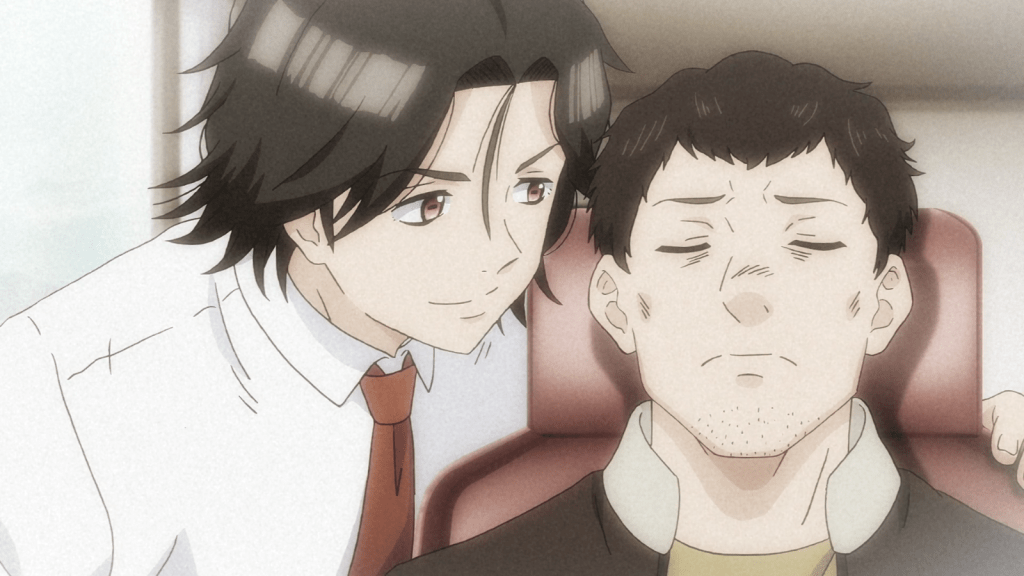
The secondary story of the episode was about a Humanoid named Matsumura with a long history of reckless actions, low-grade crime, and addiction. He goes to see a “Life Planner” by the name of Seto, asking him if he can cure his addiction to alcohol. Seto employs a controversial, under-the-table treatment to do this. He essentially puts Matsumura into a hypnotic state and instills false memories of an “Old Friend” who keeps him on the right track. The treatment was a success and Matsumura stopped his crime and drinking, instead donating money regularly to his “Old Friend.”

Like many episodes of The Gene of AI, this installment sparks some interesting thoughts and real-world parallels. I don’t have time to flesh them out in detail, but I’ll mention a few notes. The case with the piano boy reminded me of what happens to kids with ADHD and perhaps other conditions I’m not as familiar with. Putting young children on stimulant medications so they behave in school is a form of “emotional tuning.” Please note that I’m not saying ADHD medication is always bad. It’s a very nuanced and complex topic.

As for the case with the alcoholic, that was also extremely interesting, but a bit harder for me to see the real-world parallels. The treatment of addiction can be extremely difficult, especially for those with “an addictive personality,” or the tendency to trade one addiction for another. Seto’s solution was basically to brainwash the addict. Considering that Matsumura agreed to this “treatment” beforehand, I don’t think it’s unethical, but it’s an iffy subject for sure.
Making addicts believe they are helpless is something that real societies have been doing for some time. The AA /12-step format is, in my opinion, a cult which “brainwashes” its members into believing their progress is due to a “higher power.” So for me, the case of Matsumura can be viewed as a metaphor for problematic addiction recovery programs.
Episode 6: Robot
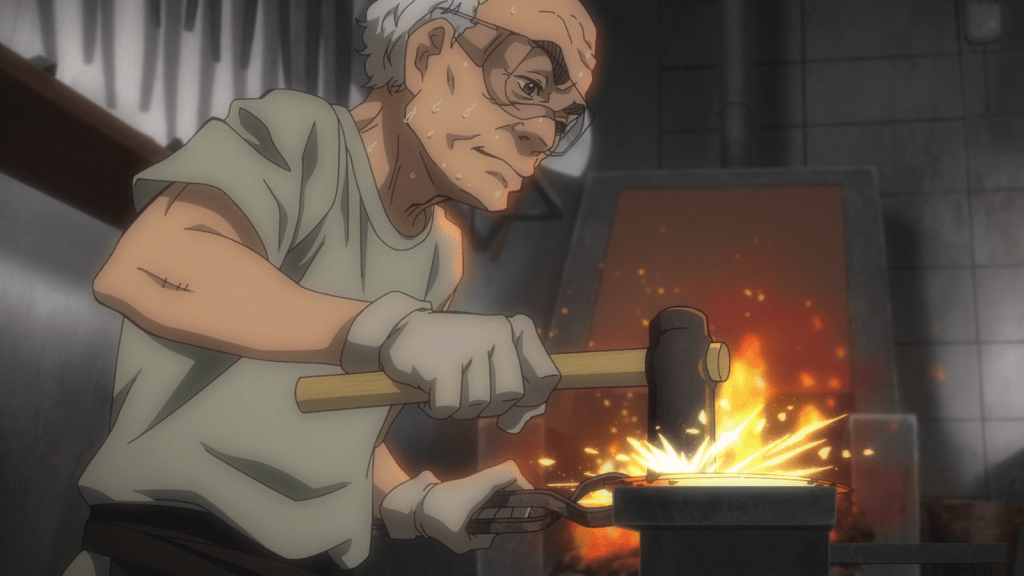
The first half of the episode was about a robot working as an apprentice under a metal-worker/blacksmith. The man in charge wants to teach robots ancient trades to preserve them as history changes. The robot is an especially talented mimic and loves to learn new skills, so he is often called “Learner-kun.”

The old smith who trains Learner is skeptical at first that a robot can learn his craft, but to his surprise, his student surpasses him in a matter of weeks. Learner becomes a good metal-worker in no time. Rather than getting angry or depressed, the old smith moves on with his life and continues trying to improve his own skills. He’s a very well-adjusted old man.
With regards to Learner-kun, I still have issues with the fact that robots are slaves in this society, but that wasn’t the point of this story arc. I think the point was that old forms of crafting should be preserved as part of human history. Another potential “point” to the story was that the old man feels subpar because a robot can do better than him in such a short time. However, this particular craftsman was able to move past his frustrations and continue his trade.
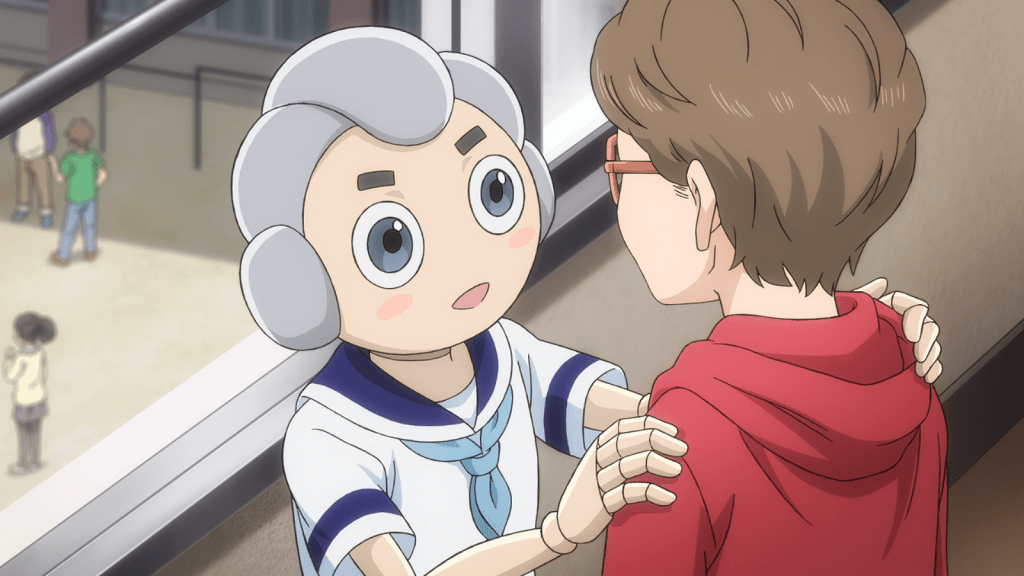
The second half of the episode was about another robot who is training to be a “care-giving” robot that helps humans who need support. This robot, named Perm, is introduced into a school to gain experience interacting with young humans. Most of the students accept him and some even become good friends with him.
However, Perm is a special kind of robot who exists as a collective entity. There are multiple “Perms” in multiple schools, learning different things and combining their knowledge into one cloud database. Occasionally, Perm acts distant or depressed. The other kids eventually realize that it’s because not every school will treat Perm well. He could be having bad experiences in other places. This realization inspires Perm’s friends to work harder to cheer him up and play with him.
In the end, Perm graduates the school after only six months. That’s just how smart of an AI he is. Thanks to his experiences with human friends, the little robot sets off into his new life with a positive attitude. Perm’s story was interesting enough, but somewhat puzzling. I’m not sure if viewers are supposed to think that robots “have hearts” or not. It definitely seems like Perm had emotions. Well, whatever the case, it was sweet to see the children interact with him in an uplifting way.
Episode 7: Human
As usual, this episode covered two different unrelated cases. The first one was about an old Humanoid man who had a head injury. His family hesitated to treat him for it, which was frustrating to the Humanoid Rights Representative involved in the case. The Representative grew increasingly insistent, and finally, the family asked Dr. Sudo to heal the old man.
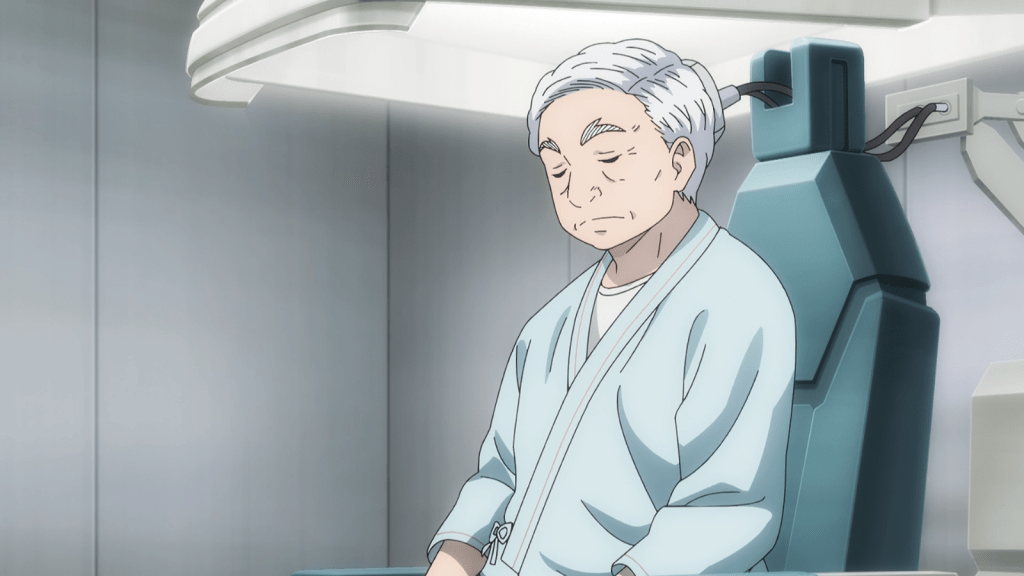
When the elderly Humanoid wakes up after the procedure, he’s loud and violent towards his son. The family revealed that this was the real reason they hesitated to treat the old man: he was an incredibly angry person and difficult to live with.
This case was interesting to me mostly because of the existence of the Humanoid Rights Japan organization. For the first time, we have acknowledgement that Humanoids had to fight for their current rights. Moreover, there are still ongoing threats to those rights. Humanoid Rights Japan is clearly still needed in this world – that being said, I think this particular Representative overstepped his bounds by pressuring the family without knowing their story.

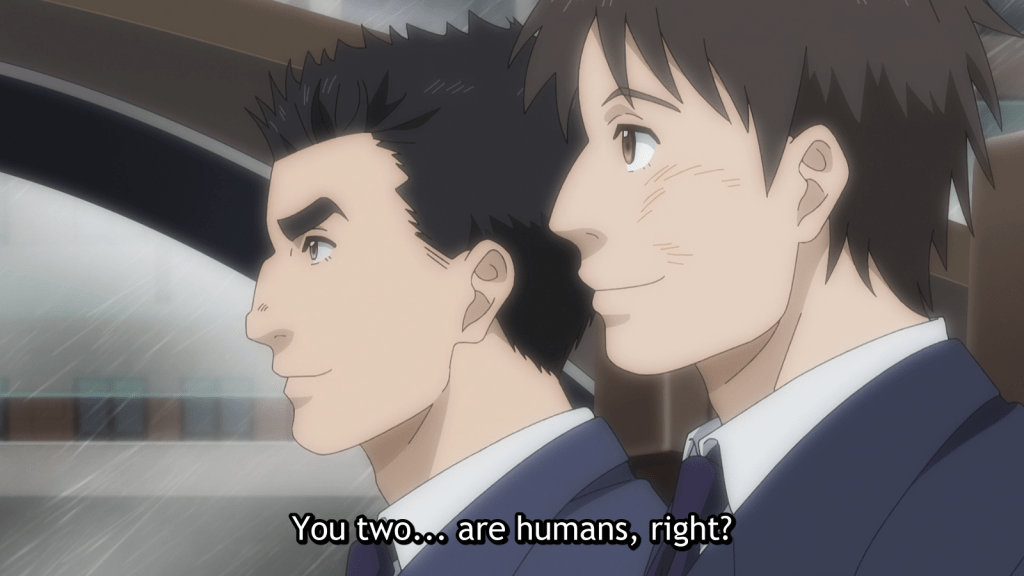
The second case was rather bizarre to me, and I’m not sure exactly what it was supposed to demonstrate. A Humanoid was stressed about the customer service part of his job, so his boss handed over customer interactions to a contractor. The Humanoid decided to accompany the human contractors on their first visit to an angry customer. Their way of dealing with said angry customer was very strange.
After it was over, the Humanoid asked whether the two contractors were truly human. Their supervisor replied, “I’m terribly sorry, but that is confidential.” The narrative seems to imply that the contractors were robots being made to impersonate humans. Again, I’m not exactly sure what I’m supposed to get from this story.
One other note. At the end of the episode, Sudo and his assistant are eating at a Chinese diner. The news is playing on a TV above them. According to the reporter, the government is preparing to review Michi’s proposal for its upgrade. I suspect they will allow the upgrade, and Michi will become even more powerful. The existence of Michi, the “Super AI,” is still surrounded in mystery. But it gives me a bad feeling. It may be that Michi and its evolution are dangerous.
Thank you for reading~
 Anime Rants