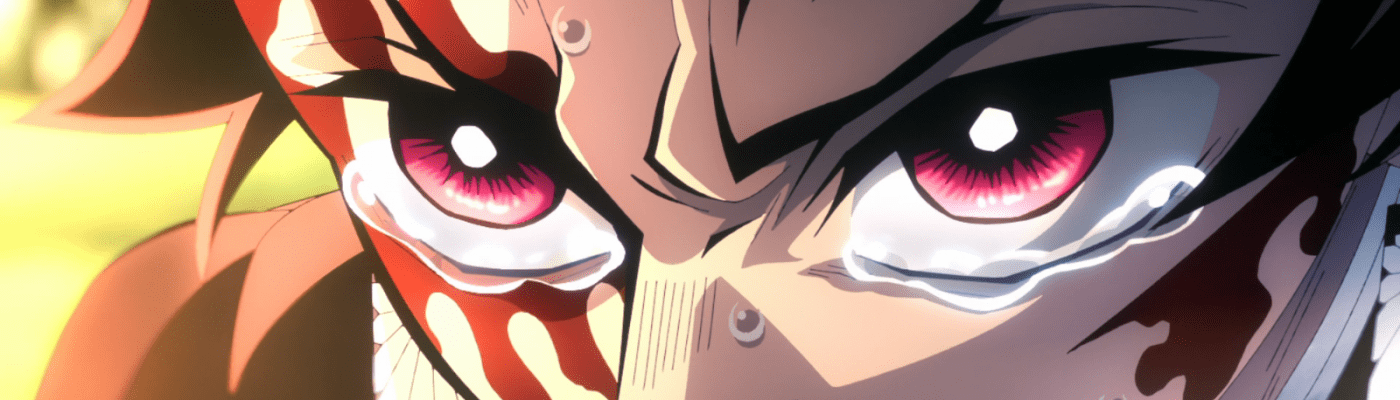
It recently occurred to me that I don’t know why the people in the Swordsmith Village wear funny-looking masks. I thought it over, and the most obvious reason is that masks protect one’s identity. The smiths in that town are the only ones who know the magical craft of making swords that kill demons. They are rare and need to protect themselves from being easily identified, especially when they leave the village to deliver new swords.
A secondary reason is probably the tradition of it. The Swordsmith Village has its own well-developed culture. Part of this includes wearing distinct masks. Speaking of those, they are actually called Hyottoko masks and they exist in reality. Hyottoko is just a character with a funny face, but I guess the swordsmiths took a special liking to it. Neat, huh?

Welcome to the second part of the Demon Slayer: Swordsmith Village discussion at Anime Rants. Like last time, my thoughts are arranged into several sections below. If you have anything to add, please let me know in the comments.
1) Hantengu’s Delusion of Morality
As you recall, Hantengu split into four versions of himself named after core emotions. Meanwhile, his “main body” – a tiny, cowardly demon – ran around trying to escape Genya and Tanjiro. When Tanjiro came close to beheading the little demon, the Anger demon reacted strangely. He absorbed the other three emotions and became a new entity – Hatred, or Zohakuten. This demon resembles a child.

The first thing Zohakuten says to Tanjiro is, “Damn you, you awful villain.” There is immense judgement and wrath in his voice. Zohakuten goes on to accuse Tanjiro and Genya of bullying the weak. This is the first time we’ve heard a demon try to make a moral argument. What is going on here? I definitely think it’s worth analyzing this scene.
Based on this scene, Zohakuten’s “morality” is extremely limited at best. He fails to understand Tanjiro’s altruistic stance that protecting others – even strangers – is the right thing to do. Perhaps it makes sense for a “child demon” to have a very childish sense of justice. Zohakuten is the manifestation of Hantengu’s hatred, and hatred is often informed by a sense that one has been wronged. It’s a primitive type of morality: “You hit me, so I hate you, and want to hit you back.”

From Zohakuten’s perspective, it’s moral to defend the main body, the weak little demon of fear. This is completely infuriating because Hantengu is the one who started it by antagonizing innocent humans. Tanjiro should be the one driven by hatred to respond in kind. The demon slayers are only trying to survive and protect human lives. But the obvious logic of this doesn’t penetrate Zohakuten’s belief that he and his kind are weak and have been wronged. He’s not moral at all – he’s just delusional.
Later episodes reveal that it’s not just Zohakuten who deludes himself in this way. The main body, the little demon of fear, also feels that he has been mistreated. He wallows in self-pity, crying at his perceived persecution. Flashbacks show us that, prior to being a demon, Hantengu was a thief and a murderer. Whenever he was accused, he would ask for sympathy and say it wasn’t his fault. It was his hands acting of their own accord, he would claim. This wasn’t even an attempt to trick others; it was a genuine delusion.
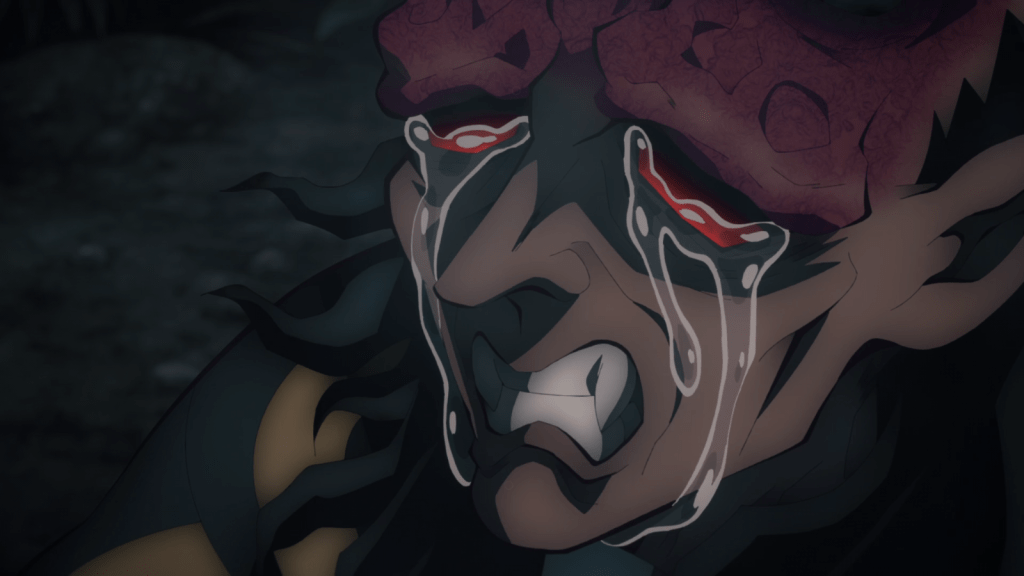
Hantengu’s refusal to take responsibility for his own actions makes him one of the most morally disgusting demons in the series thus far. He is a great metaphor for toxic people in reality who believe they can do no wrong. From their perspective, everyone is out to get them, and they cannot control themselves. It reminds me of sexual predators who blame the victims and bemoan their uncontrollable bodies. If you’re someone like me or Tanjiro with a great deal of natural empathy, be careful. Do not validate the delusions of abusers.
2) Muichiro and His Twin
I absolutely love stories about twins in anime. These stories are always extremely interesting from a psychological standpoint, and often have powerful emotional cores. Examples include Mion and Shion from Higurashi (When They Cry), Nina and Johan from Monster, Hikaru and Kaoru from Ouran HSHC, and Rem and Ram from Re:Zero. Of all the twin stories I love in anime, Muichiro’s story reminded me most of Ayato Naoi and his brother from Angel Beats. The similarity is that the twin in both series died.

Anyway, Muichiro’s story with his twin brother was every bit as powerful and emotional as expected. Even though they are the same age, the brother took on the role of eldest sibling, which is why Muichiro calls him “Nii-san” instead of his real name (which is unknown). With their parents dead, Muichiro and his brother had to survive on their own in a woodcutter’s cabin. The “older brother” was often curt and unkind, but very efficient in his work. Muichiro, meanwhile, was sensitive, gentle, and perhaps less responsible.
Someone informed the boys that a demon was in the area, and Muichiro became captivated by the idea of demon slayers. He wanted to become one himself. The older brother shot down this idea and called Muichiro useless. Muichiro stopped talking to his brother, believing he was hated. He didn’t understand that his sibling was being harsh out of a desire to protect him. In reality, the older brother cared more about Muichiro than his own life.

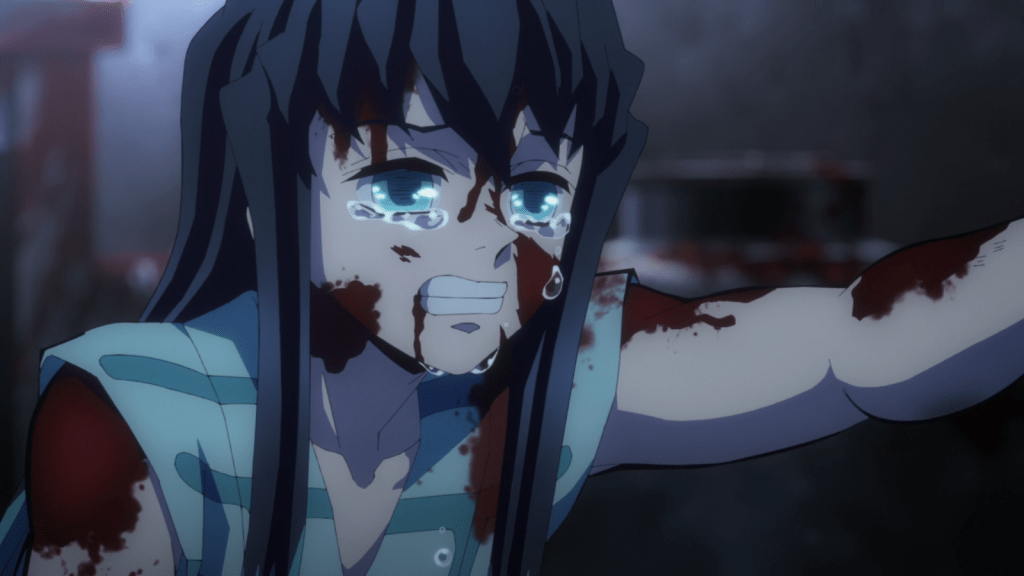
On one fateful night, a demon attacked. Muichiro’s brother died protecting his twin. At that moment, Muichiro finally understood that his brother was always looking out for him. He felt unspeakable fury and began attacking the demon. This was Mucihiro’s awakening as a demon slayer. Even without a sword, he managed to defeat the demon, crushing its head with a rock and holding its body down with multiple wooden stakes. The sun finished it off at daybreak.
Muichiro was so traumatized by these events that he entered a state of dissociative amnesia. He forgot about about his brother and his life before. It was Tanjiro’s words that began to trigger his memories. Finally, by the time he broke out of Gyokko’s water pot prison, Muichiro remembered everything. He later thanks Tanjiro for helping him recover “something precious.” It was a heart-wrenching story that I won’t easily forget.
3) Mitsuri the Love Hashira
I was impressed with the show’s presentation of Mitsuri Kanroji. She is framed as admirable and courageous, if a little goofy. I’m happy that there’s a female character being portrayed positively as a hero and a fighter. Besides enjoying her personality – goofiness included – I also loved her character design and fighting aesthetic. Her whip-like sword is so beautiful! The color of her hair is vaguely reminiscent of Utena Tenjo. It’s stunning to watch her gracefully jump around, slashing enemies in the moonlight.
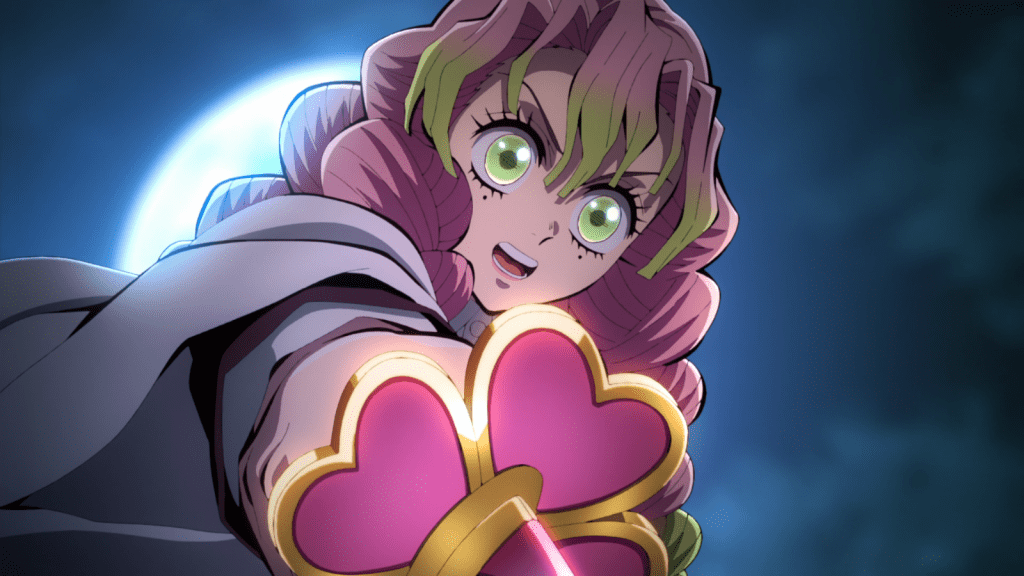
The “strong girl” character type is rarely ideal in the way it’s handled in anime. This show, like most others, was too cowardly to design a woman who actually has muscle mass and high testosterone. Despite being immensely strong, Mitsuri is still animated as a petite, tight-waisted young lady with skinny arms. However, just because a character fails to meet the ideal in terms of representation doesn’t mean it’s a disappointment as a whole. I like Mitsuri, and I think having a strong girl character is a step in the right direction for Demon Slayer.
One thing that struck me about Mitsuri is how selfless she has always been. She wants to be helpful to others, which is why one of the first things she did as a baby was lift up the heavy pickling stone to “help” her mother in the kitchen. Mitsuri assumed that the best way to be helpful to her kind parents was to marry a good man and continue the family. So, when potential husbands lost interest in her, Mitsuri wasn’t just sad for her own sake. She also grieved the lost opportunity to be “useful.”
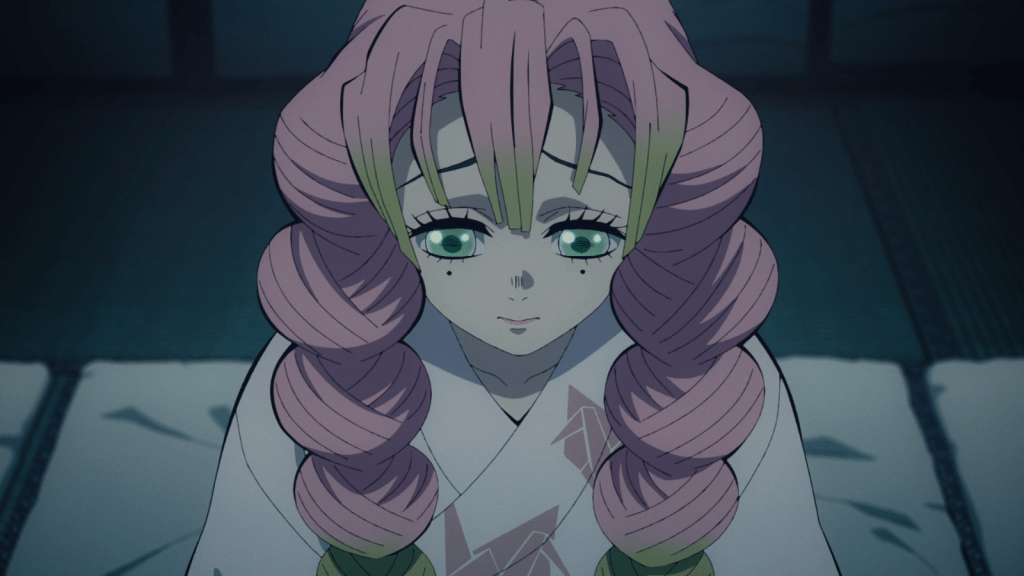
For a short while, Mitsuri tried to be a “normal girl.” She dyed her hair black, stopped herself from eating as much, and pretended to be weak for marriage interviews. But doing this broke her heart, and she couldn’t go through with living a lie. Mitsuri is extremely brave for making this decision, though also privileged. Most women from that time period would have been forced to live as submissive babymakers because there was simply no alternative for them. But there was an alternative for Mitsuri. She was recruited into the demon slayer corps.
As a demon slayer, Mitsuri found herself truly in her element. She was accepted and appreciated by the others in the fighting force. Most importantly for her, slaying demons was helpful and useful. Mitsuri was literally saving lives. It was dangerous and hard work, but incredibly rewarding. Since she was both strong and agile, Mitsuri quickly rose through the ranks and became one of the Hashira. She still wants to get married some day – but only if she can find someone who is actually stronger than her. I’m thoroughly pleased with the character of Mitsuri.

4) Nezuko Conquers the Sun
In the last episode of the season, Tanjiro suddenly realizes that he’s left Nezuko in a position where she will be hit by the light of the rising sun. He tries to stop her, but the sun touches her just a little bit. Since Nezuko is a demon, she immediately starts burning, screaming in pain as Tanjiro frantically tries to cover her skin with his own body. Across the field, a demon is chasing some swordsmiths with the intent to devour them. Tanjiro knows it’s his duty to save those people and slay the demon, but he can’t bring himself to leave Nezuko.
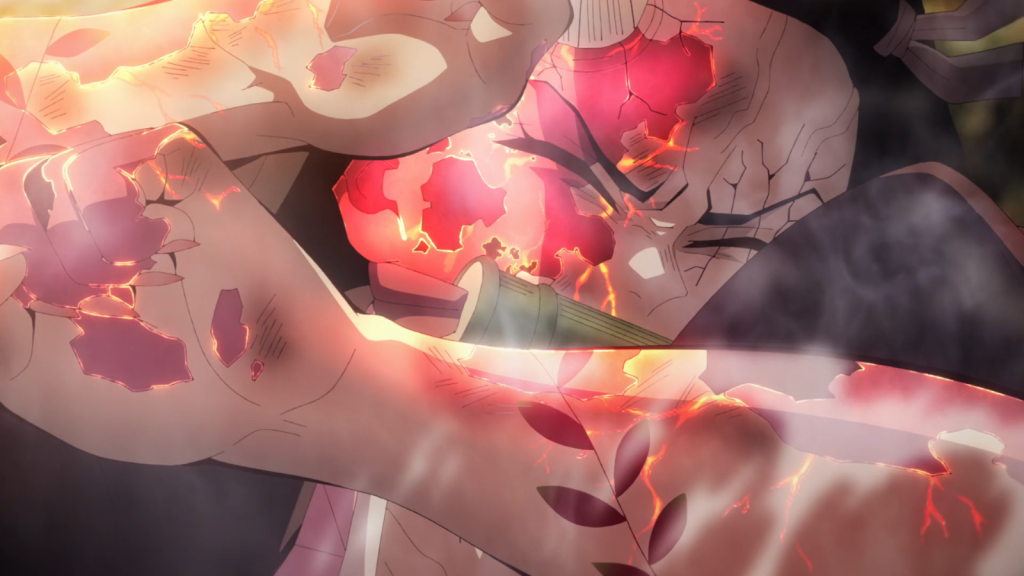
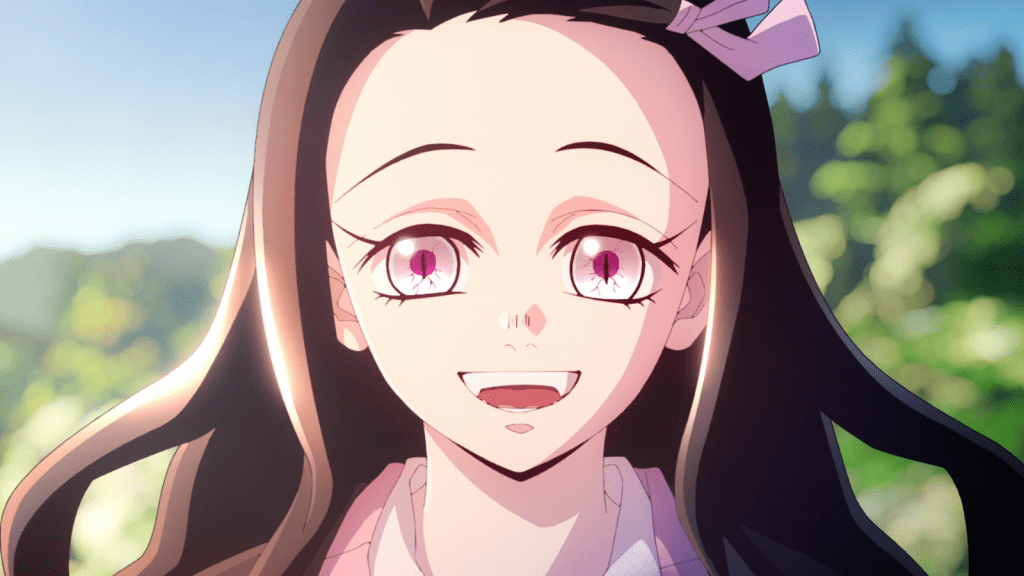
That’s when Nezuko made the choice herself. She used her demon strength and kicked Tanjiro away from her. She would rather have him save the innocent swordsmiths than waste time sheltering her. Tanjiro respected Nezuko’s last wish and was able to slay Hantengu once and for all. He then collapsed and started weeping, assuming that Nezuko had completely burned to nothing. Much to his amazement, Nezuko walked across the field toward him. Her burns were gone, and she was smiling in the sunlight.
Not only can Nezuko walk unharmed in the light, but she can also speak again – at least, a little bit. She still seems to have limited capacity to communicate, and her demon fangs are still visible. What’s going on here? Why and how did Nezuko suddenly gain the ability to do what no other demon has done before? This season doesn’t give audiences a very clear answer. Maybe it will be explained better in a future arc. Manga readers might already know. As for me, I think there are two equally valid answers.
Demon Slayer has always made it clear that Nezuko is special. She can survive without human flesh, she can put herself into a sleeping state for years at a time, and she can change sizes. She even made it so her blood could damage other demons. Though it takes time, Nezuko has been able to adapt to everything the world throws at her. The sunlight is no different. Tamayo said that Nezuko’s blood is constantly evolving. So, Nezuko is probably developing into a “perfect being” – though we don’t exactly know why.
The second answer is a little more metaphorical in nature. Demons are supposed to be selfish. They view themselves as superior, taking human lives to further their own. Nezuko is the only demon to sacrifice herself for someone else. By kicking Tanjiro away, she committed a truly selfless act. Perhaps, when this condition is met, a demon becomes a being that can walk in the daylight. In terms of story, it’s the the conclusion to a hero’s character arc: their reward for being righteous. To restate, I think both answers are reasonable.

5) Closing Thoughts
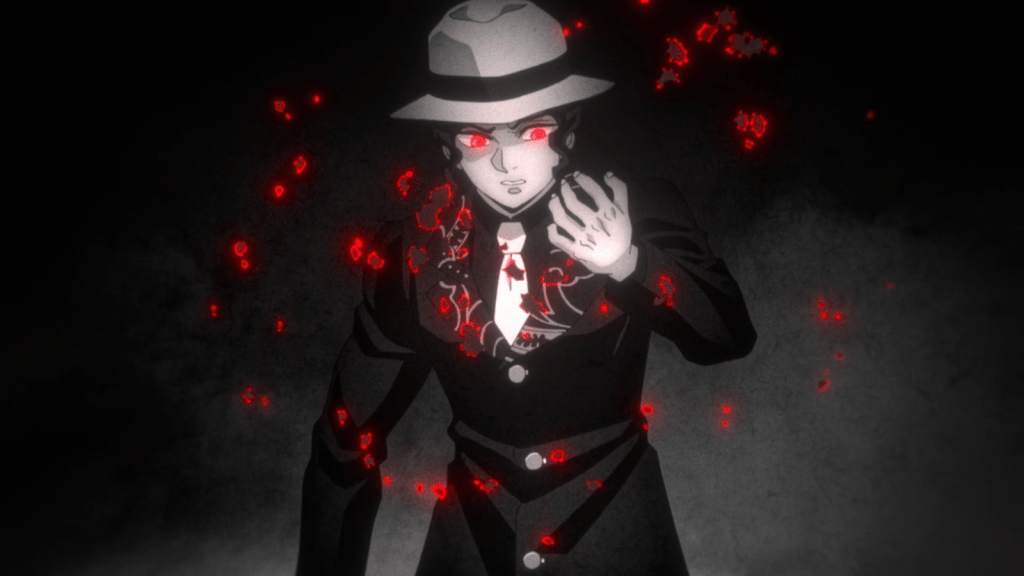
In addition to showing Nezuko’s new ability, the last episode revealed some interesting insights into Muzan’s history. We learned that he was born about a thousand years ago, and that he suffered from an illness that kept him bedridden most of the time. He was trying an experimental treatment with a strange doctor after all the normal physicians had given up. Muzan lost patience and murdered the doctor out of bitterness. But soon after, he began to feel stronger.
The strange doctor’s treatment had turned Muzan into a demon. He didn’t feel cursed by it, or anything like that – he celebrated becoming a superior lifeform. He began killing humans to satisfy his new cravings for flesh and blood. Muzan spent the next few centuries trying to find a way to continue the treatment in order to become a truly perfect being who could survive in the sunlight. His only real clue is that the doctor used “Blue Spider Lily,” a plant he has never been able to find.
I was fascinated by all this new information, so I thought I’d summarize it here. Besides that, I don’t have much to add. All that’s left is to state that I enjoyed this season of Demon Slayer more than all the others so far. The Entertainment District Arc is a close second, but the Swordsmith Village Arc was the one I enjoyed most on an emotional and psychological level. Thank you for visiting Anime Rants. Sayonara until next time!
~Thanks for reading~
~

 Anime Rants
Love the article!
Also, muichiro’s brother’s name was mentioned in the credits, but it’s Yuichiro
LikeLiked by 1 person
Thanks so much! I’m glad you enjoyed the read. I completely didn’t notice that the brother’s name was in the credits. Appreciate you pointing that out.
LikeLiked by 1 person