
Contents
Johan Liebert is one of the most highly respected and well-written antagonists in anime history. He is a fascinating character that I’ve been obsessed with for a decade now. I never tire of writing about this fascinating fictional serial killer. Ever since the first time I watched Monster in 2015, I have wondered if Johan was “abnormal” in terms of gender. (I say that as someone who is nonbinary.) The possibility is explored herein.
Disclaimer: I am aware that this possibility is fully head-canon and not provable unless for some reason Urasawa decides to announce something with clarity. This is just a theoretical idea and something I like to think about in my spare time. I am not asserting that it’s canon in Monster.

Part 1: Johan’s Crossdressing
As Monster fans undoubtedly remember, in the middle of the series, Johan crossdresses as a woman and calls himself “Anna Liebert,” after his twin sister. Johan’s adult crossdressing is one of the biggest pieces of evidence that he could be genderqueer. As such, it makes sense to review this event. Let’s go over the context in which this happens in Monster.

The story arc with Grimmer, Detective Suk, and “Anna” begins in episode 41, when a mysterious woman shoots and kills Mr. Petrov, former director of Kinderheim 511. This arc continues until about episode 50. The famous scene where Anna is revealed to be Johan occurs at the end of episode 44. It’s an eerie scene.
Johan has a number of lines and scenes as Anna. He engages in dialogue with Detective Suk in episode 43, commits murder in several different episodes, and traumatizes an orphan in episode 49. During this arc, Johan spends almost all his time as Anna. We can deduce that he adopted “Anna” as his new temporary identity and lived in Prague for several weeks, even fooling the neighbors into thinking she was a sweet girl named Anna.

In addition to dressing up as Anna as an adult, Johan may have also done the same when much younger. We know from flashbacks that Johan used to dress as a little girl when he lived with his twin sister and his mother in the Three Frogs Inn. We don’t know if Johan volunteered for this treatment or not. I tend to think he didn’t care one way or the other. It’s not like the twins had outside influences forcing gender roles on them.
It’s quite possible that the mother made them both dress as girls to make it seem like she had only one child. It might have been something she was ordered to do by those interested in the twins. We simply don’t know. Either way, the point is that Johan’s earliest memories would have been spent in girl’s clothes – possibly even before he had a concept of gender.

We’ll come back to the raising of the young twins at a later time. For now, we need to know why exactly Johan was crossdressing as Anna. We don’t know all of Johan’s reasoning, but some of it can be surmised. Part of it was to help him easily manipulate Detective Suk and acquire the tape he was after. But he didn’t necessarily need to cross-dress to acomplish this, especially when manipulating someone as foolish as Suk.
We also know Johan moves between different identities like the monster in the picture book moves between people, taking their names and eating them. This means that “Anna” was more than just a device to fool Detective Suk. She was also a full-fledged identity that Johan lived as for several weeks to several months in Prague. These are fine reasons, but I propose that there is another important piece to Johan’s cross-dressing: a nonbinary gender identity.

Part 2: Johan as Genderqueer
According to my thinking, Johan is probably genderfluid or agender. A genderfluid person may identify as one gender sometimes and another gender at other times. An agender person is someone who doesn’t jive with the concept of gender at all. They do not relate to any specific gender or view it as unimportant in their lives. Both of these identities are under the nonbinary umbrella. Why do I think these terms could fit Johan? I’ll try to explain.

Johan’s particular identity issues predispose him to being agender. Anyone who studies Johan can tell you that his core issue is having no stable sense of identity. His method is to move between identities. Johan doesn’t care about who he impersonates. He can take on any name. Would someone so unattached from concepts of identity even consider gender important? I don’t think Johan has any attachment to the idea of being a man. That’s why he can easily take on a female role if needed.
Let’s go back to the topic of the young twins being raised by their mother in the Three Frogs Inn. If Johan was dressed as a girl for much of his young life, he probably figured out that gender roles are shallow, arbitrary, and restrictive. It follows that he stopped caring about his gender – or he never cared to begin with. I’m not saying wearing a dress will make a boy genderqueer or anything like that. I’m just saying that Johan didn’t care and that his environment probably contributed somewhat to this lack of emphasis on gender roles. (As a nonbinary person, I don’t view this as a bad thing.)

Consider how comfortable Johan seems to be with cross-dressing. When he played Anna, Johan was confident. The narrative suggests that he easily passes as a woman and even managed to make his voice sound like that of his sister. Obviously, Johan knew what he was doing. We can assume this isn’t the first time nor the last.
In addition, Johan seems slightly queer to me at all times. Despite having a feminine face, he normally looks fairly masculine in men’s clothes. However, he speaks softly and has interests in softer subjects than the typical manly man. (For instance, things like poetry, art, and psychology.) Those traits alone don’t make anyone genderqueer, but with all the evidence together, including the cross-dressing, it becomes more likely for Johan.
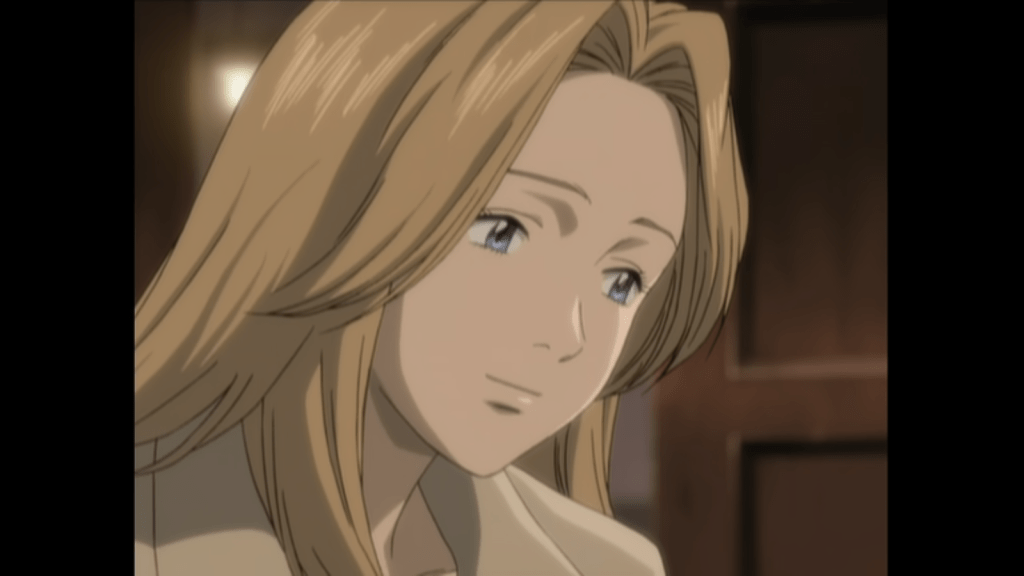
In summary, Johan’s lack of identity means he cares nothing about having a particular gender. Hopefully this makes sense. According to this fan theory, Johan would be agender. However, genderfluid may also work as a term since his identities, as far as we know, are either man or woman. Since he presents as a woman sometimes and a man at other times, genderfluid is another decent way of referring to Johan.
(Side Note: it isn’t unusual for genderfluid people to have a preference for how they present in public. Some spend more time as a man, while others prefer to be feminine most of the time. It’s therefore not a problem that Johan normally takes on the role of a man.)

~Thanks for Reading~
Written by 7Mononoke
 Anime Rants