
Immortality is a concept that has enchanted humans for as long as we have been capable of conceptualizing it. Across time and cultures, there are many myths of immortal beings. Several cultures also have tales about the elixir of life, the fruit of life, or the fountain of youth. Hell’s Paradise retells the legend of the immortals and the water of eternal life. These ideas are not unique, but the anime manages to reuse the old story elements in a creative and entertaining way. Episodes 7, 8, and 9 do not disappoint, so please enjoy my episode review.
Episode 7: Flowers and Offerings
Gabimaru’s group finds a young child with mysterious powers. She doesn’t speak, or perhaps can’t. A tree-like monster is the child’s guardian. He says if they hand over the child to him, he will show the humans to a nearby village and give them information about the island and the elixir. The group agrees to this, and soon arrives at the village, which is completely empty. The woody creature provides food, drink, and hot baths.

According to the treelike creature, the island is indeed the home of the gods. It is divided into three rings. The outermost is the shore and the woods, which are guarded by monsters. The second layer is where the village is located and where the tree creature lives in peace with the child. The innermost layer, where the mist is thick, is where the Elixir of life can be found. The old tree-man explains that the whole island is under the control of the Tensen, godlike beings who have consumed the elixir and can live forever.
The two feminine beings making out in the last episode were Tensen. They are able to regenerate even when chopped up. One of the godlike beings shapeshifts into the body of a man and quickly defeats Chobei and his brother. Both of them are thrown into a pit of flowers, which begin to cover them in vines quickly. According to the tree creature, the humans who are offered to the flowers receive pure souls and forgiveness of sins, but die in agony. The flowers that take over their body are the basis for the Elixir of Life.
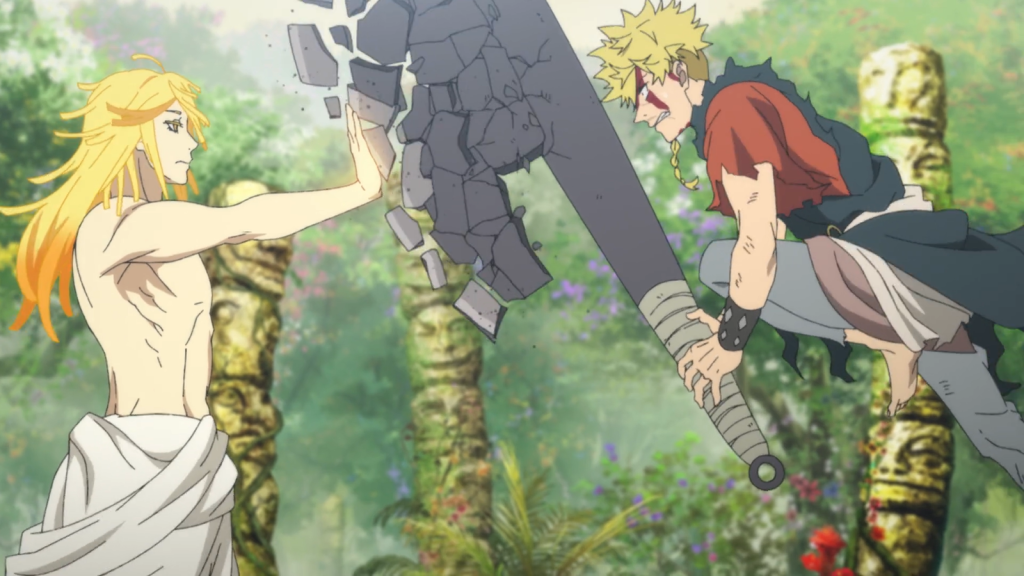
The rest of the episode is much more relaxed. Sagiri takes the opportunity to spoil the child by bathing her and showing her how to use the cleaning products. Gabimaru also washes himself. While doing so, he remembers his wise and beautiful wife. As the group leaves the village, Gabimaru feels more motivated than ever to find the elixir and return to his beloved spouse.
This episode answered some questions, but brought up others, too. For example, what exactly are the Tensen? Are they gods, or were they once human? There’s a lot we have yet to discover. As for characters, the tree creature was really cool and the child was super cute. I liked all the flashbacks with Yui, Gabimaru’s wife. She is a really neat character and voiced by a personal favorite seiyuu of mine, Mamiko Noto. The discussion of scars, though brief, was very wholesome.

Episode 8: Student and Master
This episode focused on Tenza, the thick-headed and good-hearted man who is accompanying Nurugai. Now that he knows Nurugai’s sex, Tenza wants to protect her from danger. Before long, the two are found by Shion, another samurai/executioner. He is blind but can move about freely and fight well by using auditory and olfactory cues. His criminal companion tried to seduce him, so Shion executed her. Afterward, he discovered that leaving the island was impossible, so he sought to regroup with others.

Although it takes some convincing, Shion agrees to be friendly with Nurugai and not try to execute her. Suddenly, one of the godlike Tensen appears and starts an attack on the group. The three humans are no match for the immortal monster. Eventually, Shion’s throat is injured, and Tenza gets several large holes bored through his body. Nurugai can only watch in horror as Tenza makes a valiant last stand to make time for her to escape. Tenza’s last fight was epic. Thanks to him, Shion was able to grab Nurugai and run.
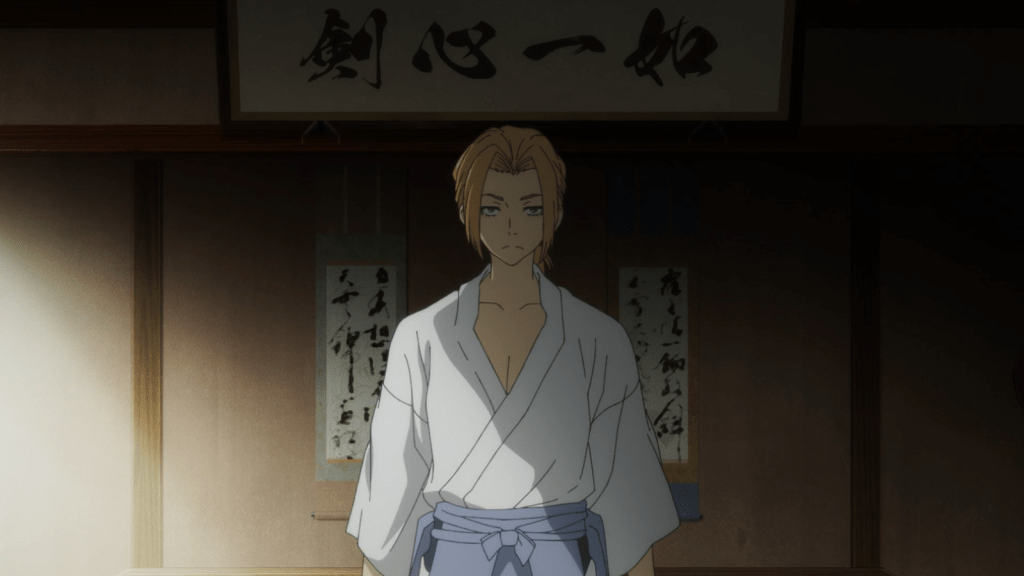
Episode 8 also included the backstory of Tenza as he was taken in by Shion and taught the way of the samurai. Before being found by Shion, Tenza was a street urchin and a thief. Even after Shion started teaching him, young Tenza wanted to leave his training and be “free.” But another samurai told him the story of Shion’s last apprentice, who did the same thing. Shion ended up with the painful duty of executing his own student after he chose the “free” life of crime. Tenza reconsidered and kept training with Shion until he also became a worthy swordsman and a new samurai executioner. Shion saw potential in Tenza that nobody else did. It was really sweet.
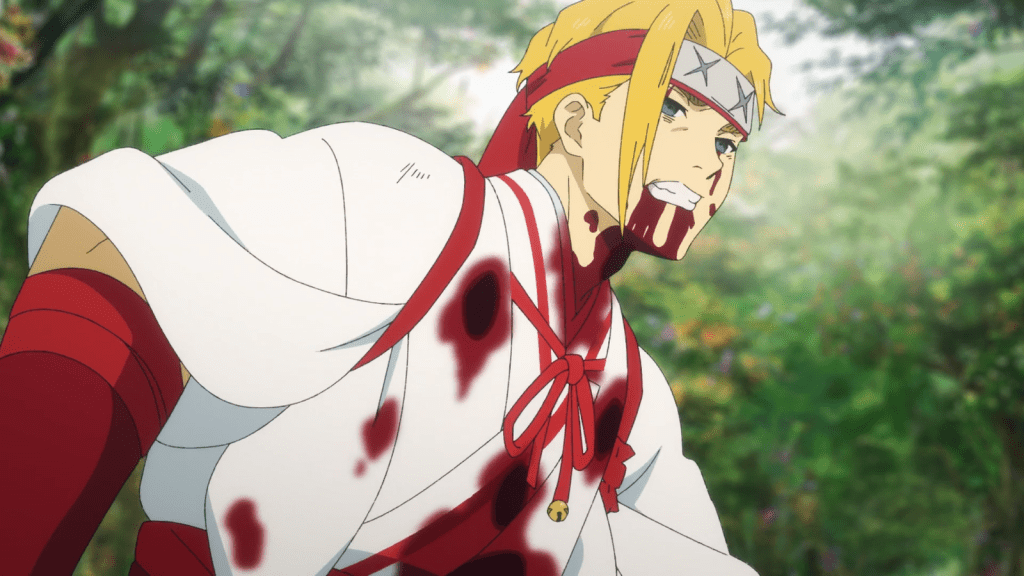
It’s sad that Tenza is dead, but I was already expecting many characters to die in the course of this survival competition. This episode was good overall, but there were two things I didn’t like as much. Firstly, it struck me as poor writing to include Tenza’s backstory on the same episode as his death. In cases like this, backstories are often predicters for who will die in a given episode. The anime Akame ga Kill did this so formulaically that it was dull and hard to connect with emotionally. I hope Hell’s Paradise does better in the future with who and how it choses to develop and kill off.
The second “issue” is small, but maybe worth writing. Some male characters in this anime are misogynistic and buttheaded about women. This is realistic portrayal of the times. While sexism was never morally acceptable, it adds realism when an anime includes the cultural biases of the setting. That being said, I couldn’t help but feel put off by Tenza’s treatment of Nurugai. And the positive response Nurugai gave was rather befuddling. (She wants to marry this man who is suggesting she is inferior?) But again, it would be historically appropriate for Nurugai to seek a protective husband, especially if she wants to continue her clan’s legacy. The historical elements of this anime are interesting as always.
Episode 9: Gods and People
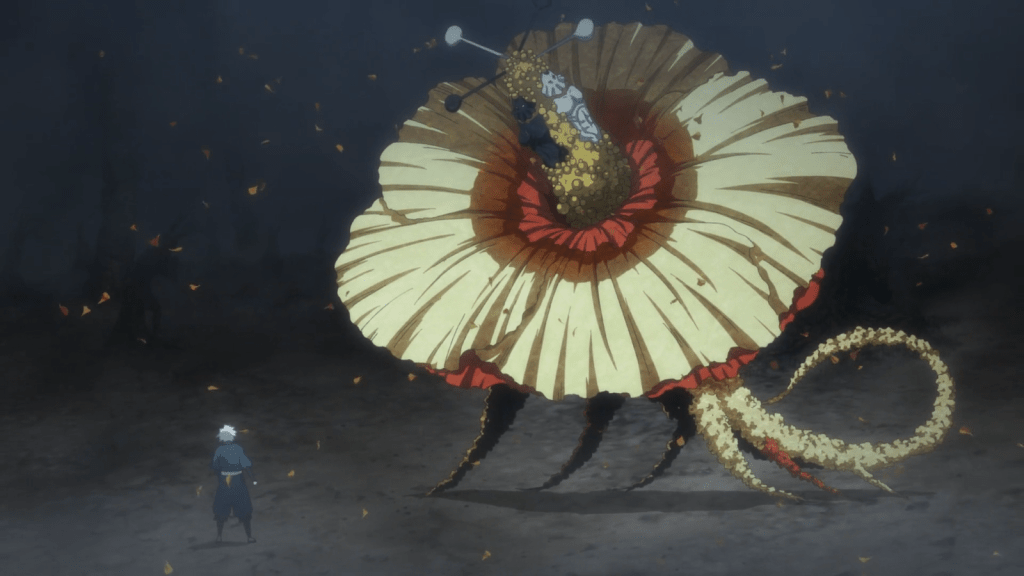
Gabimaru goes to find the innermost circle of the island and retrieve the elixir. He reaches the gate, but before he can enter, a Tensen appears. What follows is a long and extremely intense fight scene between the ninja boy and the immortal creature. Gabimaru tries everything and finally manages to severely weaken the humanoid form of the Tensen. But then it transforms into a giant flowerlike monster with two creepy heads. This creature drove Gabimaru to the brink of death. He was about to die, but the little girl, Mei, saved him.
The next day, Sagiri and company set out from the village, following the old treelike creature. He tells them that there are seven Tensen who rule the island. They were originally one being, a hermit who became a god and split itself into seven pieces. The tree-man also explains that the people of the island all looked human once. However, at the end of their long lifespans, they become treelike creatures and slowly lose their awareness. Meanwhile, Gabimaru wakes beside Mei. Approaching them are two figures: Tamiya the criminal and his samurai supervisor, Fuchi. To be continued.
Hell’s Paradise has nice visuals. This episode’s long fight scene was enjoyable to watch. However, it does make the task of defeating seven Tensen seem nearly impossible, when Gabimaru can’t even beat one. The world-building and lore of the island is interesting, imaginative, and generally well-written. In other news, the Aza brothers are still alive and have escaped the flower pit. I’m glad about that, since I really liked the character concepts for both of them.

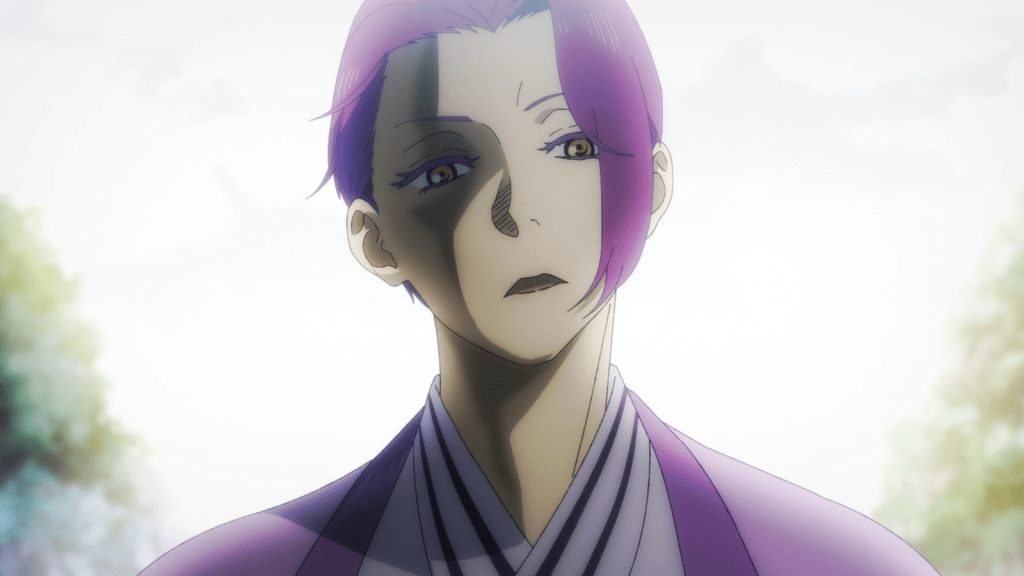
The most interesting part of the episode for me was seeing the Tensen interact with each other. They have distinct personalities and preferences, with some of them even having different genders and sexualities. The Tensen also possess a concept of family, though it remains to be seen how harmonious or loyal each one may be. They have names, too, but I only know two of them so far. (Rien is the leader with short purple hair, and Zhu Jin is the one who fought Gabimaru in this episode.)
I love when there are nonhuman or monstrous villains who have many human traits and ways of thinking. (An example would be the Chimera Ants in Hunter x Hunter.) Thus, I’m extremely interested in the Tensen. It’s a shame there are only 3 or 4 more episodes in which to develop them. Regardless, I can barely wait for more Hell’s Paradise!
Thank you for reading~
 Anime Rants
The triumph of heroes is much greater when the villains are nigh-invincible. And they also showed that, for all their power and abilities, the Tensen clearly have limits, as Gabimaru came within an inch of destroying one alone, and they need that elixir to rejuvenate and continue living. That’s a villain one can take: powerful, but not limitless, with weaknesses and emerging vulnerabilities. Most interesting!
As for Tenza suggesting Narugai is inferior… huh? What are you talking about? I did not get that impression at all.
LikeLike
Good point about the heroes/villains. I’m extremely interested in the Tensen for sure. As for the Nurugai thing, Tenza started treating her very differently after discovering her gender. He suddenly imposed expectations that she couldn’t fight or be independent. It was infantilizing. Now, I do think that Tenza wasn’t *trying* to be a butthead here. He genuinely wants to protect Nurugai from harm. But despite good intentions, it’s still a problematic prejudice. Or rather, it would be problematic for me. In the 1600s as an orphaned Japanese mountain girl, I might put up with it in order to secure a better chance for survival.
LikeLike
Personally, I didn’t find his treatment of Nurugai to be much different. I also don’t think he was forcing an expectation that she *couldn’t* fight or “be independent.” He just preferred to avoid taking her into danger if it could be avoided. She liked that about him (and slightly made fun of him) because it was gentlemanly, but, more than that, prudent (when they had the leeway for it). I also see absolutely nothing about this which speaks to inferiority. I mean, is an officer, a fireman, or a soldier treating a doctor, teacher, or chef as inferior when they try to keep them out of danger, or are they doing their job? There’s being “independent,” and there’s refusing to listen to reason. Not remotely the same thing.
LikeLiked by 1 person
I don’t quite agree with everything but thank you for the politeness of your comments. And I’m always glad for a second opinion.
LikeLiked by 1 person