
Perhaps you’ve heard the popular Ariana Grande song “God is a Woman.” But several years before that song hit the charts, there was a very different song called “God is a Girl” by Groove Coverage. That song came out when I was a teenager and I loved it. Listening to it now, it’s not really a great song, and the Nightcore version is better than the original if you ask me. Still, the song will always hold a special place in my heart.
I mentioned “God is a Girl” because I think it’s also the perfect title for one of my favorite anime tropes. A few of my favorite anime series have a young female character with incredible godlike power. I don’t just mean an overpowered female character with supernatural abilities. I mean a female character whose abilities are so far beyond and above anyone else’s that they can only be described as goddesses.

Calling this a “trope” might be incorrect, since it isn’t common at all. If it’s a trope, it’s a rare one. Finding good examples was actually a bit difficult. Anyway, this post will look at three different examples of anime where a young girl is a powerful godlike entity. After that, there will be plenty of discussion, including the reasons why this trope is interesting to me.
Contents
Case 1: Haruhi Suzumiya
Case 2: Lain Iwakura
Case 3: Madoka Kaname
Discussion of This Trope
Closing Thoughts
Case 1: Haruhi Suzumiya
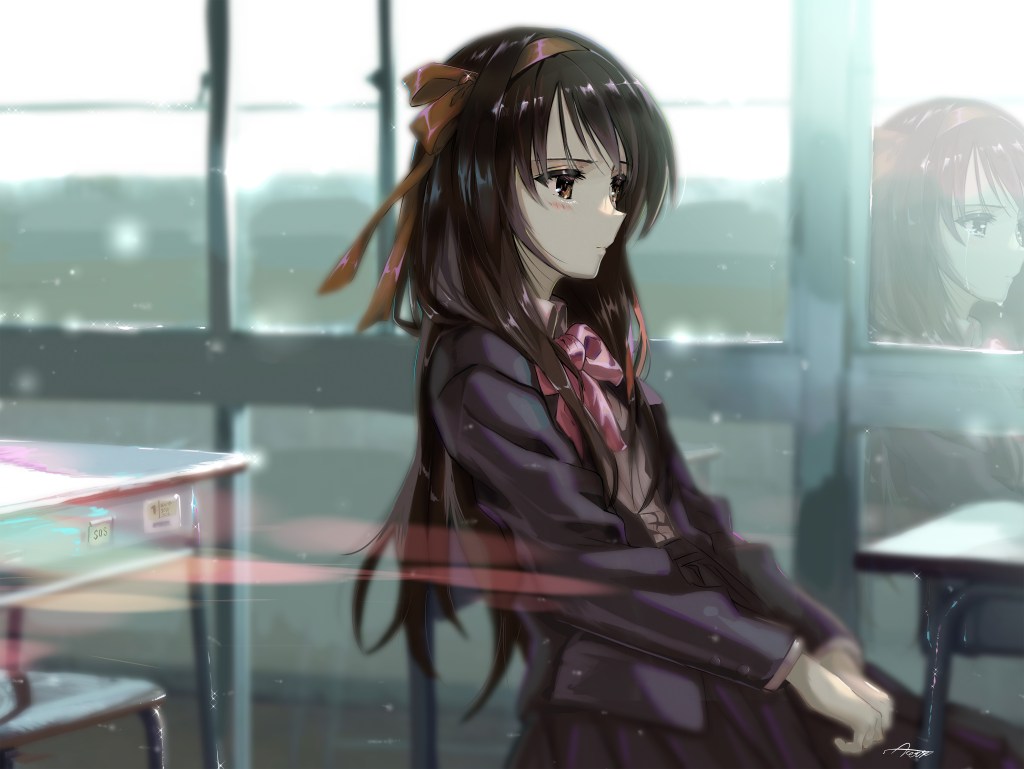
Haruhi Suzumiya is a strange existence with incredible powers that change the world around her. She is the main character of the widely recognized but still underrated anime, The Melancholy of Haruhi Suzumiya. Although different people disagree on whether she created the current universe and what her origins and limits are, there’s no doubt Haruhi is a godlike entity. Let’s go over how her powers work and what she’s like.
The most interesting thing about Haruhi is that she has no idea she is a god. Her powers are unconscious, and she isn’t aware of her abilities. Haruhi is being closely monitored by a variety of powerful entities like psychics, time travelers, and even an alien machine of some kind. What they all have in common is that they don’t want Haruhi to become aware of her god powers. (We’ll go over why this is the case at a later point.)
Moving on to the types of powers Haruhi wields, there seem to be three. These are: 1) making relatively small changes to the world (which could still be disastrous); 2) willing concepts and ideas into existence; and 3) creating and destroying new dimensions. An example of the first power is when a regular cat that Haruhi found boring suddenly received human-like consciousness and the ability to talk. That’s just one of several changes Haruhi unconsciously made to the world because she was bored with how ordinary things were. There are other examples, but they are superfluous to the point.

Haruhi’s second power type, willing things to exist, is distinctly different from the first type, which alters existing entities. The best example is during the murder mystery arc. The evidence pointed to the idea that Haruhi’s friend Kyon accidentally committed the killing. When she realized this, Haruhi felt terrible for Kyon. She wished there was an additional suspect besides the people there. This nonexistent suspect would take the blame as the murderer so Kyon would be innocent. Thus, Haruhi’s unconscious god powers activated and created a new entity that sneaks menacingly around the house. Haruhi literally willed a living being into existence.
The third type of power is the creation and destruction of alternate worlds. When she is experiencing negative emotion in her life, Haruhi unconsciously generates new dimensions very similar to the world we know, but incomplete. Her moody subconsciousness then manifests in the form of a giant, faceless monster and destroys the new dimension. Countless worlds are created and destroyed this way all the time, or so it is thought. As far as we know, most of them are empty worlds. But there’s no telling whether our world might be destroyed in the same way if Haruhi’s subconscious wished for it.

The implications of Haruhi’s powers are terrifying. Now, when you understand her behavior, you’ll see why it’s imperative to hide the truth from her. To put it simply, Haruhi is an absolute asshole. She’s rude, selfish, domineering, and arrogant. She enjoys bullying people. The girl is also fickle, changing moods quickly and often sinking into grumpiness or melancholy. Finally, she’s unreasonably obsessed with sci-fi, making it her purpose in life to find espers, aliens, and time travelers. This daydream is far more important to Haruhi than showing basic decency to the people who surround her.
It’s bad enough that so much godlike power belongs to a moody teenager who knows nothing. But things would be even worse if the arrogant girl realized she was a god. Imagine what someone like Haruhi would do. The world would almost certainly be doomed.
Case 2: Lain Iwakura

Serial Experiments Lain is a trippy, psychological cyberpunk anime from the 90s. The titular character, a middle-schooler named Lain, provides another example of a god figure who is a little girl. Although we will mostly be looking at the differences, there are some similarities between Haruhi and Lain. For instance, both are young girls and powerful gods. Neither of them knew this fact at the start of their story. In Haruhi’s case, she never realizes the truth. However, Serial Experiments Lain focuses on Lain’s realization of her powers as she struggles with the perceived loss of her humanity.
I think it’s time we discussed Lain’s powers and behaviors. But it’s a little difficult to do so objectively. The anime is largely up to interpretation. So, what follows is only my personal understanding. “Lain” is is an entity with a multitude of facets and “selves.” They exist immaterially in the mysterious dimension called The Wired. Essentially, Lain is the omnipresent God of the Wired. However, the Lain we follow for most of the anime is one who lived like a normal human for a time. She values humans and respects the concept of the physical body. Although Lain is a collective, spiritual entity in the Wired, the main Lain is a distinct person. That’s who we’ll be talking about.

Lain’s powers are difficult to organize and delineate. Nevertheless, I’ve tried to condense them down into three types. These are: 1) PK such as telekinesis which can be used in the real world in her human form; 2) Godlike control over the world of the Wired, including omnipresence and full access to any information stored there at any time; and 3) Memory alteration of humans who are connected to the Wired. It takes the entirety of the series for Lain to realize she has all these powers. She discovers them slowly and experiments with them. Let’s look at a few examples.
A group called the Knights sends agents to Lain’s house. They use binocular-like devices to spy on her. Lain responds by breaking the devices with her mind from a significant distance away. That’s an example of her psychic powers. As for the second type of powers, there are examples spread throughout the anime. Lain does things like appear in multiple places at once, easily access top-secret information files, and cause the world of the Wired to “leak” over into human reality. At one point, Lain combines her control of the Wired and her psychic powers to remotely carry out several murders.

The first two types of abilities are already formidable, but the third is probably the most frightening and powerful of all. Lain can erase the memories of others. She does this on two occasions. On the first occasion, Lain erased and/or altered all her friends’ memories related to a certain dramatic incident. The second time is at the end of the series, when she erases everyone’s memories of the entity known as Lain. It’s complicated, but this action was taken to save her best friend Arisu from suffering mental trauma. Lain continues to exist as a god in the Wired, occasionally visiting the human world.
It’s pretty scary to think of a being that can remotely erase or alter the memories of countless people. Lain is godlike indeed. But unlike Haruhi Suzumiya, Lain Iwakura generally has a thoughtful and caring personality. She wouldn’t be the type to ruin the world on a whim. Rather, she only used her most powerful abilities to protect herself and her dear friend Arisu from physical and emotional harm. After eliminating some threats and erasing herself from the minds of the populace, Lain left humans well enough alone. She is not a dangerous force to humanity.
Case 3: Madoka Kaname

Puella Magi Madoka Magica is about middle-schooler Madoka, who becomes involved with a dark, cruel system of magical girls. When it comes to Madoka, there are major differences from the two previous examples. For starters, she was originally a normal human. She used the wish system of the magical girls to become a god. Consequently, Madoka was the only one among our three examples who chose her powers and limitations. Another difference is that Madoka is widely considered a benevolent, loving god rather than a neutral one (like Lain) or a chaotic one (like Haruhi). Let’s discuss the details of this character’s godhood.
While I could go into detail about how the magical girl system works and why it was so unfair, that isn’t really necessary. For our purposes today, we only need to know that Madoka became a god in order to correct a flawed system that was harming many girls across the globe and across human history. By becoming a being that transcends time and space, Madoka lost her human identity. The memories of the original human Madoka were locked away and hidden from the world. Therefore, the world of magical girls refers to this god as “The Law of The Cycle.” But what is the purpose of this Law, and what are its powers?
The main function of The Law of The Cycle is to rescue magical girls from ultimate despair when they reach the end of what they can accomplish. Ordinarily, they would turn into monstrous witches that cause death and destruction. However, Madoka avoids that fate by spiriting the girls away and gently erasing them so they can rest in peace. The third Madoka Magica movie also suggests that at least some of those girls join Madoka in a spirit realm.

Madoka/The Law has three types of powers, not including the magic abilities she used as a standard magical girl. As a goddess, Madoka can: 1) manifest in multiple places and/or multiple time periods at once; 2) spirit away/erase magical girls who have despaired; and 3) alter or erase memories in both humans and magical girls. There are a few other things she can do as well (like appear inside dreams or occasionally recall human memories), but these three are more than enough to give the general picture.
In summary, this goddess not only saves the despairing spirits of the magical girls, but also prevents monster-witches from being born, thus saving lives in every demographic. Now we know what kind of powers Madoka possesses and what she uses them for. What about her personality? She is similar in personality type to Lain, meaning she is shy, thoughtful, kind-hearted, and idealistic. But by comparison, Madoka is even sweeter and gentler. She cares deeply about her friends and family. Protecting them was the reason she sacrificed her human identity. Compared to Lain, Madoka is also more girly and typically more expressive. She’s adorable.

Importantly, Madoka isn’t perfect. As a human, she was easily frightened and extremely indecisive. She was never popular, nor could she manage good grades. Psychologically, Madoka has an interesting and flawed side: she believes she is hopelessly ordinary. There is nothing special about her. She will never shine, and she will always feel empty- or so she believes. That’s why, as soon as Madoka learned about the magical girls, she idolized them and wanted to be one. Originally, she didn’t even want a wish granted, which was part of the magical contract. Madoka just wanted to be a hero and actually make a difference by saving others. That would make her feel special… and no longer ordinary.
Madoka certainly achieved her goal of saving others and being out of the ordinary, but she also lost her human sense of self in doing it. Plus, nobody remembers the original human Madoka anymore. Is there a point to being special if nobody– including yourself– can ever recognize it? It’s interesting to consider. Also, it’s rather tragic that she sacrificed her humanity to feel like she had value. Ultimately, however, she knew what she was doing. She made her own decision.
Discussion of The Peculiar Trope
While there are plenty of goddesses in anime, the girl-god trope is uncommon in the sense that not many anime series use it the same way as the three examples above. Comedy, shounen, and ecchi anime in particular have a lot of goddesses. But what I’m talking about is different from just having a character who is a goddess. For one thing, while the goddess may have a special ability or a certain advantage, she is still much more limited in her powers than, for example, Haruhi. Also, in those types of shows, goddess characters may not have detailed or interesting personalities. They are much more goofy and shallow. Then what truly defines the girl-god trope? To understand a little better, we should go over the criteria for this trope.

There are three criteria to meet the “god is a girl” trope. First, the girl must be powerful enough to be reasonably considered a god compared to all other characters in the same show. Second, the girl must have an interesting and well-written personality and psychology. Lastly, there must be a tragic element related to the story or powers of the girl- (occasionally this could be ironic rather than truly tragic). As you can see, the three anime characters in the cases above fit these criteria.
The next topic of discussion is why the god-girl trope is used and how it serves the anime’s story. First, look at The Melancholy of Haruhi Suzumiya. This is a case where the tragic element is minimal or not present, being replaced with the ironic element. The idea that god doesn’t know she’s god and mustn’t be allowed to know is richly ironic. Furthermore, any series that uses this trope has some element of irony in it, because most people don’t envision an super-powerful deity to be a cute young girl. Anyway, besides providing good instances of irony, what other purposes does it serve to use the god-girl trope? I think so. A few examples are provided below.
The “God is a girl” trope helps create an innovative story that uses different aspects of psychology, theology, fantasy, sci-fi, tragedy, and more. In other words, the plot becomes more interesting and diverse in its themes. Having a character with godlike powers may also raise the stakes of the story, since the god potentially has control over the world’s fate. Another reason to use this trope is that it makes a story about an otherwise normal girl suddenly become hugely epic in scale. It could widen a story’s audience too. Yet another reason behind the girl-god trope is to explore fantasy in new ways. There’s a lot of room for creativity if you’re creating the lore of a god. The last reason I’ll give is that using this trope sometimes sets up an emotionally stirring story.
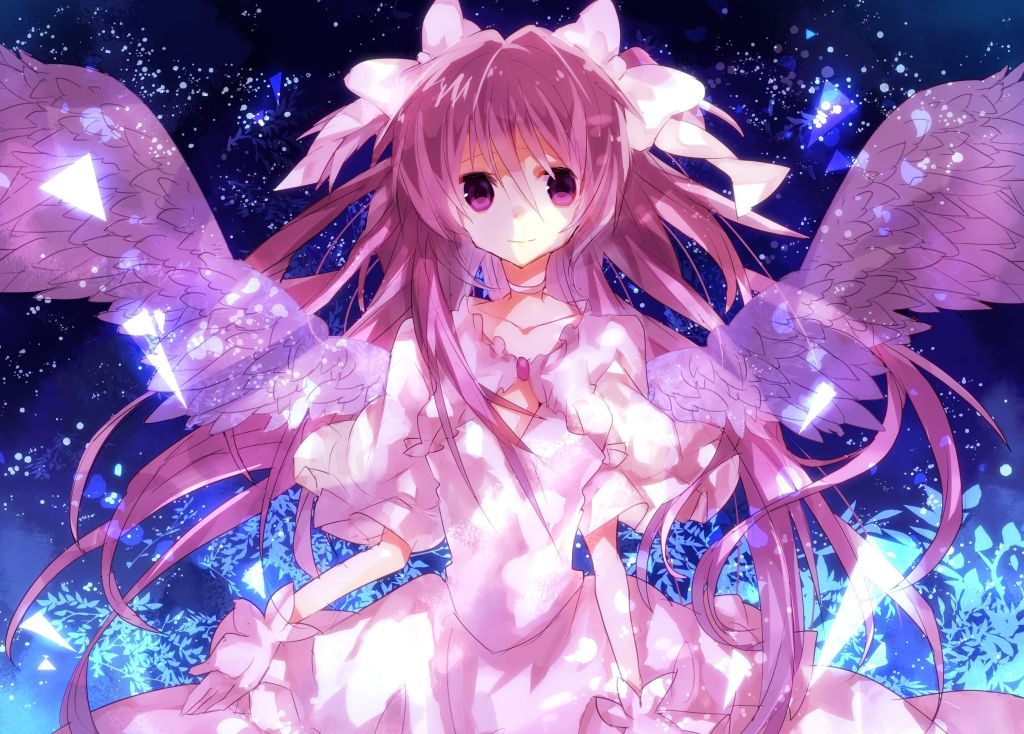
The way Madoka Magica made Madoka into a god was bold. It was a move that served several purposes. But the most important reason was to create a reasonably hopeful ending for an otherwise dark and tragic story. There didn’t seem to be any way out of the cycle of suffering for the magical girls. They reached despair, died, and became witches that killed others. Then Madoka came along with this radical and innovative solution that traded her humanity for the hope of all magical girls. Making Madoka into this truly beautiful goddess made for a powerful, hopeful ending to the story.
How did Serial Experiments Lain use the trope? The creators of the story produced a fascinating, gradual plot twist by slowly revealing that Lain is a godlike entity. It created a lot of interesting lore interpretations. Additionally, the god-girl trope served to take a simple story – a girl’s exploration of identity in leu of new technology – into a unique sci-fi tale with a powerful protagonist. Unfortunately, I doubt the story would have been as popular if Lain was truly an ordinary human girl trying to find herself.

If Madoka Magica used the trope to establish a hopeful ending, Serial Experiments Lain used it to make the story themes more melancholy. Due to her godlike nature, Lain is unable to live as a human girl despite craving normal human connections. She also altered Arisu’s memories to save her from mental trauma; but in so doing, Lain had to make Arisu forget about her, too. These aspects of the story and its conclusion are sad and painful. Without the element of Lain being a god, the story wouldn’t have reached nearly the same level of emotional effectiveness.
If you are interested in the “God is a girl” trope as I have defined it, you may also like to hear about a few anime series with variations of this idea. I have three examples. Some them don’t meet the specific criteria I mentioned for the true trope, though. Higurashi no Naku Koro ni features the character Rika Furude, who has the ability to loop back to an earlier time in her life following her seemingly inevitable death. This young girl is mentally immortal, retaining memories of many different world lines. While Rika herself is not a goddess, this is a power that was given to her by a deity (Oyashiro-sama). She can be considered a god-like entity.
Higurashi uses the god-girl element to create simultaneous hope and despair for Rika. Her power is both a blessing and a curse. She’s trapped in these repeating worlds that always end in her death. For about a hundred years total, Rika relives similar timelines, never graduating from the body of a child, never completely solving the violent crimes in her town, and never escaping her own death. This almost destroys Rika, but eventually she escapes the loop and can start a happy life. I thought it was interesting how this variation of the trope made it so the godlike entity was virtually helpless for a long time.

The second variation to mention is one where the godlike girl must pay a steep price to use her power. Momoka from the anime Mawaru Penguindrum can use a powerful spell that switches the current world over to a different version of the world where a few things have changed. For example, Momoka saves her best friend by changing to a world line where her abuser is no longer alive.
This is a truly godlike power, but it takes a heavy toll on the user. When she uses the spell, Momoka is badly burned by magical flame of retribution. Depending on the amount of changes made to the future, the spell may take the life of the user. Momoka dies when she changes the world to a different future to minimize the damage done by a devastating terrorist attack. She saved hundreds of lives.
Fruits Basket has a very different variation of the girl-god idea. Akito Sohma is the God of the Zodiac, wielding the power to control the minds of the twelve people cursed by Zodiac spirits in each generation. (Note: Despite pretending to be male for most of the anime, Akito is indeed a girl.) Though Akito “loves” her twelve servants, it’s a toxic love that encourages abuse of all kinds. This is a case where the god-like girl is the antagonist. She’s a petty, aggressive abuser who ruins lives to satisfy her inner emptiness. Some fans say that Akito seems to have Borderline Personality Disorder. I think it’s an interesting twist to have a god character with severe psychological issues.

Closing Thoughts: Why I Love This Trope
Hopefully, this article served as a thorough explanation of the “God is a girl” anime trope. We went over the three best examples I could find: Haruhi Suzumiya, Lain Iwakura, and Madoka Kaname. Then we discussed the possible uses of the trope in each anime. Finally, we covered three brief examples of variation of the trope in other anime shows. But there’s one thing that still hasn’t been touched on. While I wrote, I found myself wondering why I enjoy the god-girl trope. Why is it fascinating to me? Why did I want to explore it like this? Here are my thoughts.
At first, it was hard to put my finger on why this trope appeals to me so much. But after some thinking, I do have a few reasons. To begin with, I like sad stories or tales of emotional struggles. The god-girl trope usually has a strong element of tragedy and/or suffering. Stories like these make me feel somehow understood. It’s probably related to having severe depression and hyperactive emotions in general.
The next two reasons are very interrelated. I like female characters with unique powers, as well as anime with unique fantasy or sci-fi lore. Additionally, I like good character psychology. Usually, stories that use the “God is a girl” trope have a lot of interesting and relatable characters. I’m really interested in the god-girls mentioned in this article. They’re fascinating and in many ways I understand them. Creative fantasy elements and creative, relatable characters are both associated with the god-girl trope, providing two more reason to appreciate it. It’s also refreshing to have female characters who have so much power, even if many of them suffer because of it.

For a final reason, I like this trope because it’s nontraditional. I grew up with the Christian fundamentalist concept of god, which I always found severely limiting. God is male in most of those doctrines. Now, I don’t believe in gods or goddesses anymore, but I still love myths and stories with a central female god. It’s refreshing and new compared to what I’m used to. One nice thing about not believing in fantasy is that you have more freedom to enjoy a variety of god myths without trying to construe one as being true. You also no longer need to invalidate other concepts of gods. Anyway, that wraps up my thoughts on this topic. Thank you for visiting Mono’s Anime Rants.
Thanks for reading~
Note: This post first appeared on my Wix blog, Mono’s Anime Rants, on Dec 30 2022. After re-publishing it here on WordPress, I’ll delete the original to avoid confusion.


Very fascinating post! You’re right, god-girl tropes aren’t used in anime much, but when they are it makes a really interesting story. None of these anime are bland by any means. I love how there is two different versions of female gods in anime, one is a girl that might have some powers but she’s really just filling a “princess” role, while the other is an all powerful being.
LikeLiked by 1 person
Then there is Mitama from KamiKatsu. As God, her powers are limited by the number of followers she has.
LikeLiked by 1 person