Disclaimers:
1) The Penguindrum project will be categorized under episode reviews, but it won’t work the same way as my usual episode reviews. Each entry in this blog series will cover 1-3 episodes of Penguindrum rather than a single episode. Additionally, there will be no recaps of the events – only discussion of the episode.
2) The Penguindrum project will contain spoilers and information acquired from seeing the end of the anime. This kind of information can appear at any point in the blog series, so if you haven’t seen the entire anime yet, be aware.
Episode 5: That’s Why I Do That
There is a lot to discuss and sort out in this episode. First, we need to revisit the question of who pushed Asami down the escalator. When asked if she remembered anything about the incident, Asami said she saw “him” (Japanese: kare) shortly before the incident. Masako responded, “So you witnessed it,” and shot Asami with a memory-wiping projectile. This suggests that whoever pushed Asami was a man. I’m more confused than ever about the identity of the culprit, since I thought it had to be Ringo or Masako. All I can do is hope it gets explained later.

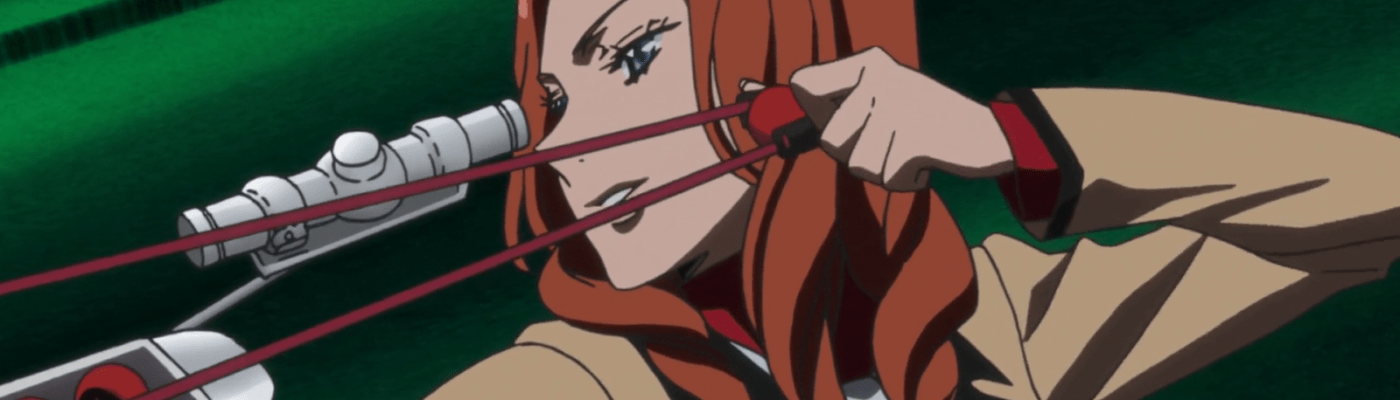
Moving on, Masako is first fully revealed and introduced in this episode. We know about her identity and agenda from future episodes, and it’s worth looking at her early actions through those lenses. First of all, Masako is Kanba’s twin sister and the only one who remembers his true origins. Masako’s other sibling is a significantly younger brother named Mario. This boy is sickly and fated to die. The only thing keeping him alive is the second penguin hat. Masako’s main goal is to find the Penguindrum to save Mario’s life. Her secondary goal is to remind Kanba of the truth and win him back.
Kanba and Masako are very alike in ways that might not be immediately obvious. Although Masako is generally more strategic, both siblings are action-oriented, practical, and logical. Both are “hunters” by nature. For Kanba, this manifests as being a playboy and charming lots of girls. Masako is also a charismatic go-getter, though in different ways, since she has little interest in seducing people. If anyone or anything is in her way, she remorselessly eliminates it. And like Kanba, if there’s something she wants, Masako will hunt it down no matter what.
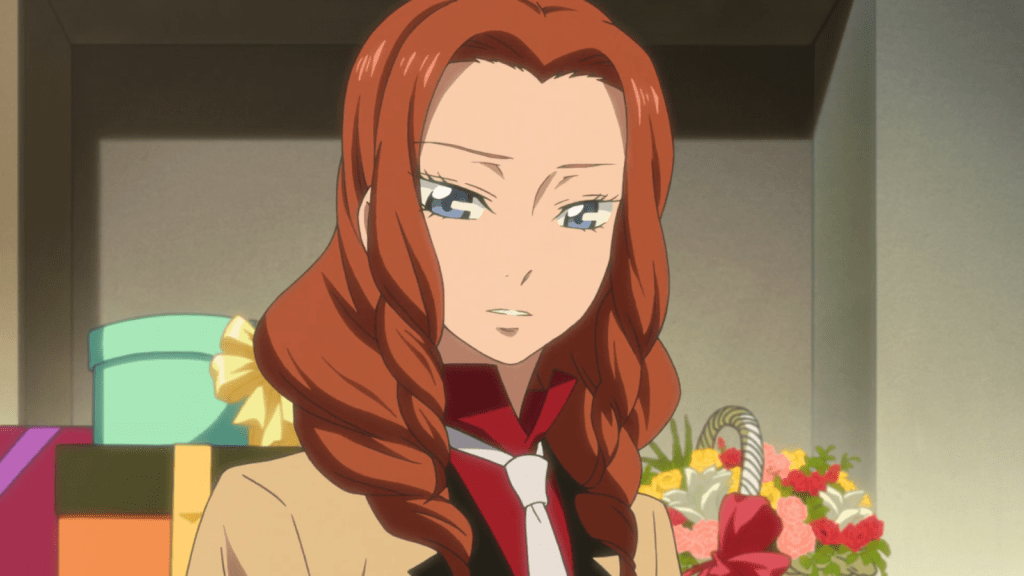
The twins are also similar in their goals and flaws. Both are trying to save someone they love by obtaining the Penguindrum. And of course, both have incestuous attractions. Masako is in love with Kanba on some level. It would be more accurate to say she’s obsessed with him. Kanba’s love for Himari isn’t technically incestuous, since they are not related. But they were socialized as siblings together for about a decade. Plus, Kanba was in love with Himari even while convinced they were a biological family. So yes, both Kanba and Masako are attracted to one of their “siblings.”
Penguindrum’s fifth episode only focuses a little on Masako, but I thought it was a worthwhile discussion nonetheless. Most of the episode is about Ringo’s visit to the Takakuras, where she learns about the penguin hat and Himari’s peril. We also see some interesting flashbacks about the typhoon several years ago and how those experiences influenced Kanba to become an extremely determined person. Kanba metaphorically breaks his back for Himari, risking his life and sustaining injury in order to get the hat back after Ringo threw it away. In some ways, Kanba is impressive and admirable.
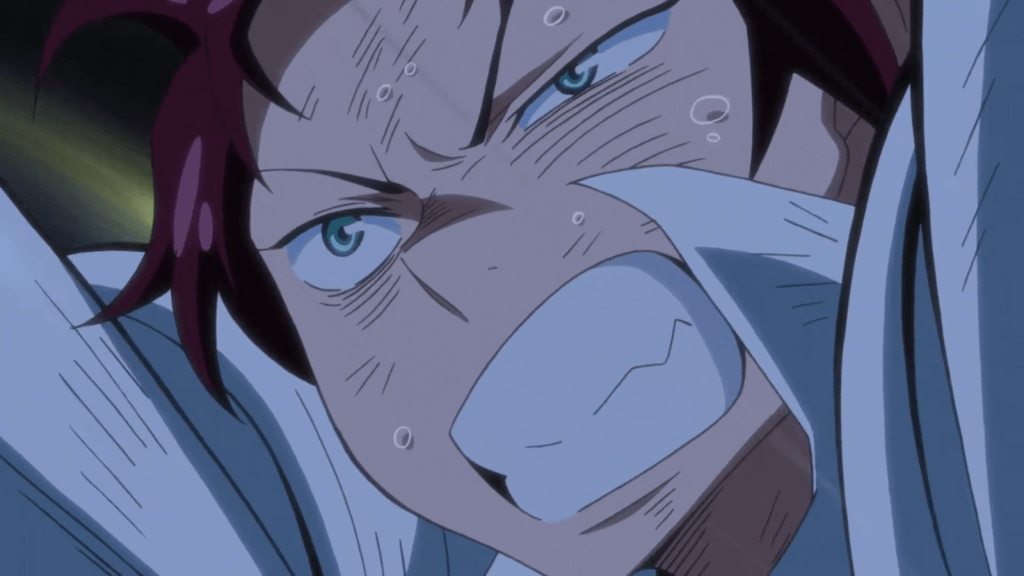
Speaking of Kanba, this episode is also a key point in his descent into being a criminal. What he’s willing to do for Himari has so far included database hacking, spying on girls at school and using a lock pick to break into Ringo’s house. But in episode 5, Kanba begins to accept money from his parents’ organization. This is the group responsible for the terrorism 16 years ago, and they are planning more violence in the near future, as we see by the end of the series. Even if Kanba doesn’t know the current plans, he still accepted money from terrorists. That’s some very dubious morality.
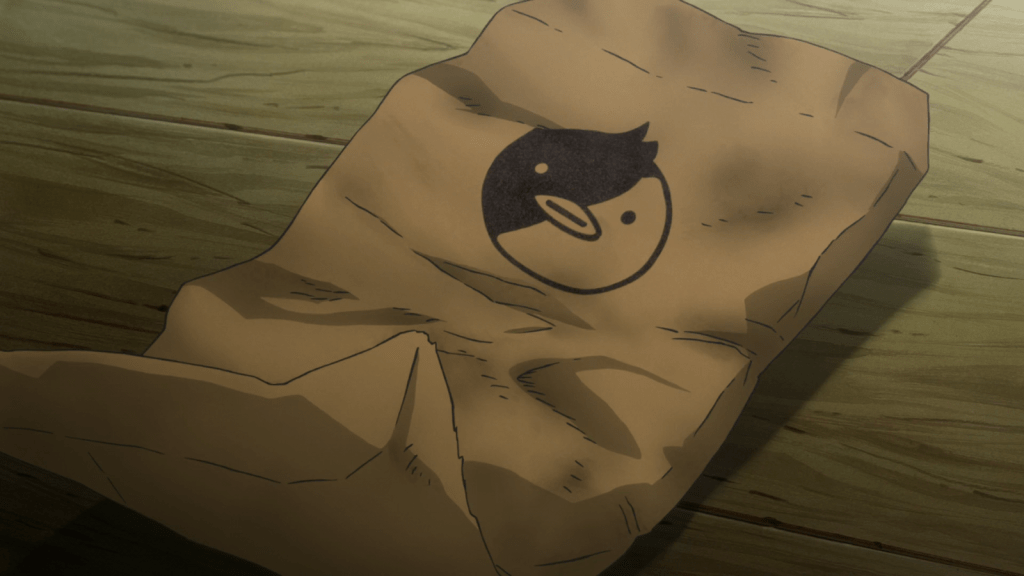
The next point of discussion is the penguin logo. By episode 5, you’ll probably have noticed that this logo appears frequently all over the anime. In this episode, we see the penguin logo on the envelope of cash Kanba brought home. I believe this logo is the mark of the terrorist organization run by Kenzan Takakura. Alternatively, it could be the logo of the Destination of Fate, where beings like Sanetoshi and the Princess of the Crystal come from. When you see the penguin logo, it usually means something isn’t right. Either the marked item is from Sanetoshi, who is generally bad news, or it came from a nefarious terrorist organization.
There’s one last topic to cover. At several points in this episode, Shouma refers to the penguin hat as “an alien lifeform.” Is that really the case? You might be able to make an argument for it. After all, the sequence leading to the Princess’ world has a very outer-spacey aesthetic. However, I think it’s more accurate to say the hat is a spiritual being rather than an alien creature. Later episodes of Penguindrum suggest the two penguin hats are entities born from Momoka’s soul when she sacrificed herself. The fanbase generally accepts this as the canon explanation of the Princess and the hats.
This explanation isn’t perfect, since it fails to explain the personality of the Princess of the Crystal. Although what we saw of Momoka was limited, she seemed to have an optimistic, warm, and generous personality. The Princess, on the other hand, is cynical, demanding, and sometimes downright insulting. There is no reason given for why Momoka’s soul would have a different personality. This is probably another instance of Ikuhara’s love of absurdity and leaving things up to audience interpretation. Anyway, that’s all my notes for episode 5.
Episode 6: You and I are Connected by M
(It’s going to be another long analysis, FYI. There was a lot to cover.)
Episode 6 introduced Momoka, who is critical for tying together the larger story and its characters. However, before that topic, let’s focus a little on Ringo. In any work of Ikuhara, it’s helpful to identify and visual symbolism and character aesthetics. Ringo’s visual themes are the ocean and its creatures. That’s probably because of her fond memories of going to the aquarium with her parents. We sometimes see Ringo’s room looking deep blue like it’s underwater when she’s thinking or dreaming. Her two favorite stuffed animals are a sea otter and a kappa. Additionally, Moray eels are symbols of disaster and misfortune in Ringo’s mind.

Interestingly enough, in Ringo’s thoughts and memories, her two stuffed animals serve as stand-ins for her parents. The sea otter is her father and the kappa is her mother. I think this was done for several reasons, but mainly because it lightens up what would otherwise be dark and stressful scenes. Although the stuffed animals look silly and the voice-acting is comically melodramatic, the scenes of Ringo’s parents are grim when taken seriously. They shout at each other, cry, and throw things when angry. Scenes in other episodes also suggest there was domestic violence.
Ringo has a lot going on. While it’s no excuse for her stubborn delusions and stalking habits, the family dysfunction she suffers does make Ringo more sympathetic and understandable. I know firsthand that it’s incredibly stressful to grow up with your parents fighting, even if there was no hitting. Ringo’s parents were dealing with the grief of losing a daughter, but they shouldn’t have let that trouble their remaining child. Young children tend to internalize things and interpret any difficulties or abuse as their fault. That’s part of psychology, and it’s why Ringo decided to emulate Momoka in a desperate bid to “fix” her family.

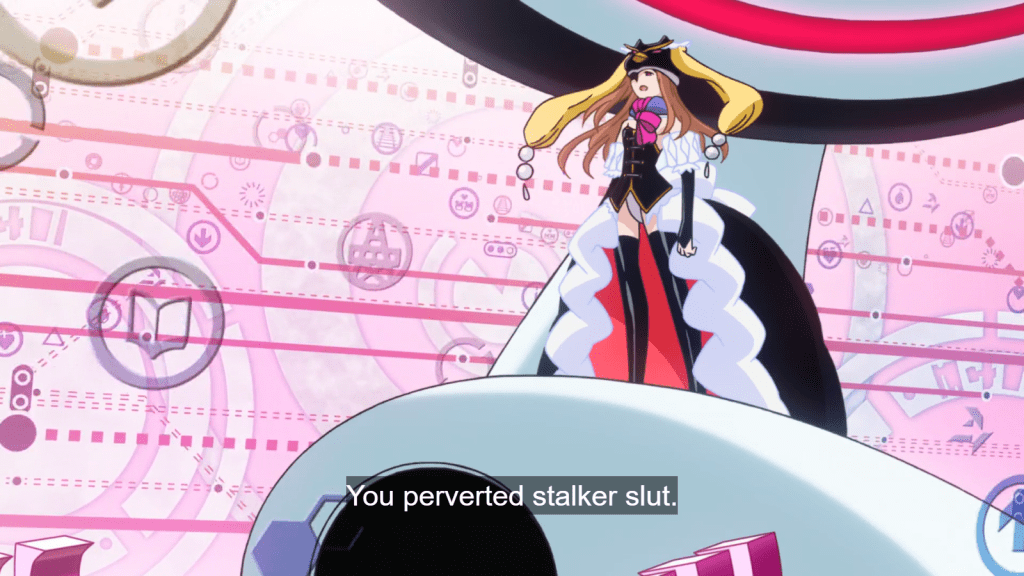
Moving on, we know that Momoka is the glue that ties everything together. She had special bonds with young Tabuki and Yuri. She wrote the Fate Diary. The terrorist attack on the subway caused her death. Penguindrum can be viewed as a story about Momoka and the people that were affected by her. Additionally, Project M and other mentions of the letter M might be related to Momoka. For example, the play that Yuri stars in is called “The tragedy of M.” If M stands for Momoka, it would make sense. Momoka’s death was extremely devastating to Yuri.
In Ringo’s insane plan, Project M is technically referring to maternity. She wants to have Tabuki’s child because she believes this will connect her to him forever. But I also think in another sense, the M in Project M could stand for Momoka. After all, Ringo’s ultimate goal is to become Momoka. Still, despite Momoka’s importance, the M’s in Penguindrum don’t always link back to her. When Masako mentions Project M, it probably stands for “Project Mario,” since her little brother’s name is Mario. Her goal is to save his life.

Before we move on from Momoka, there is one more thing to point out. As I watched this episode – for probably the 5th or 6th time – it occurred to me that what’s written in Momoka’s diary makes no sense. The events described in the book didn’t really happen to Momoka. At least, that’s my current understanding. Let me explain my reasoning.
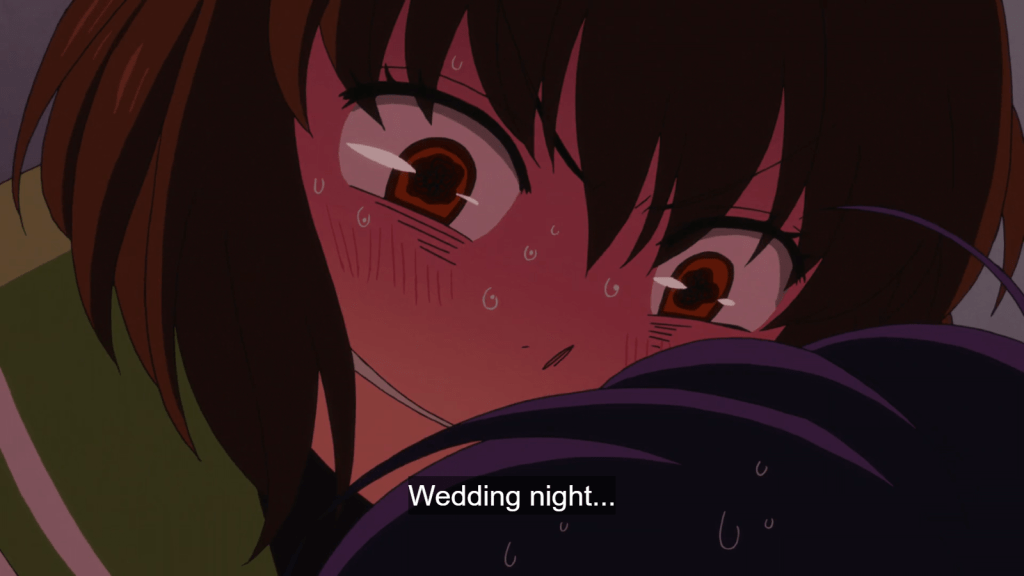
I used to believe the diary contained the childhood experiences of Momoka as she spent time with Tabuki. The events, I thought, were true. However, this seems less and less likely with what we see written in this episode. A childish kiss by the lake is believable – but not marriage, moving in together, and having a “wedding night.” These are not things that happened in a ten-year-old’s life, but rather, the things she hoped would happen in her future. Basically, the diary is full of Momoka’s romantic fantasies. The tragedy is that she died before living any of them.
I’m not sure why I didn’t understand the diary at first, but episode 6 makes it clear with the quote that Ringo reads. “Write the world’s fate here. When the future written here becomes true, everything precious to me will become Eternal.” According to this, Momoka was indeed writing the future she hoped for. Note: this scene contains a reference to Death Note. You can see a brownish Death Note behind the diary on Ringo’s desk. It makes me wonder what a small child was doing with a book that’s supposed to kill people, but it’s just a reference and not meant to be taken seriously.

Some aspects of the Fate Diary still don’t make sense to me. Later episodes of Penguindrum reveal there’s a spell written in the diary that changes fate. Momoka can activate this at will, but it comes with a painful price of fire. Given that she has this godlike power, why didn’t the fate she wrote about come true before her death? The only explanation I can think of is that despite writing so many details, she never actually activated the spell to make her future with Tabuki come true. She didn’t need to because fate was already on the path to allow this happy future.
That’s all I can think of for now related to Momoka and her diary. The final topic to discuss from episode 6 is Tabuki’s mention of Schrodinger’s Cat. I’m going to assume most people are already familiar with the concept because I’m terrible at explaining it. I recommend the wikipedia page for learning about Schrodinger’s Cat, but it’s basically a thought experiment used to explain a certain aspect of particle physics. Light is both a wave and a particle until it is observed, when it becomes one or the other. The cat in the box is both alive and dead at the same time until the box is opened. At that point, it becomes either fully alive or fully dead.

So, why did Tabuki mention a complex physics thought experiment? You don’t even need to understand the science behind Schrodinger’s Cat because Tabuki isn’t talking about that. He’s borrowing a loose understanding of the idea to make a statement about his emotions and the way he views the world. First, Tabuki stated that he felt like Schrodinger’s cat. When Ringo asked what that meant, the young man replied, “It’s a half-dead, half-alive cat.” The implication is that, on an emotional level, Tabuki isn’t sure if he’s dead or alive. Perhaps he’s both at the same time.
To me, this is a poignant description of Tabuki’s grief. (The bicycle analogy he provided was also highly interesting and insightful.) Momoka brought meaning and color to his perception of the world and himself. When Momoka was alive, Tabuki was also alive. And with her tragic death, a part of him died, too. Even now, 16 years later, he hasn’t fully processed the loss he suffered as a child. Although Tabuki is a functional adult, reasonably content in daily life with his hobbies and teaching job, he never feels whole. He’s alive and dead at the same time.

We’ll eventually start to see that in this anime, the theme of boxes is extremely important. It isn’t a very visible theme in episode 6, but it might still be worth noting that Schrodinger’s Cat is in a box. When the box is opened, the cat’s state will become certain. The theme in Penguindrum is that everyone is metaphorically trapped in boxes, which are spiritually killing us. Breaking out of the box could mean certain death, but that might be better than being perpetually half-alive. It’s slightly similar to what Tabuki is saying in episode 6 about the cat and his view of the world.
As usual, Penguindrum shows itself to be a thematically strong and psychologically fascinating anime. That concludes my thoughts for episode 6. Thanks for stopping by and reading – it means a lot. Sayonara until next time!
Thanks for reading~
 Anime Rants
Wow! That is a lot deeper than I ever got.
LikeLiked by 1 person