
Toradora is a 2008 drama/romance anime set in a highschool. It’s sweet and funny, with surprisingly well-written characters and excellent visuals. There are countless anime series that fall into the school/drama category, and normally, I don’t like them. Toradora is an exception to the rule for two main reasons. For starters, it was one of the first school anime that I ever watched, so I wasn’t yet disillusioned with the genre or tired of the tropes. The second reason is that I found myself genuinely interested in the characters in Toradora. Even now, I occasionally like to go back and re-watch the series.
The question I’m addressing today is whether or not this is ok. Can an old fan still enjoy Toradora? But before we dive right into that, I want to discuss my history with Toradora, some of the general problems with the series, and the some reasons why it might be strange for an older fan to still like Toradora. Sections will be divided into headers for convenience.

~History with Toradora~
I don’t precisely remember when I first started watching Toradora, but I think I saw parts of it in 2010 or 2011, when I was first getting into anime. I didn’t invest in the series or complete it until, I believe, summer 2012. My first reaction was to absolutely love Taiga. There was a lot of myself in her, and I could understand her well. I wasn’t very mature as a young adult, but prone to anger and other emotional outbursts due to onset of various psychological issues. Additionally, like Taiga, I had a deep need to be seen as tough and independent. I often acted aggressive toward others at college. To top it off, I’m quite a short AFAB person. Taiga was my older, immature self in anime form.
Besides my attachment to Taiga, I also liked the general spirit of Toradora. I wasn’t sick of all the tropes, as I mentioned in the introduction, so watching it felt fresh. The real deal surrounding my enjoyment of this anime is related to my upbringing. Going into much detail would be superfluous, but I grew up homeschooled, emotionally oppressed, and severely unsocialized. So even though I was college-aged when watching Toradora, I was mentally and socially on the level of a young high-schooler. As such, I was interested in the drama, relationships, environments, and activities shown in Toradora.
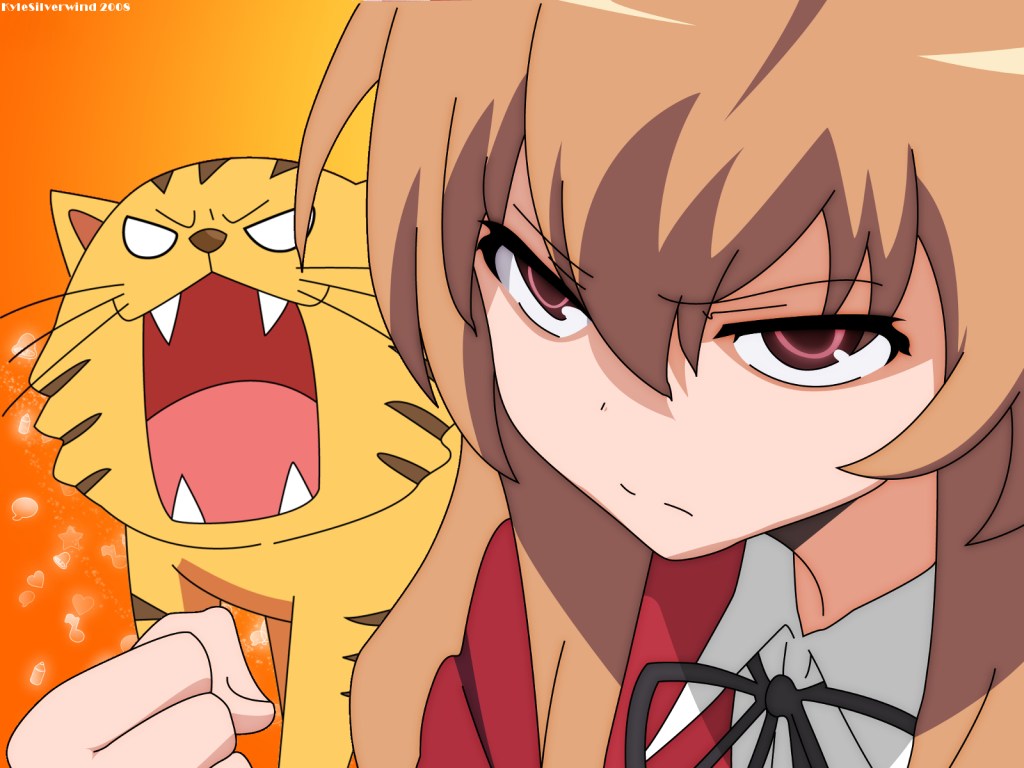
It’s been a long time since college, but I still watch Toradora every few years. With each watch, however, I became more aware of potential issues. The anime simply wasn’t as good as I remembered. Plus, I started to wonder if it was alright for me to continue to enjoy a highschool drama. Let’s go over these concerns in order. First, we’ll look at some criticisms of Toradora.
~Criticisms of Toradora~
As I’ve alluded to a few times now, Toradora is a trope-filled anime. Pretty much any anime teen romance trope you can think of happens in this show. If you’ve seen a handful of series like this already, it may be difficult to enjoy Toradora’s tropey misadventures. Examples of tropes include two people getting locked in a storage shed together, an adventure in a spooky ocean cave, wardrobe malfunctions, typical beach and pool episodes, overused character archetypes, and in general, love polygons. There’s no shortage of events and details that have been done a hundred times over. Toradora lacks originality in some important ways.
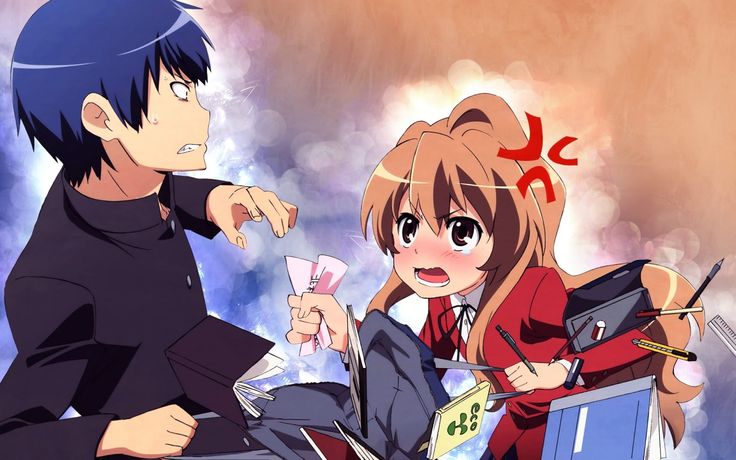
One interesting criticism of Toradora is the idea that it depicts a toxic relationship. And indeed, it’s true– Taiga and Ryuuji make one of my favorite anime couples, but I can only appreciate their relationship in a strictly fictional sense. A real relationship with that many problems would be toxic. Ryuuji is codependent and does everything for Taiga, who rarely contributes or takes good care of herself. He should stand up for his own boundaries and give her the chance to be independent. And as for Taiga, she sometimes hits or insults Ryuuji. This is mainly done as a comedic thing in the anime, but if you think about it in reality, it would be physical and emotional abuse. The idea that Ryuuji and Taiga have a toxic relationship is not far-fetched.
There’s another frequent criticism of Toradora to mention, but compared to the last two, this one is more personal and subjective. Some people dislike certain characters immensely. This isn’t a problem for me, as I can appreciate all the Toradora characters on some level. By far the main culprit of the character hate is Ami Kawashima, the “idol” with an extremely flawed and difficult personality. While I acknowledge that she’s a bitch, I think her character is important to the story. Furthermore, she does start to care about others and experience personal growth as the show continues. I believe the characters in Toradora are reasonably well-written and largely very likeable, but not everyone agrees.
~Problems with Adults Enjoying Toradora?~
Perhaps you think, right off the bat, it’s weird for a middle-aged person to still appreciate something like Toradora. But what makes it “weird,” and is it really a bad thing? Well, it can potentially be a bad thing, but I like to think my justifications are good. Now, let’s look at some reasons for why it would be strange or problematic for a grown adult to enjoy Toradora. I’m not going to include the pathetic “reasoning” that says something is bad or gross because it’s unusual. Are there other reasons besides just an aversion to what’s uncommon?
Some might say that it’s a sign of immaturity if a full-fledged adult still enjoys a teenage drama show. It could be a sign that the person never matured emotionally or mentally. That’s one possibility. My response is that it’s ok if someone is less mature; that’s no reason to judge them. Everyone is at a different place in life. Personally, I don’t really care if people see me as somewhat immature. If I cared about that, I probably wouldn’t still be obsessed with anime and writing weird blog posts about it. So, as you can see, the first reason falls apart.

One reason that doesn’t fall apart as easily is the idea that some unsavory adults will inevitably sexualize teenage characters. This is really the only reason I can think of for why it could be a bad sign for an adult to like a teen drama. Needless to say, fantasizing about the teenage characters and their bodies is not the reason I appreciate Toradora. I don’t do that. But the unfortunate reality is that there are plenty of adults who do this. Some will say that things like age and consent might not truly matter when fantasizing about a 2D fictional character. I somewhat disagree, since the premise of liking young anime characters still makes me uneasy. I’m not going to insult someone or jump to conclusions over something like this, but I still see it as a potential problem.
On this topic in particular, there is another layer that deepens it. Despite the fact that Taiga is canonically in highschool, her character design looks distinctly younger, and very childlike. This suggests that the creators of the show/manga might have been trying to appeal to lolicons and pedophiles. It’s also possible that the author simply wanted a story about a girl who is made fun of and/or disadvantaged because of her size. Knowing anime’s huge and pervasive problem with pedophilia, however, this answer seems naïve. We now have quite a strong reason for objecting to Toradora, especially for older teens and adults.
~Why I Can Still Enjoy Toradora~
We’ve been over some reasons for why it might be problematic for someone of my age to enjoy an anime like Toradora. Some of the reasons were easy to knock down. I can still enjoy Toradora because I don’t sexualize the characters, I don’t mind others thinking I’m a little immature, and I don’t mind being seen as unusual. However, the strongest reason remains standing. How can I let myself enjoy a show that could very well be part of anime’s lolicon/pedophilia problem?
The simple answer is that, as long as one is aware of problematic elements and can mentally compartmentalize things, there’s nothing wrong with enjoying a production that has serious issues. If it doesn’t make you uncomfortable, there is no harm in it that I can see. Additionally, if you’re worried about supporting a bad creator, you can opt out of paying for the production. This is especially easy with anime. Just open up a free streaming site. You won’t be giving a cent to anyone.

To restate, while it’s not ideal to like something with problematic elements, you can still enjoy it as long as you’re aware of the issues, and as long as the issues themselves aren’t what you’re after. It’s even better if you can be aware of the problems AND spread information and education about it. That’s my take.
There is a lot that I enjoy in Toradora, and I think I’m allowed to do that without guilt or shame. I will always love Taiga, even if she represents the worst parts of my younger self. I do think there are redemptive things about her character, and I like having a feisty female protagonist. I appreciate most of the characters and their interactions. Watching Toradora gives me a sense of nostalgia and a sense of wanting to have fun. It’s also great to see Taiga and Ryuuji as a couple toward the end. I could go on, but I think you get the idea. I just love Toradora!
Thanks for reading~

 Anime Rants
I give Toradora the prize for being the best anime romcom of all time.
LikeLiked by 1 person
That’s high praise! I think I agree 🙂
LikeLiked by 1 person
The small but spunky female is a trope that goes way, way back. (I remember a song from the 60s about a 6 ft. 2×4 being swung by an angry 5 ft’2″ woman.) Toradora never struck me as having appeal to pedophiles. I knew girls who were short and not built like an hour glass and it would be wrong to say they could never be an anime protagonist because of what some perv somewhere might think.
Taiga’s shortness and slenderness was part of the reason for her tsundere nature. I don’t think it is reasonable to demand that all female protagonists be tall and curvy or risk being accused of appealing to pedophiles. In fact, I am tired unto death of almost all females being built like Victoria’s Secret models. That’s a different kind of sexual objectification and it is almost universal.
There are anime that have the sexualized loli trope going that deserve criticism but this isn’t one of them.
LikeLiked by 2 people
I’m grateful to hear your breakdown of this. It definitely helped me to realize my fears on this one were mostly misplaced. Thanks.
LikeLiked by 1 person
Hey, I haven’t seen this one yet, but this was a very sweet post. I might be open to checking this one out sometime this year.
LikeLiked by 1 person
Thanks I’m glad you liked the post! Yeah check it out, it’s a lot of fun haha
LikeLike
There’s a thing I don’t quite understand: Why would it be wrong or bad for an older person to enjoy things originally directed at a younger audience? Sure, there are some limits (not counting obvious physical or most legal boundaries), but in general I find it just plain odd to prescribe another how and what to enjoy. Is liking fluffyness and comfort a sign of childishness? Deep (and “deep”) psychological and philosophical content only considerable for adults then? Watching anime or playing games video or tabletop, potentially even with others are immature weaknesses? Is that comfort only to be found in sports, unaffordable shopping, few evenings of mildly enthusiastic one-last-hobby tangents, tax returns and once-a-month sex? There’s that proverb about how if A says something about B it says more about A than about B, where I’d put most of the maturity argument (by those opposing) in. It would be a somewhat sad sight if what one enjoys is the only measure by which one’s grown-up-ness is considered. (What do we age for otherwise?) I don’t know how I’ll see things when I will be middle-aged myself but I at least hope to keep a somewhat open mind still.
Other than that, enjoyment and being an audience is not the same thing as giving in to an obsession (or addiction). That’s probably the only bit adding on to Fred’s comment up there with which I fully agree.
As for the Tsundere tropes and characters, both in fiction and reality, I’ll quote Gigguk’s (comedically-intended) hyperbole, “all boys watching Eva like Asuka but when they grow up they realise that they’re more of a Misato man” (equally so regarding Utena, et al.). It might seem fun to many a kid, and seeing fictional or played violence in general seems to be an adequate entertainment standard for kids in the west (unlike properly experiencing it instead which is much better of course), but feeling at home as an adult with such ideals might be, at least imho, more an indicator of trouble and issues, be it past or present.
It’s not a classic because it is unquestioningly great, it’s good because it is an often-questioned classic, as goes for the other trope setters and codifiers of their respective genres and styles. Us, whether general audience or fans, picking it apart and setting the bad from the good does not make it a worse piece however, just a change in perception. (Wouldn’t that be the other way round then, a sign of maturing instead?)
Thank you for your blogs! Only relatively recently stumbled across yours and a few kindred ones (how do people manage to have a functioning work life, personal and friends’ life, hobbies, a functioning blog and time to read and reflect on so many great other ones?, gahh!); it’s nicely structured and very cohesive, and gives me quite a lot of counterpoints to think about regarding some works I haven’t considered in that ways. Not agreeing with all arguments in all posts does not mean not respecting them or not learning from them. : )
LikeLike
Wow, I really appreciate your comment and the thought you put into it. I think you have a point that it wouldn’t necessarily be be wrong or bad for an older person to enjoy things originally directed at a younger audience. I never really meant to say it was objectively bad. But it could possibly be a sign of immaturity in some cases. As I explained in the post, though, I don’t think that’s a valid criticism either. So what if I’m not super mature? And why judge the maturity of others when everyone has different minds and experiences? So yeah, you’re completely right.
I also appreciate your thoughts on the Tsundere and toxic character tropes. Good insight. And I’m glad you think Toradora is a classic, too.
Last of all, thank you so much for the kind words about my blog! I’m glad you’ve been enjoying it. And please don’t hesitate to comment as much you want. Discussion can be interesting. For some reason, WordPress had flagged your comment as spam, but I fixed it, so all your comments should go through now. Thanks again. 🙂
LikeLiked by 1 person
Thank you for the reply and I’ll take you up on the commenting then. : )
(I can’t promise to write shorter but I earnestly will try. Though reading and commenting with purpose takes time on blogs as these where there is in turn purpose and structure in each entry. Though I don’t know whether quoting Gigguk counts as being overly thoughtful, haha!)
Indeed, WordPress, or rather Akismet, really doesn’t like links of any sort or kind. Not even to their own, official pages. Not even to the very same page the comment is written on.
On one hand it’s understandable, on the other hand it might be a bit annoying, but on the third…hand it’s less trouble for the host to not see comments rather than getting flooded with spam. (Though I’ve been not accepted with pretty simple, positive, and link-free comments too, so it might also be Gauß-Voodoo-Magic at work. Or perhaps it just didn’t like Swedish or Japanese?)
I just like to either underline or at least show what I reference, be it sources or just fitting memes (albeit Munroe could be put into eiher category, I think).
As for a brief and somewhat fun interpretation of the Tsundere trope there was an old (and basically self-axed/short-lived) webcomic titled “Ow, My Sanity” (not linking to comic directly since the website’s so old that there were no certificates back then, which would make Akismet even angrier) where, to just quickly sketch the point, one later character behaves in a classic Tsundere way (for actual though hidden reasons) but is rebutted as the protagonist explicitly rejects her with “having no interest in someone whose personality can change that quickly, nor someone who’s deceptive enough to make it seem that way”. As someone having lived with a person of strong ambivalent characteristics, it did make me rethink fictitious and real personalities a little more.
(The author’s, Adam J. Thaxton’s, take on the Lovecraftian in general was a bit more profound, but the webcomic was quite all right.)
LikeLiked by 1 person
I’m rewatching now and if there’s one thing I dislike watching it a second time through as I’m older is that I feel like the romantic drama feels very forced.
I can’t help but feel bad for Ryuuji because he did – as mentioned – a lot of heavy lifting to try to help Taiga succeed in her romance and in return he didn’t even get to confess to Minori and get her honest reaction until the god damn end because she decided unilaterally Taiga needed a rebound.
Meanwhile Ryuuji is too busy playing the mature adult for everyone around him – while I understand that one of the main conceits of his character is that he literally doesn’t really get to have a childhood as a result of his family situation they went and took it too far. Ami was right.
But maybe it’s that sort of self-centered, selfish teenager romance stuff that makes that lack of satisfaction I felt at the end so realistic? I still rank it pretty high, especially now among the crap ton of poorly done Isekai anime, but with a grain of salt or a swig of scotch.
LikeLiked by 1 person