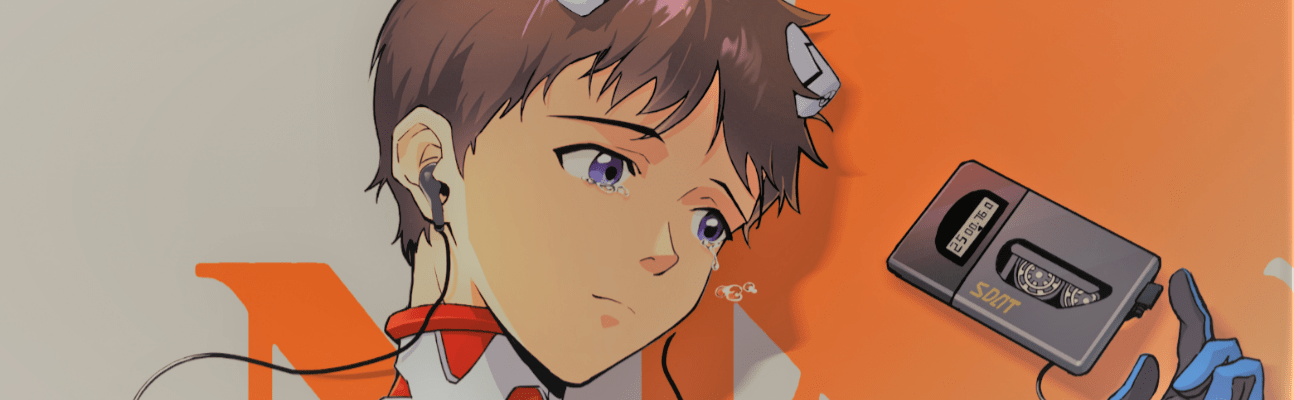
Countless bloggers, YouTubers, TV critics, and even students of philosophy and psychology have commented on the profound nature of Neon Genesis Evangelion. It’s been around since the 90s, so the populace as a whole has had 30 years to process it. Needless to say, there is a lot of Neon Genesis Evangelion content out there. Knowing that, it was daunting for me to begin any analysis of the series. However, I buckled down and tried my best. The result is this rough, relatively basic thematic analysis of the anime.
Please note that this analysis is only about the themes in the anime series, with a few mentions to the movie End of Evangelion. For this post, I am not talking about the Evangelion Rebuild movies. I consider those movies to be tales of alternate universes, and while visually astounding, they lack the psychological depth of the series.

Also note that I may expand this analysis at a later time. I know I’ve missed a few important themes, along with deeper exploration of the themes I do mention. (For example, I wrote a brief section about parents, but nothing specifically about the themes of mothers and rebirth.) If I decide to expand this post in the future, I will add edit notes.
Final note: Neon Genesis Evangelion will be referred to as NGE in this article.
Existentialism and Nihilism
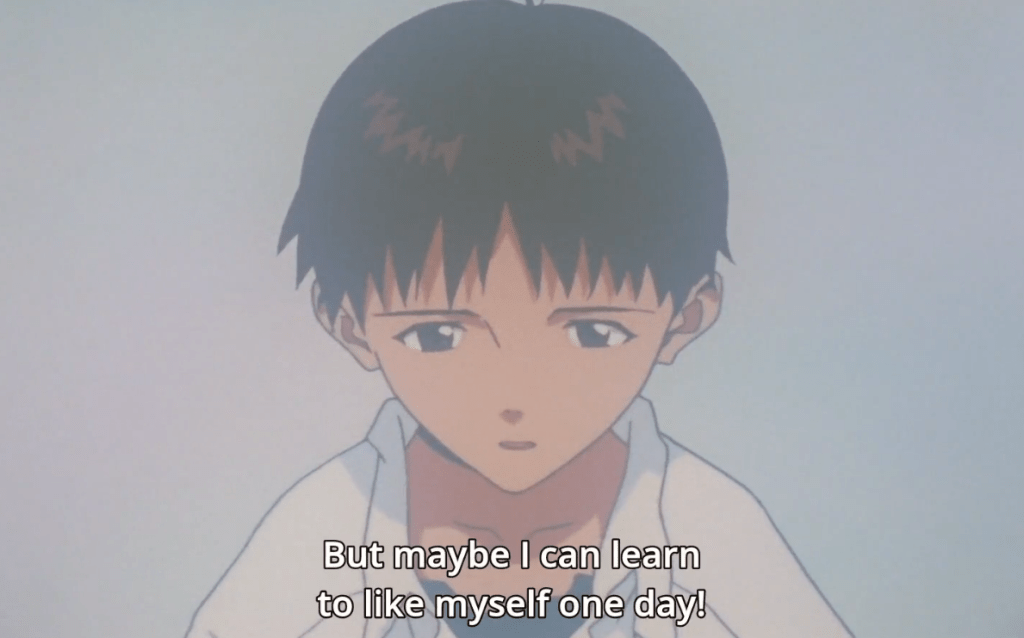
Nihilism is the idea that there is no purpose or meaning in life. Existentialism agrees that there’s no objective meaning, but places immense importance on the subjective meaning that individuals choose for themselves. The philosophies of nihilism and existentialism come up from time to time in NGE. Characters search for meaning at what seems to be the end of the world. For example, Shinji eventually comes to the conclusion that there is great meaning in interacting with others even though it hurts.

In many cases, we see attitudes of nihilism in the characters as they struggle with the emptiness of life. The Human Instrumentality Project is a desperate attempt to deal with this by forcing a new kind of existence on humanity – one that will prevent them from feeling empty and alone. In other cases, nihilistic justifications are sometimes used for negative behaviors. If there’s no point to anything, then why not do whatever you want, even if it harms or disrespects others?
One example is the way Gendo Ikari justifies creating and cloning Rei despite it being unethical. A smaller-scale example is when Shinji masturbates to Asuka’s body when she is unconscious. Feeling like life is pointless is one of the core ideas in NGE. It leads many characters to desperation. However, it’s important to restate that Shinji’s final conclusion is more existential than nihilistic. He chooses to continue existing and learning to like himself.
The Hedgehog’s Dilemma
Perhaps the most prominent theme in NGE is the Hedgehog’s Dilemma. This idea is also known as the Porcupine Dilemma and was developed by German philosopher Arthur Schopenhauer. The Hedgehog’s Dilemma is a thought experiment wherein a group of hedgehogs are cold and want to share their body heat with each other. However, their sharp spines hurt each other whenever they move too close. Therefore, they cannot have the warmth and togetherness they crave without significant pain.
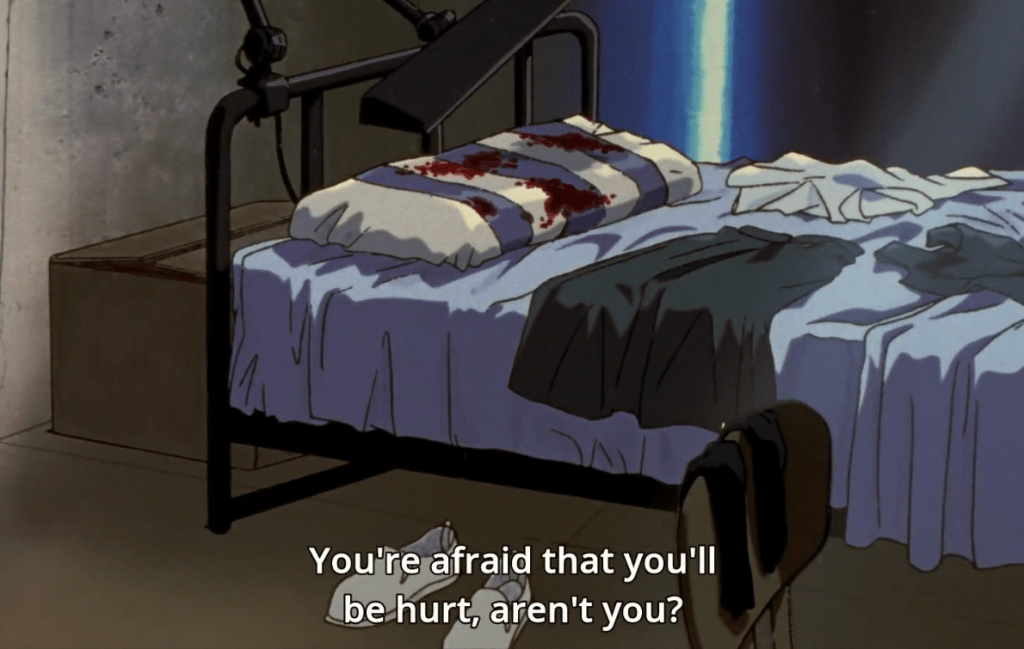
The meaning of this thought experiment is that humans cannot have relationships without getting emotionally hurt. This concept is so important to the story that NGE named an episode after it (Episode 4: The Hedgehog’s Dilemma). Throughout this anime, Shinji and many of the other characters long for closeness in a desolate world. But they hurt each other at every turn, whether on purpose or by accident.
One good example is Asuka and her habits. She wants to be seen and respected, yet lashes out at others and puts them down. It’s nearly impossible for her to form meaningful connections because she hurts everyone. She also risks being hurt herself, if others are disappointed in her or abandon her. It’s a dilemma indeed.

Escapism
Another important idea in NGE is escapism: the denial of the harsh reality in favor of distraction and/or fantasy. When I watch anime all day instead of completing my mundane chores, I am using escapism. It’s a way of psychologically “running away.” In NGE, Shinji hates and fears the cruel reality in which he’s stuck. He struggles with the temptation of running away from his responsibilities. If he just tones it out, he can forget the world is ending and that he’s one of the few that might be able to save it.
There are also various other examples of escapism in this anime. For instance, the Human Istrumentality Project is a form of escapism. By forcing everyone to combine into one bodiless shared psyche, the remainder of humanity can escape the perpetual experience of loneliness. If we are all together without physical boundaries, wouldn’t it be amazing?
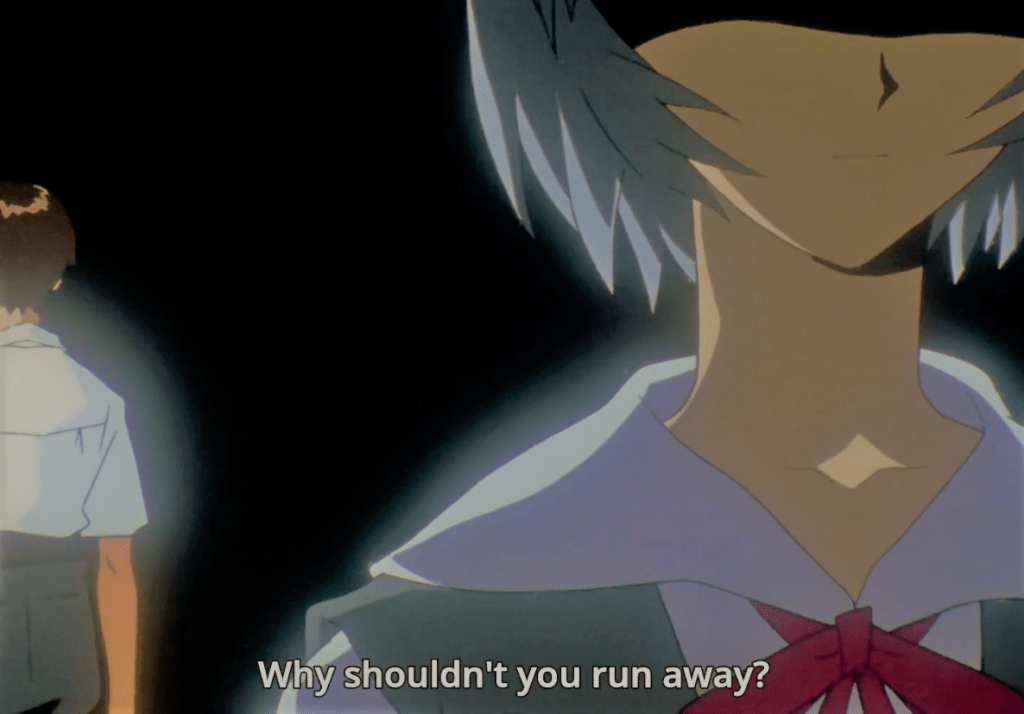
But is it right to leave our bodies behind and join our minds just to avoid feeling bad? And importantly, there is no proof the Project will even work. It could be complete fantasy, this idea that joining minds together will let us reach true understanding. Humans may never completely understand one another, and we will probably keep hurting each other forever. That’s reality, and sooner or later, it will catch up to everyone.
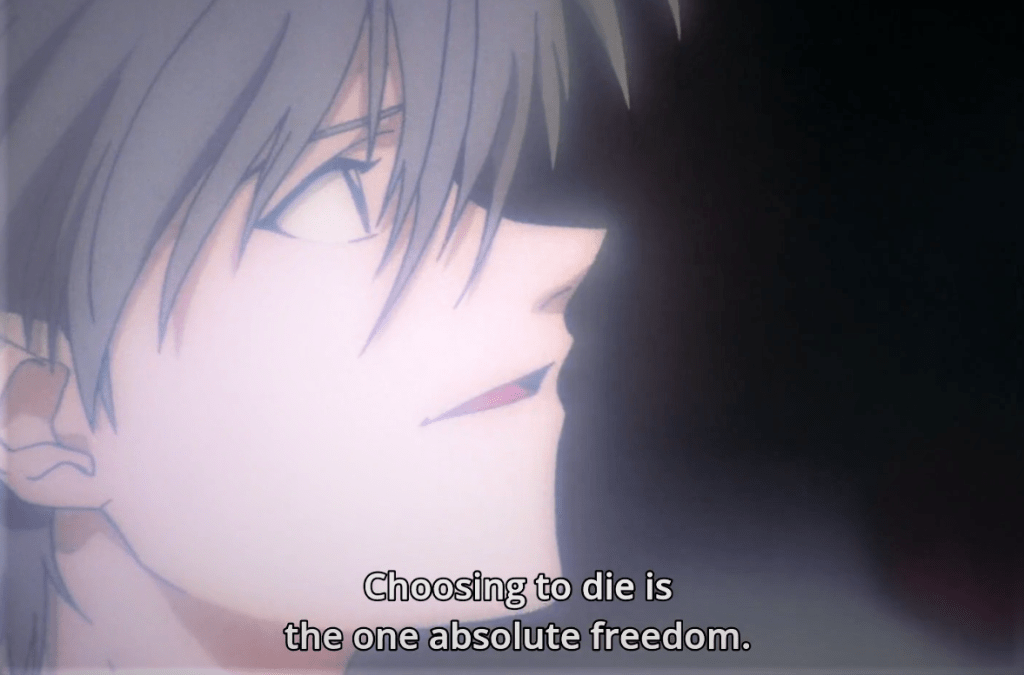
The tragedy of Kaworu also plays into the theme of escapism. I rarely see anyone comment on this. The deepest, darkest form of escapism is leaving one’s life behind. That’s what Kaworu succumbs to. He doesn’t want to cause the destruction of humanity, even though that is his duty. The truth he should have faced is that he might be able to live out a different destiny. But instead, he preferred death. To be fair, it must have been incredibly painful for such an existence to go on living. So, Kaworu surrendered his life and thanked Shinji for killing him. Escapism can be a grim prospect.
Relationships and Sexuality
NGE gives significant focus to the interpersonal relationships of the characters. For example, Shinji’s interactions with Rei and Asuka are key to the story. Shinji forms a friendship with Rei as they bond over being Eva pilots. Asuka is more difficult to get along with, but she and Shinji have a strange kind of emotional and sexual magnetism between them. Additionally, Shinji’s friends at school have some weight in the story, especially when one of them resents Shinji for piloting an Eva and inadvertently causing harm to civilians.

The relationships are not limited to the children. There are also interesting dynamics among the adults. Ritsuko, for example, has complex feelings of admiration and love toward Gendo. She wants his attention. There’s also the unhealthy romantic relationship between Misato and Kaji, wherein Kaji never really considers Misato’s consent. Of course, there are also important interactions between the children and the adults. Shinji’s complicated relationship with Misato is the best example of this.
The theme of sexuality is closely tied into many of the relationships in NGE. I already mentioned how Shinji and Asuka have some sexual chemistry. At one point, they try kissing, but neither one enjoys it. Their personalities are not a good match. Shinji likes Rei better as a person, and there is also a little bit of sexual tension there. Rei’s unreactive personality means she doesn’t care when Shinji sees her naked. As she becomes more “human,” however, Rei changes. She blushes when Shinji says she might make a good wife.

Asuka is constantly horny for Kaji. And Kaji is constantly horny in general. He seems to be a very sexual creature, even going so far as to say that “love” has nothing to do with gender. Some fans say he is bisexual. Personally, I would appreciate Kaji so much more as a character if he actually got consent from the women he messes around with. That scene where Kaji is making out with Misato in the elavator is a depiction of sexual assault and how frightenly common it is for people to deny it or sweep it under the rug.
Another example of sexuality in NGE is the believable but inappropriate sexual tension between Shinji and Misato. In the movie End of Evangelion, Misato stoops to actually kissing Shinji. And of course, there is the famous scene where Shinji masturbates to Asuka’s body while she is essentially in a coma. A lot of the sexuality in NGE is messed up, but these flawed characters and their many mistakes are very realistic and remain interesting to me in terms of psychology.

Finally, there is a romantic and sexual element between Kaworu and Shinji in the brief time they have together. Kaworu is regarded as a good example of a gay anime character, while Shinji’s attraction to him suggests he may be bisexual. I believe the attachment between Kaworu and Shinji was primarily emotional and romantic, but there were also some very sensually charged moments, such as when the two bathe together. As you can see, sexuality and relationships are both strong elements in this anime.
Parents
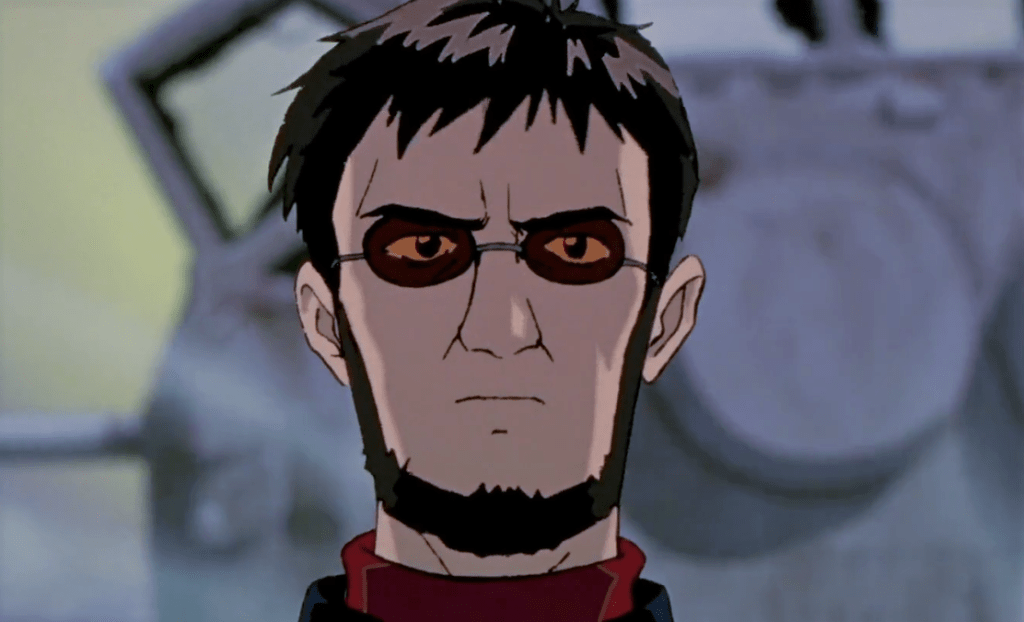
Parent-child relationships and communication are significant themes in NGE. The most obvious and famous example is Shinji’s relationship with his father, Gendo. After his wife died, Gendo didn’t even attend her funeral, and proceeded to emotionally abandon Shinji, leaving him in the care of strangers. Beyond just being strict, Gendo is a selfish man who only sees his son as a tool – albeit a tool to save humanity. As for Shinji, he fears and hates his father as a result of being abandoned and ignored.
Shinji’s mother, Yui Ikari, plays an important role in NGE despite having died some years before the story starts. Her soul was put into the Evangelion Unit 01. It’s unknown what level of consciousness she might experience, but she surely knows she is protecting Shinji. There are also a few other cases where parents are important to the story. For example, Asuka had a bad relationship with her mother, who ended up killing herself. There is also some discussion about Misato’s father. Parental connections are clearly important to the characters in NGE.

Trauma
Psychological trauma is one of the most salient themes found within NGE. Almost every character has trauma they need to work through. Some characters start with significant childhood trauma, suffering through more traumatic events as the anime continues. I lost count of the number of times Shinji gets traumatized. Even if a character (like Misato) has no significant past trauma, they still have emotional issues and problematic ways of coping. I’d go so far as to say that if NGE characters went to therapy, there would be almost no material left for the show.

As I mentioned, Shinji is repeatedly traumatized. First, there was the death of his mother and subsequent abandonment by his father. As the show continues, he goes through a lot more, including suffering immense physical pain and watching his friends nearly die. He also feels extremely guilty about killing Kaworu. And literally everyone in the series – not just Shinji – is dealing with existing in a world where humanity’s numbers have been halved by a sudden catastrophe a few years earlier (Second Impact).
Asuka is another case of a character with horrible childhood trauma. When she was young, her father remarried, and the woman became Asuka’s new mother. However, she never treated her new daughter well. She was bad at dealing with assertive children. Over time, the mother’s mental health went into serious decline, and it’s implied that she abused Asuka.
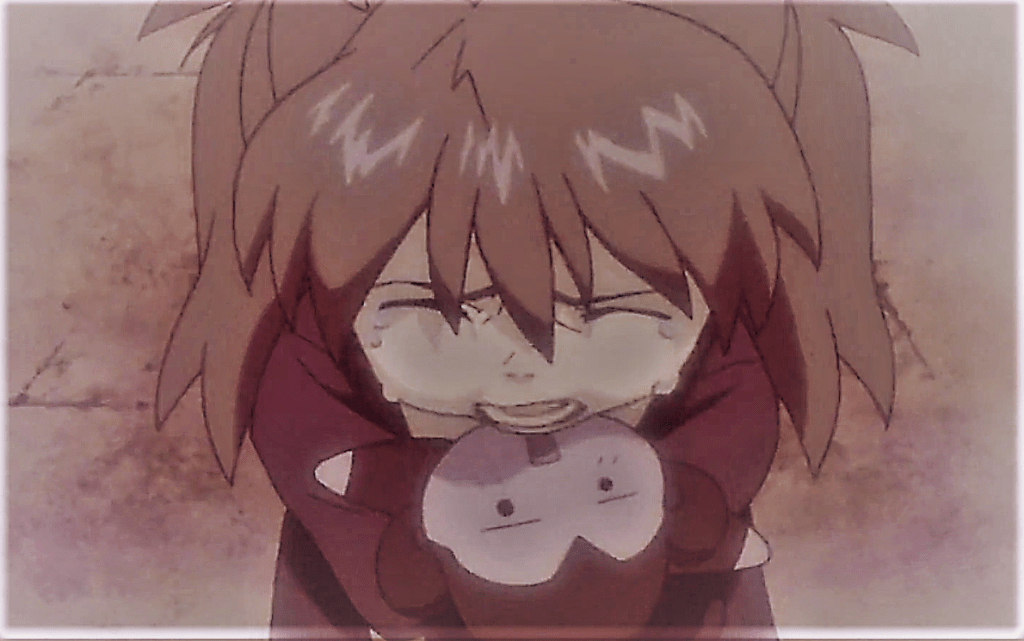
Eventually, after Asuka refused to be her mother’s doll, the mentally ill woman hanged herself and died. Asuka was the one who found her body. The trauma from these events shaped the child’s toxic personality as she grew into a teenager. As evidenced by Asuka’s case, trauma is extremely relevant to the story and characters of NGE.
Neurodivergence: Depression, Anxiety, & More
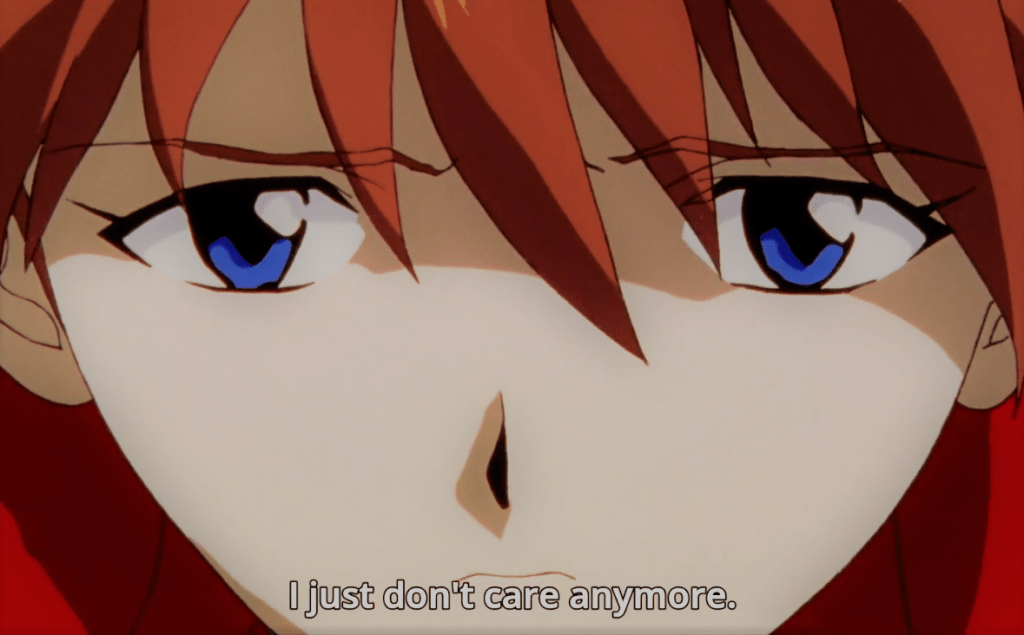
Neurodivergence is a key theme in NGE, as the creator has shared that the story reflects his own depression and anxiety. Several of the characters are probably neurodivergent, including Shinji. The young boy experiences intense social anxiety and a continuous, baseline level of depression. His depression is largely made up of self-loathing. For another example, Asuka sank into a severe and crippling clinincal depression late in the anime. Hers was characterized by a sense of emptiness, apathy, and exhaustion in addition to feelings of worthlessness.
There’s also more than depression and anxiety to be found in NGE. Due to multiple characters having abandonment issues, some insightful fans have pointed out that NGE is portraying Borderline Personality Disorder (or at least some elements of it). My BPD has gotten much better as I’ve aged, but it used to be an intensely destructive disorder in my life as a young adult. I can confirm that much of the psychological exploration of Shinji, Asuka, and Misato reflects my own feelings.
Dissociation can also be a sign of neurodivergence, and various dissociative symptoms are sometimes seen in the characters from NGE. For example, as early as episode 3, we see Shinji completely dissociating during his simulation training. He is like a robot, just aiming and pulling the trigger over and over without any of it feeling real. There are also other cases throughout the anime. Finally, I think that when Shinji temporarily loses his body in episode 20, it may be a metaphor for dissociation, among other things.
Loneliness and Despair
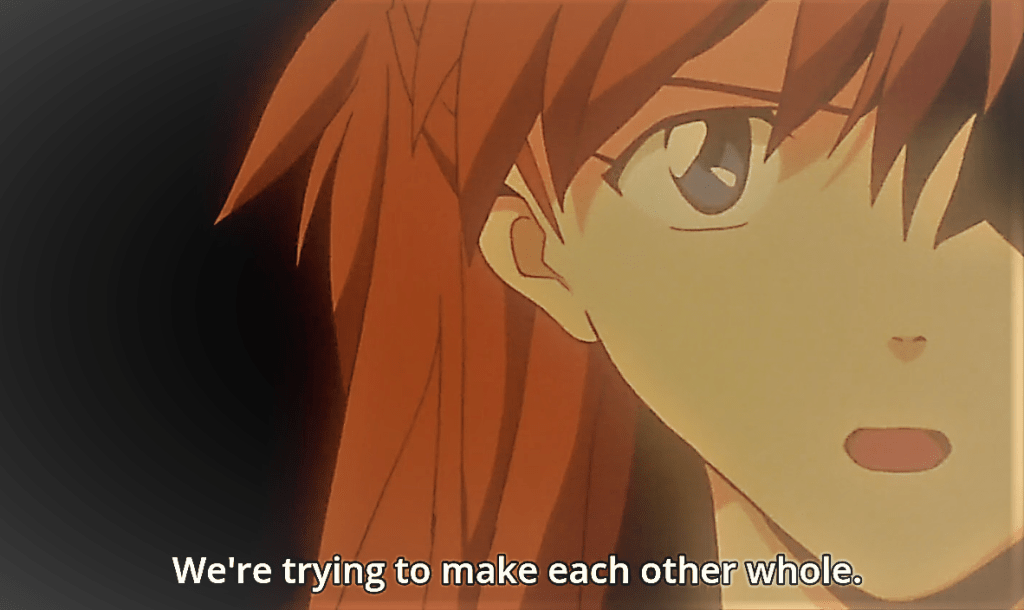
Although chronic loneliness can be a part of depression, I believe that loneliness in general is part of the human experience. NGE explores the theme of loneliness quite a lot with its characters. On a certain level, everyone is ultimately alone, and complete oneness with others is impossible. This is just how life is, but it makes many of us feel sad. Existential loneliness aside, literal loneliness is pretty unpleasant, too. Spending too much time alone is depressing. We do not want to be alone because, as humans, we are social animals. We need emotional and physical contact.
Too much loneliness, trauma, or stress can lead people to despair. Søren Kierkegaard wrote a book called “The Sickness Unto Death,” which asserted that despair is worse than any illness and even worse than death. Interesting, episode 16 of NGE is called “The Sickness Unto Death, and Then…” I think the reference serves to point out the despair Shinji often feels at himself and the world at large. As he says, “There are too many painful and unpleasant things in the world for me to exist.” Again, this ties in closely with chronic depression, but I thought it deserved its own section.
Identity and Coming of Age
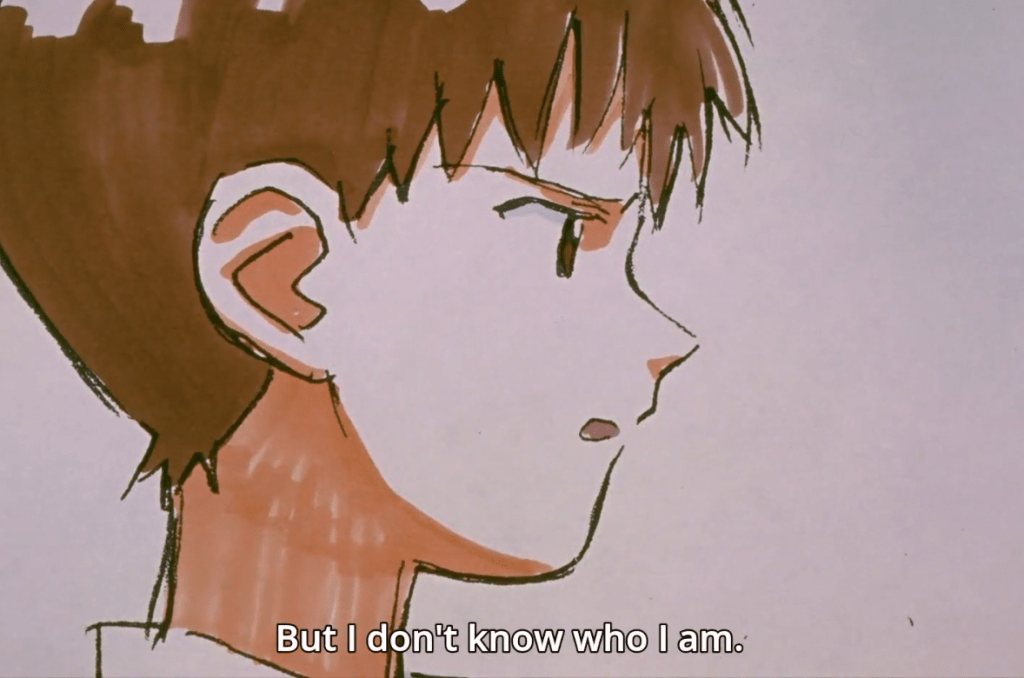
Coming of age is a prominent theme in many anime series, and NGE is no exception. The younger characters – especially Shinji – are starting to experience adolescence in all its complexity. Shinji has to figure out if it’s alright for him to exist and how to conduct himself in said existence. Like everyone going through this time in their life, the young characters need validation from each other and from the surrounding adults. Figuring out who you are is never easy, and for some people, the struggle lasts long after puberty. However, as a general rule, this process begins in adolescence.
The theme of identity is intertwined with the idea of “coming of age,” though they can also be separate, as mentioned before. Everyone is a mixture of different elements that together form a general identity. Part of good mental health and confidence is feeling like you have a stable identity. However, getting a handle on your identity can be difficult, especially when trauma, stress, or hormonal fluctuations act up and cloud your mind.
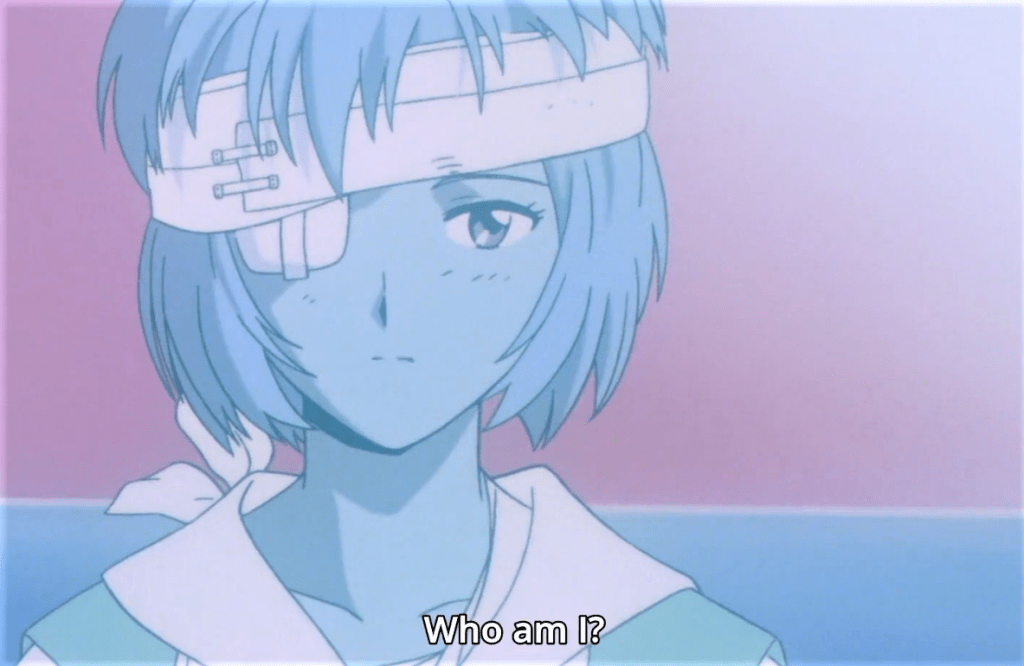
Several characters in NGE struggle with their identities, but the best example is Rei. In all her iterations, she seems to not have any real sense of self early on. That has a lot to do with the fact that she is a human clone raised in a lab. However, the more she interacts with others, the more Rei develops emotions and identity.
Change
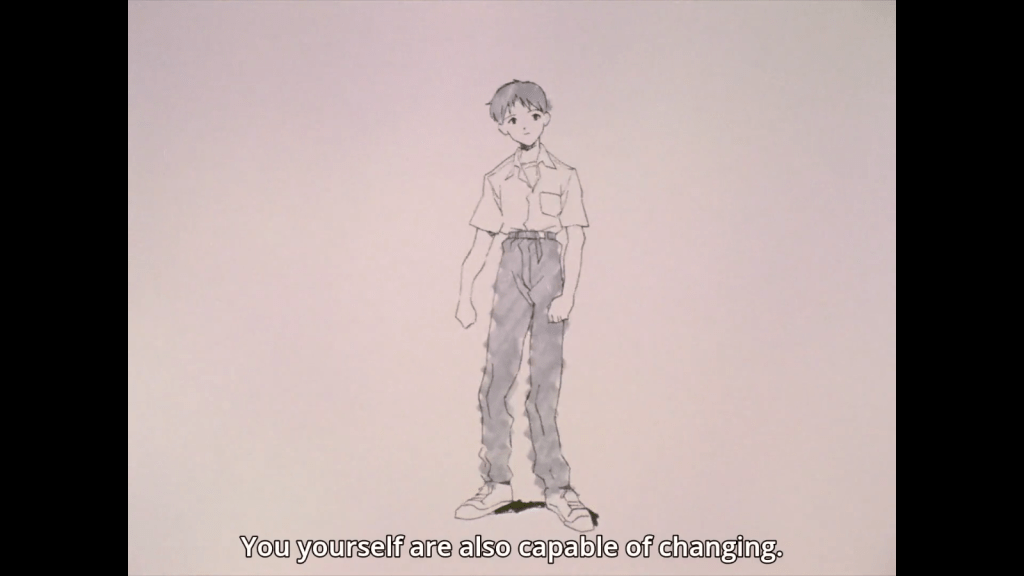
Change is another topic that is relevant to any discussion of NGE. Nothing stays the same forever. Society, our minds, and our values change with time. Even the kinds of life in the world change over long eons as evolution plays out. When you are going through adolescence, you change a lot, and very quickly. That’s one reason why change is such a big deal for the young characters in NGE. Beyond adolescence, though, change continues. It’s inevitable and a natural part of life. Even if it’s scary, we must accept it.
Responsibility and Duty
Although perhaps less important than some others on this list, responsibility and duty are still themes found within NGE. It’s Shinji’s duty to pilot the Eva, since he is the only one in the world who can sync with Unit 01. Many of the adults in NGE also have crucial duties, including Ritsuko the scientist. Misato becomes the guardian of Shinji, which is a huge life decision and responsibility. Gendo shirked his responsibilities as Shinji’s father. The characters each struggle to maintain balance under immense pressure.

Individuality and Hope
As important as duty and responsibility are, the themes of individuality and freedom are even more salient in NGE. Human civilization ended along with the lives of most humans as the Instrumentality Project was put into motion. However, Shinji decided to keep existing as a human, and as an individual, rather than a collective identity forever linked to other psyches. That’s why everyone congratulated him at the end of the series. It was Shinji’s graduation into a true individual.

In the movie End of Evangelion, Shinji wakes up out of the Instrumentality, and it seems the only survivor with him is Asuka. The world is ending, and Shinji is full of rage and sadness. He’s stuck with the one person he gets along with least. But ultimately, he made his decision. The value of individuality – the freedom to be oneself – is even more important than satisfying the eternal existential loneliness that humans feel.
Neon Genesis Evangelion and End of Evangelion certainly don’t have happy endings, what with most of the characters being dead and the suggestion that humanity will go extinct. There’s also no telling if Shinji and Asuka will literally kill each other from hatred. But as long as they are alive as humans, there is still hope for some happiness. I think that’s why the ending of the anime series is equally as important as the grimmer ending of the movie. It shows that, at least for a moment, Shinji had hope and decided to accept himself.

Thank you for reading~
 Anime Rants
I am always going to remember a moment from the last episode of the original anime. It shows Shinji floating in a white expanse with nothing around him, unable to do anything. Then they draw a line, the ground. Now he is bound by gravity, but he can also move about freely. That’s always stuck with me as a demonstration of how sometimes we think it would be better to be without any sort of limits, rules, borders, or bounds, but these are actually the things which empower us in ways we take for granted. There may be such a thing as too much, but there is also such a thing as too little.
LikeLiked by 2 people
Are you perhaps familiar with the NGE fanfiction “Nobody Dies”, 7mononoke? Admittedly, it’s more created for entertainment purposes than for psychoanalyses, but the interplay between people of that much healthier minds due to lack of trauma and less messed up relationships still is nice to see for our beloved punchbags (and at least the first few dozen chapters work out nicely). Very maybe you might find it enjoyable as well (apart from some parts). (Another one would be, and I kid you not, “Shinji and Warhammer 40K”, where Shinji gains some much more different personality traits after finding the eponymous board game somewhere, though arguably by exchanging one set of mental traumas and conditions with another one. Don’t think you would enjoy this one as much, but just to mention another variant where the people’s interactions are changed up a bit.)
Always held NGE in high esteem, though after hearing a good friend say “Hm, NGE is the only case where the main guy is enamored with his mother who is also his sister”, it did gain one more layer of amusement.
Nice overview of most if not almost all of the themes!
LikeLiked by 1 person
Such a beautiful analysis
LikeLiked by 1 person