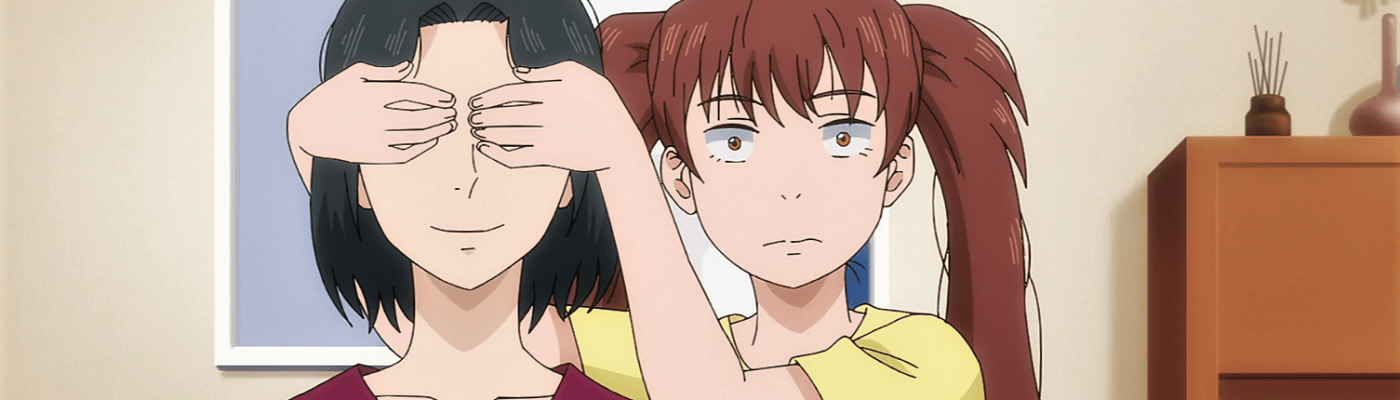
Hey there, and welcome to Anime Rants! With the next two episodes of The Gene of AI, the discussions and dilemmas are even more interesting than before. I am absolutely loving this anime, and although I do find it visually underwhelming, that’s not something that bothers me when there is thought-provoking content to consider.
Before we jump right into episode reviews, I must add a small content warning. The Gene of AI deals with adult topics, especially in episode 4. There is nothing explicit or sexually graphic in this article. However, sexuality is an important topic. Pornography, sexual fantasies, and similar elements will be mentioned. If you are averse to reading about this topic for whatever reason, you should probably skip my review of the fourth episode.
With that out of the way, let’s begin the recaps and responses for episodes 3 and 4!
Episode 3: Where The Heart Lies

Let’s start with a brief episode recap. There two subplots: one about a boy and his AI teddy bear, and the other about a Humanoid girl with a “pet” Robot. In this anime, Robots and Humanoids are both androids. However, Humanoids are acknowledged as equal to humans in consciousness, emotional capacity, and intelligence. Robots, on the other hand, are mass-produced products that supposedly don’t develop real emotions.
A certain Humanoid woman has been keeping a Robot named Joe for seven years, essentially using him as a slave (including for sex). The woman is troubled when she falls in love with a human man, thus emotionally betraying Joe. Having no heart, however, Joe doesn’t mind.
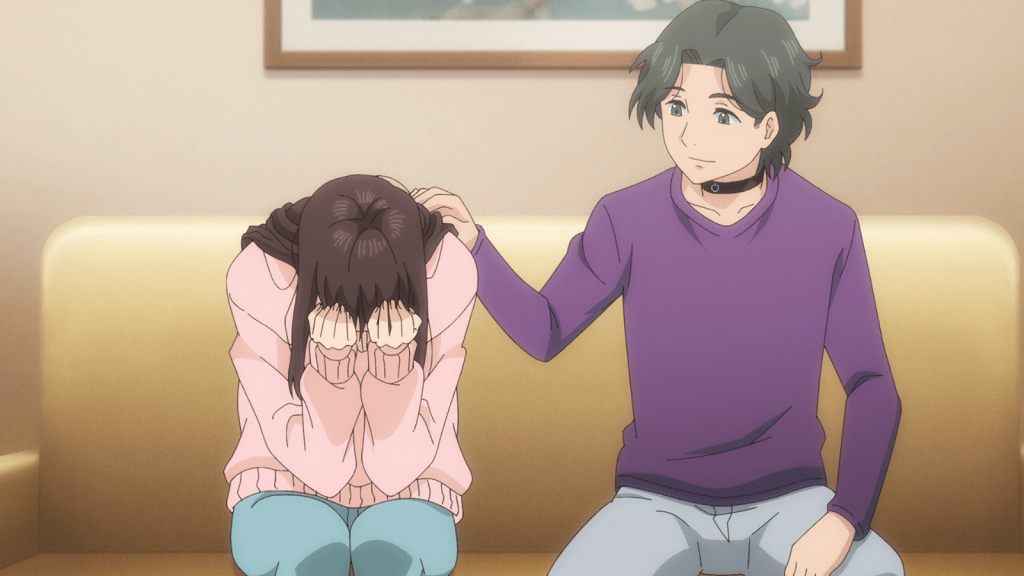
The Humanoid woman eventually returns Joe to the rental company and his memories get reset. But after being away from Joe for a few days, the woman realizes she was in love with her Robot slave. Thus, she rents the same Robot again, and returns to her normal life with Joe. The only thing is that Joe no longer remembers their seven long years together.
Joe genuinely seems to have no “heart,” but not every case is that straightforward. The rest of the episode was about a young boy named Kenji who is extremely attached to his AI bear, Poppo. The bear goes through several breakages and has to be fixed by Dr. Sudo multiple times. At one point, Poppo begins recovering memories of his previous owner. When Sudo suggests erasing those memories, Kenji refuses. He believes Poppo has a heart and genuine emotions. It would be unethical to tamper with his memories.
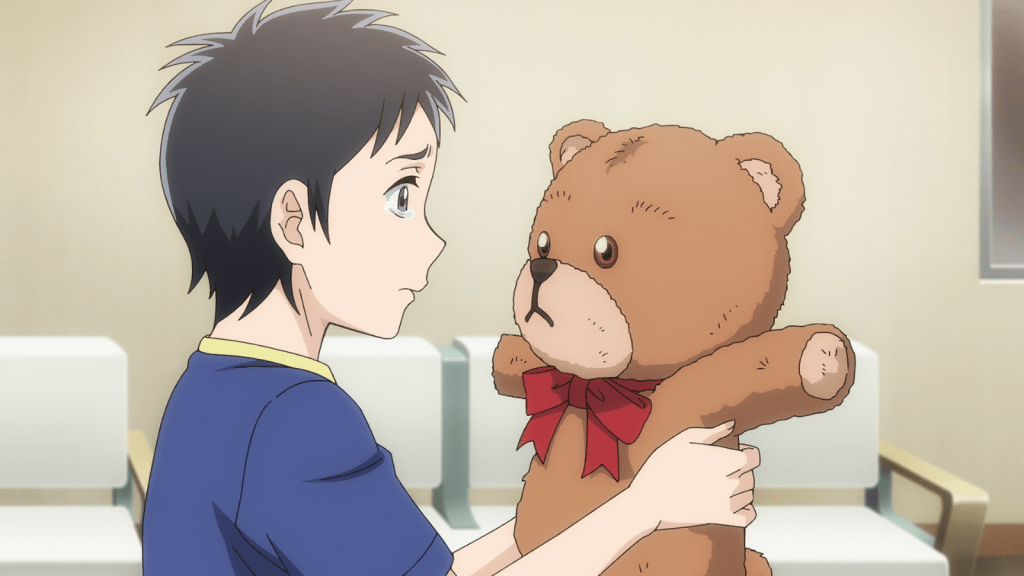
Eventually, Kenji takes Poppo to the shrine of his previous owner, who died young. Now, Poppo finally understands why his last owner disappeared. Kenji and his mother take Poppo to see the ocean, and it seems like the little bear is deeply moved by the beautiful sight. Kenji’s mother, who disliked the bear before, no longer feels sure that Poppo has no heart. As for Sudo, his stance is just “I don’t know.” Whether or not Robots have hearts, he will do his best to fix them. That’s where the episode ends.
My first thought was that this episode would feel too juvenile with the teddy bear subplot. However, I ended up enjoying the story. Poppo was very cute and I’m glad he got closure about his previous owner. Personally, I think Poppo developed a heart, but it doesn’t happen to every Robot. The bear is probably a rare case.

As for the Joe subplot, it was definitely interesting. But I really didn’t like the idea of Robots being slaves while there is even a question that they might have hearts. It definitely feels wrong to me. That being said, I also have a hard time blaming the Humanoid woman for using Joe. If the system already exists, why not use it to get yourself the perfect, pre-programmed boyfriend? It’s not right, but it’s an understandable desire.
I would love to know what difference there is between a Humanoid’s mechanical brain and a Robot’s. I think it has something to do with the Humanoids having power to choose and the Robots answering to their programming. That answer only raises more questions, though. We don’t even know if humans have free will, so how would society determine if a Humanoid has it? As usual, this anime raises many interesting discussions.
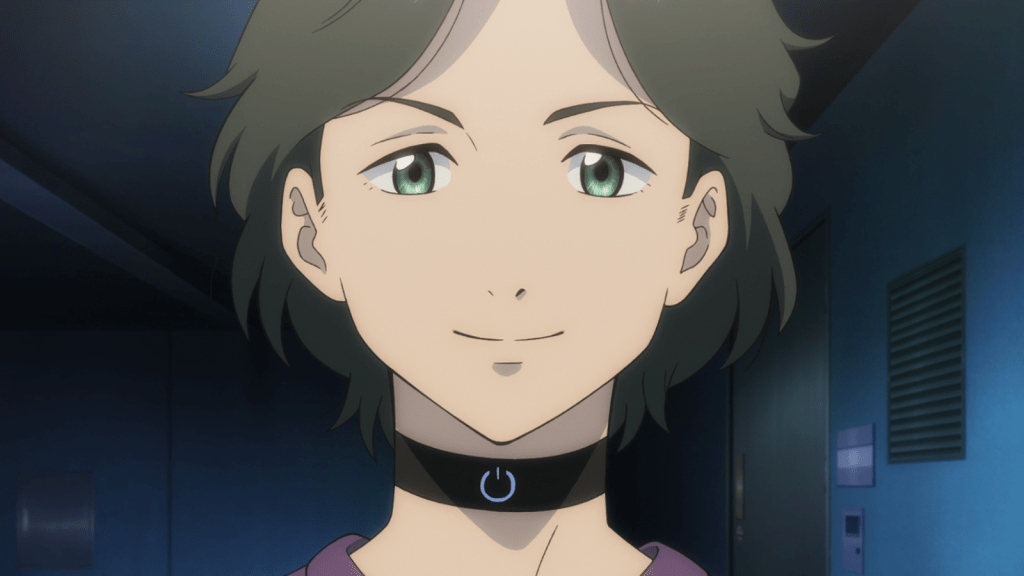
I’m enjoying this anime, but it’s far from perfect. My main issue with this episode was the way it started. The first scene shows the Humanoid woman burrying Joe after murderering him. This ends up being just a nightmare, and is never talked about again. That’s a cheap move to hook audiences on a false premise. It’s not honest storytelling.
Episode 4: Four Cases
For me, this was overall the best episode so far because a) the AI dilemmas were extremely interesting to me, and b) the humor was really good. This episode covered four different cases involving interesting applications of AI. Technically, the first and the fourth are related and could have been one chapter. But I’ll go over all four in order. Rather than give my thoughts at the very end, I’ll include my responses with each of the four cases.

The first case was about the Fantasy Generator, which is an AI that creates realistic CGI videos of drama or romance situations. The characters are all customizable, so if you teach the AI how you look and how your crush looks, it will generate them as the two lovers in a drama. Risa’s friend suggests running some simulations with Risa and Sudo as characters. Risa likes Sudo, so it should make her happy to see fantasy scenarios involving him.
All of the situations generated were completely cringe, but also completely hilarious. In the first scenario, Risa is a schoolgirl running along the road because she’s late for school. She runs right into a handsome man. The satire of shojo tropes was amusing. In another scenario, Sudo and one of his male patients got into a sensual gay scene (which was sadly cut short.) Naturally, the gay porn set-up was also super cringe and had me laughing. In the end, Risa decides she doesn’t like the Fantasy Generator.

I think the first case was cool for the humor, mostly. It’s important to note that the anime isn’t making a joke out of gayness, but it’s making fun of the straight girls who only watch to fetishize the men being together. (And making fun of the poorly written anime and hentai that also feature gay sex.) Putting humor aside for a moment, there are some serious implications to something like Fantasy Generator. For example, depending on how realistic the CGI people look, videos generated by this program could be mistaken as real footage. We are already having this problem in reality with “deep fakes.”
Another thing about the Fantasy Generator is its parameters. You can probably create all sorts of messed up scenarios and then essentially have a custom movie with only the fantasies you want to see. You could generate a depiction of sex with any desired kink or preference. Maybe a sick pervert wants to generate a video of rape. Beyond sexual scenarios, you could also potentially generate movies that show extreme violence or crime. For instance, an insane enough person could set up a scenario where he gets to see himself as a school shooter, realistically killing people.

The Fantasy Generator would therefore need rules and paramaters for what it can show. (I’m fairly certain the program is only for drama and romantic scenes. It seems to have rules in place already, and you need an expensive license for it.) If the Fantasy Generator had absolutely no parameters, then we would have to discuss the ethics of using AI to engage in extremely violent, wrong, or illegal fantasies. Again, this problem already exists in other forms, with violent media or unethical porn being widely available.
The second case was a bit awkward because it was focused on the dating and love life of a highschooler. But I would be lying if I said I don’t remember being an embarassing, horny teenager myself. Nozaki is a normal boy with an immense crush on his classmate, Sasaki, and has trouble not staring at her chest area. One day, he intalls a game/app that generates a holographic girl only the user can see. The AI girl, named Nana, is customizable. So, of course, Nozaki makes her look just like Sasaki.

Long story short: Nozaki got too used to going on dates with his VR girlfriend Nana. So when he finally started dating the real Sasaki, he accidentally called her Nana, and she dumped him. The implications are pretty obvious. As Sudo said to Nozaki, VR porn and such doesn’t hurt anyone, but it can still influence your life if you’re not careful. There are also issues with privacy rights, since pictures, videos, and other information about a person is fed into the Nana app to customize her. It’s a whole new level of sexualization if someone can create holograms of what you probably look like naked.
On a somewhat random note, I like how this anime is handling sexuality. Despite the fact that sexuality is so far a prominent theme, it’s hasn’t been handled in the typical anime way. It isn’t an “ecchi” anime at all, and doesn’t use gross camera angles, nor nudity of underage characters. The body proportions of the women are also fairly realistic for anime. Considering that this case was about a horny teenager, I’m impressed that the anime didn’t do much to sexualize the teenagers. The worst we see is Nozaki staring at some chests.

The third case was about two Humanoids in a long-term romantic relationship: a male named Hide and a female named Kayo. Hide has a serious problem with cheating, and it’s threatening his relationship. But Kayo says they can stay together if Hide can find a way to change. Thus, Hide asks Sudo to install a certain “switch” on his body. (Also note, I liked that Hide’s excuses about not being able to control himself were painted as melodramatic, stupid, and worthy of a laugh. I’d rather have that than the show framing him as a victim.)
The “Clarity Switch” is an application that only works on Humanoids, since humans do not have cyberized brains. The exact mechanism is not explained, but when pressed, it floods the Humanoid’s brain with clarity of mind and good sense. With this tool, it’s easy for a Humanoid to simply “switch off” their sexual impulses. Hide uses the Clarity Switch whenever he feels like he might cheat, and thus regains control of his life. He stops flirting with female friends at the bar. He doesn’t bother Kayo for sex every single night. He can even resist being “turned on” by porn if it’s a bad time.

Case 3 had a surprising ending, because despite Hide’s joy at fixing his life, Kayo eventually broke up with him. Ironically, the cause was that Kayo had fallen in love with another man. Instead of using somethnig like a Clarity Switch to force the relationship to keep working, Kayo chose to pursue the new love interest. I actually liked Hide despite his history of trangressions. So, this ending was a bit sad. But I think Kayo’s choice to follow her heart was just as valid as Hide’s choice to use the Clarity Switch.
Hide will be alright, though, because Sudo offers to remove the switch and “maybe add something that will cheer you up this time.” This implies that the Clarity Switch is not the only kind of mental modification available to Humanoids. There are probably all sorts of mods to control emotional responses and behaviors.

It’s interesting to think that, if we ever cyberized the human brain, we could also achieve things like this in reality. Even without making the brain mechanical, it might be possible to control one’s mood with other technology, such as case-by-case cocktails of medications or hormones. That’s what psychiatric medications already do on a much more primitive, clumsy level. And while psych meds are positive and helpful, that may not be the case for every potential application. “Mental modifications” could also be done on citizens without consent, like futuristic lobotomies. It’s fascinating and scary stuff to think about.
Case 4 was quite short, and it boils down to one thing: Risa’s female friend is secretly in love with her. Risa is leaving at night after a visit, and her friend comes to the door with her. It’s the same friend who was using Fantasy Generator. She tells Risa that she has a simulation with the two of them in it, but when Risa acts surprised and uncomfortable, the friend says she was just kidding. Risa then leaves the apartment.

The friend says quietly, “Good luck, Risa. It would be nice if at least one of us got what we wanted.” She was wishing Risa good luck on her pursuit of Sudo. The friend doesn’t want to get in the way because she can see how much Risa likes Sudo. But nevertheless, she can’t help liking Risa. At least, that’s how I interpreted this scene. It’s likely that the friend was not “just kidding” about having a simulation of Risa. That means she put Risa’s CGI model into a fantasy scenario without asking permission.
The implications and discussions for case 4 are pretty much the same as those for the first case. Is it alright for someone to use AI to engage in romantic/sexual fantasy when the person whose likeness is being used might not have consented? I would say it largely depends on the specifics of the situation. People should not try to control “thought crime.” However, by creating an AI generated movie of your fantasy with your friend’s likeness, you are no longer just using your imagination. You are creating a real product that could be abused. That might be more than just “thought crime.”

I do apologize for the absurd length of my episode 4 review, but I hope it was at least a bit interesting. That’s where I’ll wrap things up for today. The Gene of AI continues to entertain me with intriguing thought experiments!
Thanks for reading~
 Anime Rants
What if a person could create a fantasy of doing something evil that would satisfy well enough that they wouldn’t actually do the evil? That’s called “safety valve” theory.
About creating VR fantasies with realistic images… People do this anyhow, even without VR and AI, in their imaginations. How is it different? If a boy looks at an attractive pair of breasts, he’s probably creating a full color 3-D simulation in his head of what he wants to do. Maybe doing it by VR/AI it decreases the likelihood he’ll overstep bounds in real life.
LikeLiked by 2 people
Just watched episode 1 . Kind of sad, right?
LikeLiked by 1 person
I hope that my attempt at writing shorter does not make come over wrong, but let’s see whether there’ll be a need for a post scriptum:
– “real footage vs. fake”: That has been an issue since forgery was a business and exponentially so since the introduction of computers and the internet, it is nothing that new. This works in both unpleasant ways however, since it makes faking easy but also copying the fingerprints of people in photos (as has been done with some politicians). The bigger issue begins to arise at something else: at what point does it consitute the illegal reproduction of presentation in copying a human? There was a film about that actually, “The Congress“, (based on the amazing Lem’s novel “Kongres futurologiczny”/”The Futurological Congress”,) where an aging actress who is nearing the end of her career sells the rights to her digital self (her literal image, as in: outward appeareance as a person) for a lot of money but to neer appear again in cinema. Implications about this alone are frightening, but the fact that we are already able to replicate this is the concerning part in our media industry where “the entertainment industry [is welded] to the back of the financial one” (Jakub Flasz).
– “Someone creates something visually, that is commonly viewed as not good” (abbrev.) Well, to paint the two extremes out first (latching onto your own mentions thereof): So shooter games and crime films and series are bad since they depict or allow to enact inhuman deeds then, right? And, in return, someone of clear and clean mind would only write and produce sweet clouds of text and visuals, and never harm or pain?
These are obvious extremes that I know you don’t agree with but maybe it can help define the point I’m getting at: Neither bad media nor bad fantasies do necessitate a bad person, as long as that person is aware of the distinction between reality and fiction and does not intend to carry those even partially out in reality. (Remember what strong repression of personal-societal freedom and obedience to outer conformities make of e.g. Japan with both its 本音 and 建前 behaviour as well as the source for hells-know-how-many specific (and, let’s be honest, deranged) depictions of fantasies as an “inner answer” to the “outer cool”, or the British with their subcultures of old.) A bad person will be bad even if given such material or not (for the largest part); a not-so-bad person will not suddenly turn into a bad person (for the largest part) if given or not given the same. Same goes for religion, a bad person will be a bad person with or without religion (though sometimes religions enforce the bad behaviour, but that is a different topic entirely). I’d personally rather people live out their fantasies in demarcated, virtual spaces, alone (or in games at the most) than in reality. (As Fred said!) The following’s mostly an issue in the USA (of course), but not/less unhinged people play almost the same video games as their school shooter counterparts (and even in other places, both unhinged and less unhinged people (though usually with much less access to weapons and not a system built for violence, but those systemic issues are, again, different topics)). Also, do you remember the video games the US army used to train their adolescents to later shoot underage kids in actual warfare?
The problems you speak of are unfortunately not in a subjunctive state, and the ones in control are not the good kind… So I’d really rather it be personal and fictitious spaces for the individuals in question rather than controlled and weaponised. Whether it’d work? It is happening anyway, so I hope the ways of control are not accessible to anyone in the first place, otherwise it’d be creepy in the ways “smart” devices are today, just worse.
Once more, not fully agree with the conclusion but do agree with your base line, and will think over in comparison with your conclusion.
– “maybe add something that will cheer you up this time” This is peak horror. There was a character in one of the TTRPG groups I’m in who learned to magically give absolute ecstasy to a person he touched. So he used it on himself. The result was a deadly and unbreakable addiction. Way to control people “Brave New World” style.
(So much for trying to write short…I’m sorry, feel free to not let it be posted. I think a show is good though if it enables these ideas and discussions.)
LikeLike