As the clever and quirky protagonist of The Apothecary Diaries, Maomao is a great example of a well-written female character in anime. She has rapidly risen in the ranks of my favorite female anime characters, and I don’t think I’m alone in this. A lot of fans appreciate Maomao for her unusual and colorful personality.
I thought I had Maomao completely figured out, but in episodes 19 to 21, she surprised me again. Maomao can be amazingly altruistic. She’s always helping those around her. To be honest, I think of Maomao primarily as a character who is often emotionally detached and not always considerate of the feelings of others. But when you look at her actions, it becomes clear that Maomao wants to help people.
With that in mind, I hope you enjoy my next set of episode reviews for The Apothecary Diaries.

Episode 19: Chance or Something More
The early parts of the episode show Maomao piecing together a series of events that may be a distinct plot despite seeming coincidental on the surface. Some information from Lihaku makes Maomao suspect the culprit might be Suirei the Court Lady. But since she has no direct proof, she doesn’t suggest this idea out loud. Though Maomao wasn’t super motivated to keep working on this stuff, she becomes inspired after Jinshi promises to reward her with a rare apothecary ingredient (an ox bezoar).

What I love about this episode is the switch from a normal atmosphere to an intensely serious one. This episode went from zero to a hundred in seconds. After a scribe tells her about the dangerous setup at the Altar of the Sapphire Sky, Maomao realizes the next step in the plot. Someone is trying to use the Altar to assassinate the noble who will be partaking in a ceremony there. Without knowing or caring who that noble might be, Maomao bursts into a run toward the Altar of the Sapphire Sky. She must stop the plot from coming to fruition.
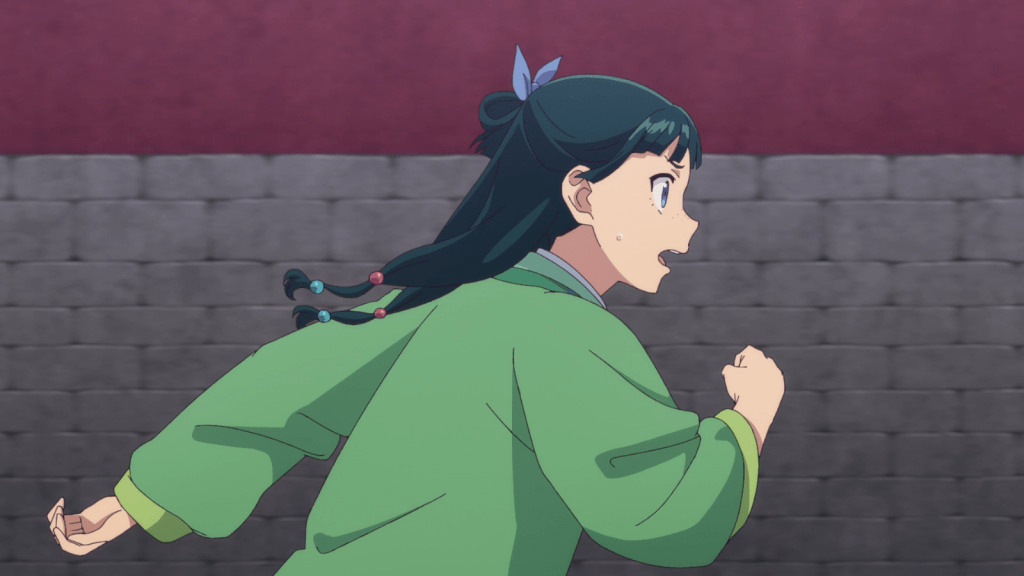
Once Maomao reaches the ceremonial building, she has an intense standoff with one of the guards. He refuses to move, becoming angrier as the girl in front of him continues to insist. Finally, he loses his temper and deals a devastating blow to Maomao’s head with his club. Not even this is enough to make her stop, though. She rises again. But despite all her efforts, Maomao wouldn’t have made it inside if not for Lakan. He told the guard that he would take responsibility for any trouble Maomao caused.

This scene succeeding in bringing together the recurring themes of classism and not having choices as a servant. Maomao can’t stop the ceremony on her own because of her low rank in society. It took a high-ranking military strategist to actually let her past the guard. It’s mostly classism, but there are also bits of underlying sexism. In the Ming Era of China, a woman wouldn’t have been allowed to speak to a man so boldly. The guard wasn’t used to being yelled at by a tiny girl, and he responded by harming her because it was basically acceptable for him to do so.

This series deals with a lot of relatively dark social topics. I appreciate the way it allows for so much discussion. It also does character development quite well, at least for Maomao. But there’s one thing I don’t understand. Why is Maomao going to such lengths to save some high-ranking noble who would probably have her beheaded for interrupting the ceremony? I suppose the answer is that Maomao is actually very humanistic and kind, wanting to save lives whenever possible. Personally, I can’t be like that toward the rich. I think we should eat them.

Whatever her justification might be for risking her life, Maomao succeeded in saving the person of noble birth. She pushed him out of the way to avoid being crushed by the falling pillar. Much to Maomao’s surprise, the noble she just saved was Jinshi. In a state of confusion and pain, Maomao passes out. Jinshi is clearly extremely concerned about her. He takes her into his arms and carries her away from the altar. As he proceeds down the path outside, everyone bows respectfully.

Lakan has a shocked expression on his face as Jinshi walks by him carrying Maomao. This suggests that not even Lakan knew the truth until now. Jinshi is someone of highest noble birth – most likely, the son of the previous emperor. He’s not some eunuch who only manages the rear palace. He’s basically a prince. Alternatively, Lakan might have been shocked because it’s now obvious that Jinshi cares for a servant. That’s an unusual development for sure. The episode ends here.

Episode 20: Thornapple
Episode 20 revealed that most – if not all – of the death plots thus far were caused by Suirei the Court Lady. Soon, there is confirmation that she was involved. She killed herself with poison to avoid being caught and beheaded – or so it seemed at first. Suirei’s grandest scheme was actually the faking of her death. The poison worked sort of like anesthesia, making her appear dead for several hours. She later woke up in the unsealed coffin and escaped.

There is a great little scene where Maomao reacts to the idea of meeting Suirei again and catching her. She’s delighted in the most villain-like way imaginable. She even lets out an exaggerated villain laugh after declaring that she would make Suirei help her discover “resurrection medicine.” In moments like this, you can tell Maomao is Lakan’s daughter. She loves finding and talking to intelligent and clever people like herself. Suirei would be the most fascinating of all, since she pulled off such a genius plot.

Before I cover the rest of the episode, let me take a moment and write about the plant “Thornapple” as well as pufferfish, which were ingredients in the mysterious anesthetic drug. As for Thornapple, we call it “Jimson Weed” in the eastern USA. The flower looks similar to a white morning glory, but the plant is otherwise quite distinct.
People have known for millennia that Jimson Weed is dangerous. A number of different toxins can be found throughout the plant. Some of them can cause “altered states,” or temporary psychosis, leading to the use of Jimson Weed as a shamanic plant used in religious rituals. This is the case for many different toxic plants throughout history. The poison might kill you, but at least you’ll have a wild “trip.” 😛

Jimson Weed was used in small, controlled doses in traditional apothecary medicine. I haven’t done the research required to assert that Jimson Weed actually has any medicinal benefits according to science, but according to ancient herbalism, Jimson Weed can have numbing properties and other benefits. Regardless of Jimson Weed specifically, we know that many different plants have useful compounds in them. It’s just difficult to separate them from the toxins.
Maomao also mentioned that she’s heard pufferfish was used in the mysterious drug. I did a tiny bit of googling, and it seems there are compounds found in pufferfish that cause numbness. It’s not absurd to think that, if isolated from the deadly toxins, this compound could be used as an anesthetic. There is also new research about a chemical in pufferfish that mimics an opioid painkiller, but that’s not really related to anything.

That’s enough about toxins and anesthetics for now. Let’s talk about Jinshi and Gaoshun. Neither of them are eunuchs. They take a nasty daily medicine to “disguise their manliness,” which I assume means block the obvious effects of testosterone. I’m not aware of any mixture of plants or other apothecary ingredients that work as hormone blockers, but this is anime, so I’ll let it fly.
Jinshi the 24-year-old eunuch is a mask or a persona. We don’t know Jinshi’s true name. He is actually only nineteen. I want to know why Jinshi and Gaoshun went to such lengths to keep up this disguise over the course of several years. Based on Jinshi’s monologue late in the episode, it seems like he wants to take his place as the son of the previous emperor. However, I don’t know how he plans to accomplish such a feat, since everyone believes that Ah-Duo’s baby died.

There was a little more content in this episode, mostly focused on Loulan and Gyokuyo the concubines. Despite being perceived as quirky and unusual, Loulan continues recieving visits from the emperor every ten days. As for Gyokuyo, she is most likely pregnant. It’s possible the emperor will have another heir soon. That concludes my notes on episode 20.
Episode 21: How to Buy Out A Contract
Compared to the last two, this episode focused more on supporting characters. For starters, we learned more about that old pharmacist who is always so nice to Maomao. His name is Guen, and his family are creators of paper. They were rich for a while, but business inevitably turned bad. Rather than let his little sister be put to work, Guen volunteered to go to the inner palace, becoming a eunuch in the process. Guen is an incredibly kind person who kept his warm heart through much adversity.

This episode also had a lot to do with Lihaku and his love for Pairin the Courtesan. Maomao agreed to give some advice and feedback to him, as he is planning on buying out Pairin’s contract from the Verdigris House. Although most of the focus is on Lihaku, we also learned more about Pairin. For example, she volunteered to nurse Maomao when she was an infant. Pairin may be most known for her intense libido, but she is also sweet and maternal. In fact, Maomao thinks of her almost as a mother. Very wholesome.

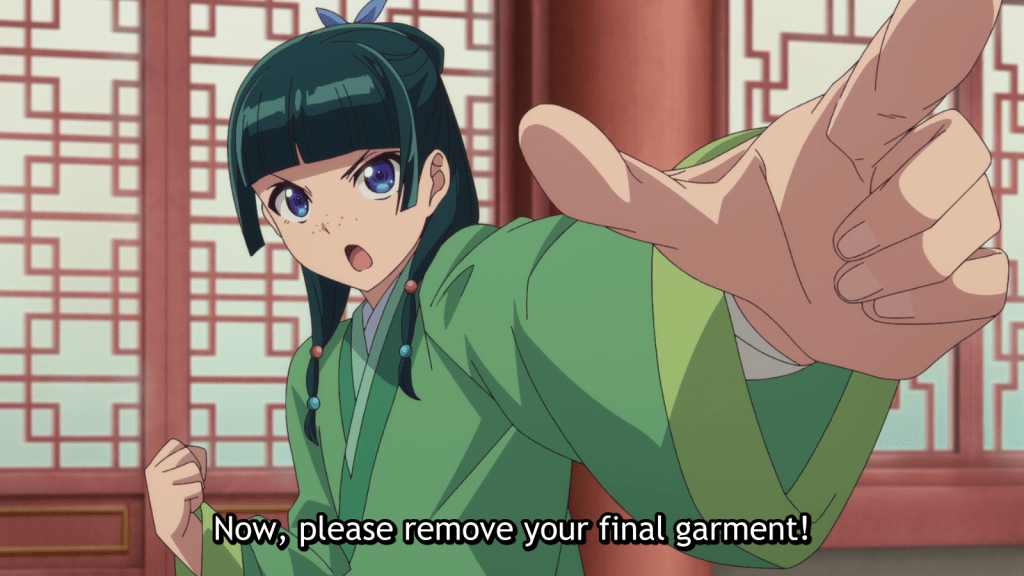
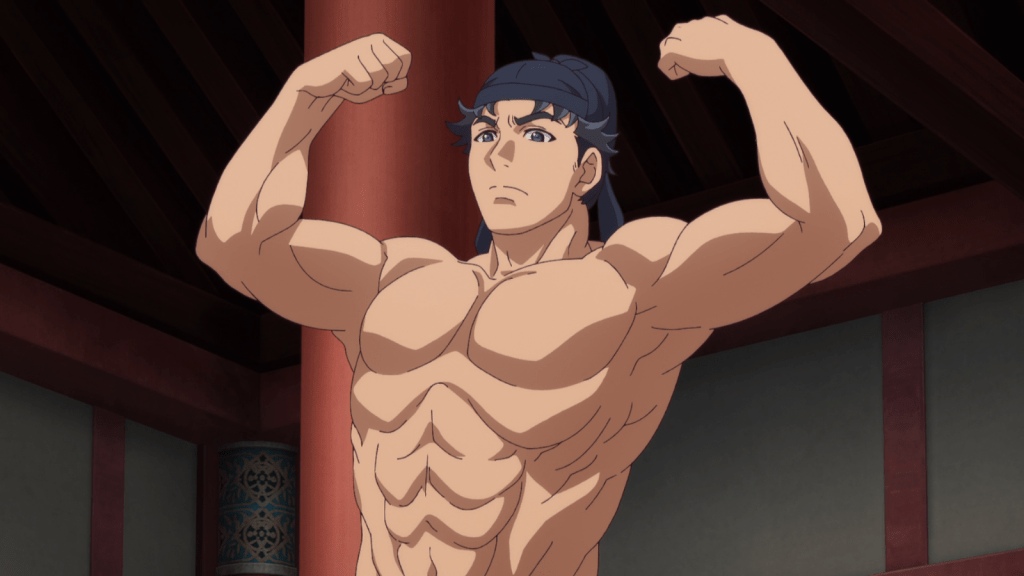
The humor in this episode was great. It was mostly concentrated in the scene where Lihaku undresses in front of Maomao. You see, Maomao wanted to get an idea of Lihaku’s body type and see if he was a good matchup for Pairin. But Jinshi, of course, misunderstood. He was shocked and outraged for several minutes before he finally understood that Maomao wasn’t interested in Lihaku for herself. I was constantly smiling during these scenes.
Also, damn, Lihaku is a frickin’ body builder! I thought he’d be a toned middle-weight, but apparently he’s a gorilla. I don’t personally find that much muscle alluring – it’s actually a little off-putting to me. Still, it’s easy to see that Lihaku is “hot” by society’s standards – both in ancient China and in modern days.
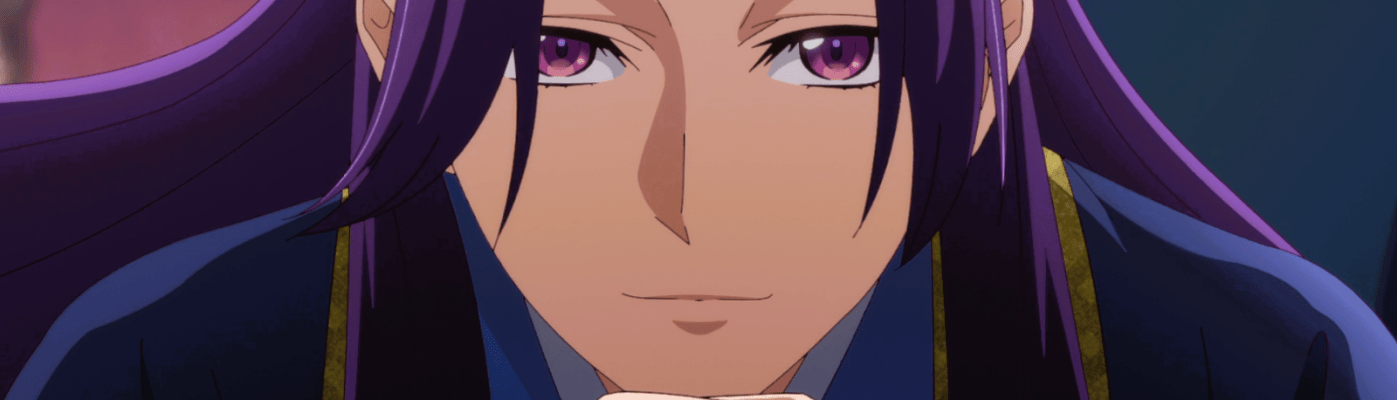
Lihaku’s love for Pairin is put to the test by Jinshi, who seems to be doing this on behalf of Maomao. He summons Lihaku to sit with him and offers to give him 20,000 silvers with which to buy out Pairin’s contract. Lihaku was severely tempted, but he chose not to take the offer. He wants to save up and use his own money. For something as important as securing a life partner, I agree that Lihaku needs to do it himself.

The last scene in episode 21 switches to an ominous atmosphere, showing Lakan sitting idly in a pagoda. He mumbles something about blue roses before smiling in his usual evil way. This anime really succeeds in making me hate Lakan. He’s probably up to another despicable scheme. Anyway, that is all for today.

~Thanks for reading~


I am wary of… no, that’s not quite right… I flat out oppose everything to do with “eating the rich.” Because 1) previous societies have done that, and it has never worked out very well, 2) open the door for eating the people who have more than you, and you open the door for people who have less than you to eat you, since, in their eyes, you are “the rich,” which justification has been used by many a vile criminal, and 3) everything which dehumanizes our fellow man will blind us and lead us all to devastation, 4) “the rich” do us much more good than one may realize, as does the hope of becoming rich someday, in accordance with our efforts, and 5) tearing the rich down will not build the poor up, not ever.
Now, as for the notion of holding everybody accountable for their crimes in accordance with the rule of law, no matter their wealth, connections, political affiliations, etc. …now THAT I fully support.
As for the show specifically, I have a theory. There are a couple wrinkles in it which need ironing out, but, still.
We learned – or had it confirmed – that the emperor is more decent than the previous emperor in at least how he does not intend to take liberties with extremely young girls. He is more restrained, and thus his behavior has produced not so many children among his many concubines. The only child of his which is confirmed to still be alive is the little princess, whom Maomao helped to save at the beginning of the story. All the rest have died due to one cause or another. This leaves a certain vacancy, a gap in the empire’s structure of power, which has yet to be filled. They actually mention that in the very first episode as well, where there is a power struggle going on revolving around bearing the emperor’s son. For whichever concubine next bears a son, there will be a significant advantage.
Unless, of course, there actually still *is* at least one son still alive.
If Jinshi is actually the son of the current emperor, not merely his brother, then he is, in effect, the crown prince, even if he doesn’t entirely know it himself. Which fills that vacancy of power, but only so long as he is alive. Take him out, and it’s an open competition again.
This gives a young, newly arrived concubine, or at least the powers behind her, great motivation for murdering Jinshi, as well as, perhaps, poisoning any of the other concubines who get pregnant, even if it is only such that they’ll lose the baby. I have a hunch that it’s going to be a lucky thing for Maomao to be where she is, not to mention fortunate for keeping Lakan away from her.
Now, here’s another clue that stood out: the new concubine apparently dresses up whenever the emperor visits, sometimes so much so that he has difficulty telling if it’s really her. Which is very much at odds with our initial impression of her, being stark and stoic and incredibly difficult to read. It makes little sense on the face of it, but it would, theoretically, permit the real concubine to be elsewhere with someone else taking her place. She could be up to all sorts of things, perhaps even posing as a court lady, causing all sorts of lethal mischief. Which would account for all of the resources at Suirei’s disposal without necessarily compromising the entirety of the palace staff. They did, after all, disguise her on her way out, so clearly it’s not unusual for them.
It would tie everything together very neatly. But, for the moment, it is only a theory. If their eyes weren’t different colors, I would think I’d just hit the nail on the head, but I’m still guessing that there is at least a connection between the two women.
LikeLiked by 1 person