Article Contents
- Introduction: The Moral Hero
- Okabe’s Transphobia and Sexual Assault
- Okabe’s Necessary(?) Violence
- Okabe’s Love For Mayuri
- Okabe’s Other Good Points
- Revisiting the Question: Is Okabe a Good Person?
Introduction: The Moral Hero
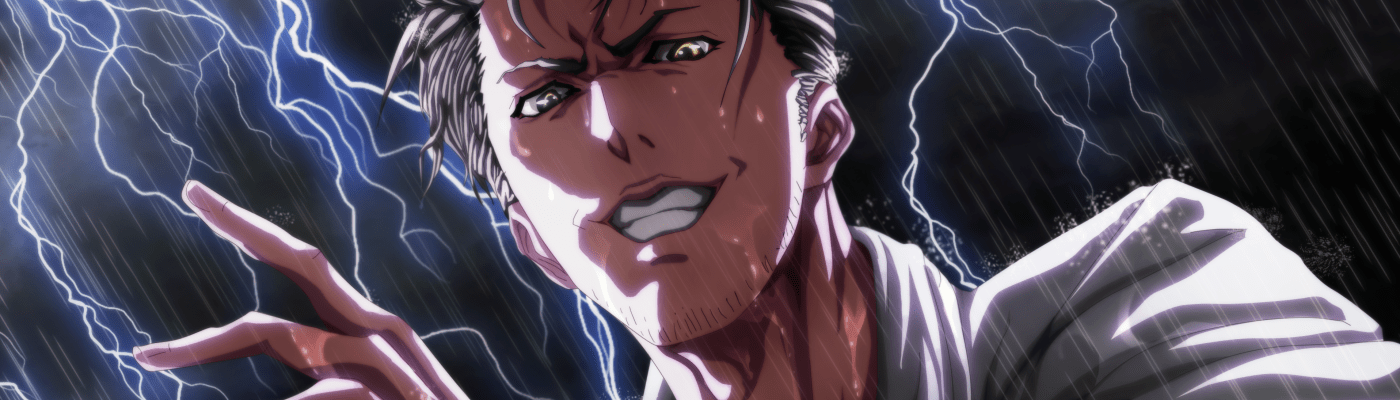
Steins;Gate is a classic anime series that will always have a special place in my heart. However, it’s not as if the series lacks problematic elements in its story, themes, and characters. There are a number of serious issues, including the pronounced transphobia toward Ruka Urushibara. That element will be important later as we begin discussing today’s topic: the character of Steins;Gate‘s hero, Rintarou Okabe.

Not all stories – and consequently not all anime series – need to have a morally upstanding protagonist. It can be interesting to see a hero with significant flaws and shortcomings. Some stories go even farther and have anti-hero protagonists. For example, think of Death Note and its maniacal main character, Light Yagami.
While it’s definitely not required for a story to have an ethical hero, many classic and beloved stories use this trope to appeal to audiences. For example, if Ashitaka from Princess Mononoke wasn’t such an amazingly virtuous person, would we still root for him as much?

The question is whether Steins;Gate tries use this appeal for Okabe. And if it tried to, did it actually succeed? Well, the general opinion of Okabe among fans is that he’s weird on the outside and a bit obnoxious at times. However, his heart is in the right place, and he’s quite an altruistic man at the end of the day – or so they say. In other words, Okabe is considered to be a moral protagonist for the most part.
Personally, I think there are a number of times Okabe did or said the wrong thing. There were also many cases in which he was selfish. For today’s discussion, we’ll take note of a few negative things and a few positive things that make up Okabe’s character. I always like to get the yucky stuff over with first, so we’ll begin by examining two examples of times where Okabe was at his worst.
Okabe’s Transphobia and Sexual Assault
Content Warning:
The following section discusses and describes fictional instances of sexual assault and transphobia. Skip this section if this is a trigger for you.
Throughout Steins;Gate, most of the main characters are to some degree transphobic toward Ruka, a transgender girl. They call Ruka a boy over and over despite her clearly feminine presentation. However, the worst offender is definitely Okabe, who constantly reminds himself in his head that Ruka is male in order to shut down his physical attraction to her. This is all largely treated as comical by the narrative.

It’s important to note that Okabe and his companions are not doing anything culturally wrong by misgendering their supposed friend. The mainstream culture of Japan is still highly transphobic. Some progressive types will acknowledge that trans women have a mental female gender, but they usually still hold to “biological essentialism,” wherein all that matters is one’s assigned sex at birth. Therefore, it’s normal to refer to someone by their birth sex in this country.
As an ally of binary trans people, and as a nonbinary person myself, I consider these views backwards, harmful, and factually incorrect. That’s why I still call out Okabe’s behavior as transphobic and immoral. Just because it’s normal in some cultures does not mean it’s right. Still, I did want to be clear about the context of this series.

In Steins;Gate Episode 10 (“Chaos Theory Homeostasis III”), there is a particularly painful scene involving Ruka. This episode takes place in an alternate timeline wherein Ruka was born “biologically female” – she is a cisgender girl. Because she looks essentially the same in both worlds, Okabe is not aware of the change. When he refers to Ruka as a boy, the other girls in the room are offended. Ruka even begins to cry a little.
Rather than accept correction, Okabe doubles down. As the other girls angrily chastise him, he loses patience completely. He then grabs Ruka, restrains her against him, and touches her crotch to verify her genitals. He is surprised that there is no bulge, as one would expect an AMAB person to have in that area. Ruka is protesting and crying the whole time.

One of the other girls hits Okabe over the head with a heavy book, and he was forced to apologize to Ruka, as if that could make things alright. Even transphobes will agree that what Okabe did was wrong in that timeline. But those of us with consciences and common sense know that it would still be grossly inappropriate and predatory no matter the victim’s birth sex. There is no way to excuse sexual assault – least of all with transphobic nonsense.
This scene definitely doesn’t depict Rintarou Okabe as a good person. But it should be noted that, by the end of episode 18, Okabe has improved in his thinking toward Ruka. He asserts that it doesn’t matter whether Ruka is male or female, because all that matters is that she is a friend deserving of respect. Of course, it’s still implied that Okabe will be too queerphobic to date Ruka in the corrected timeline (wherein she is a trans girl). So, while he does improve, he certainly has a long way to go.
Okabe’s Necessary(?) Violence
Content Warning:
The following section discusses and describes fictional instances of physical and sexual violence. Skip this section if this is a trigger for you.
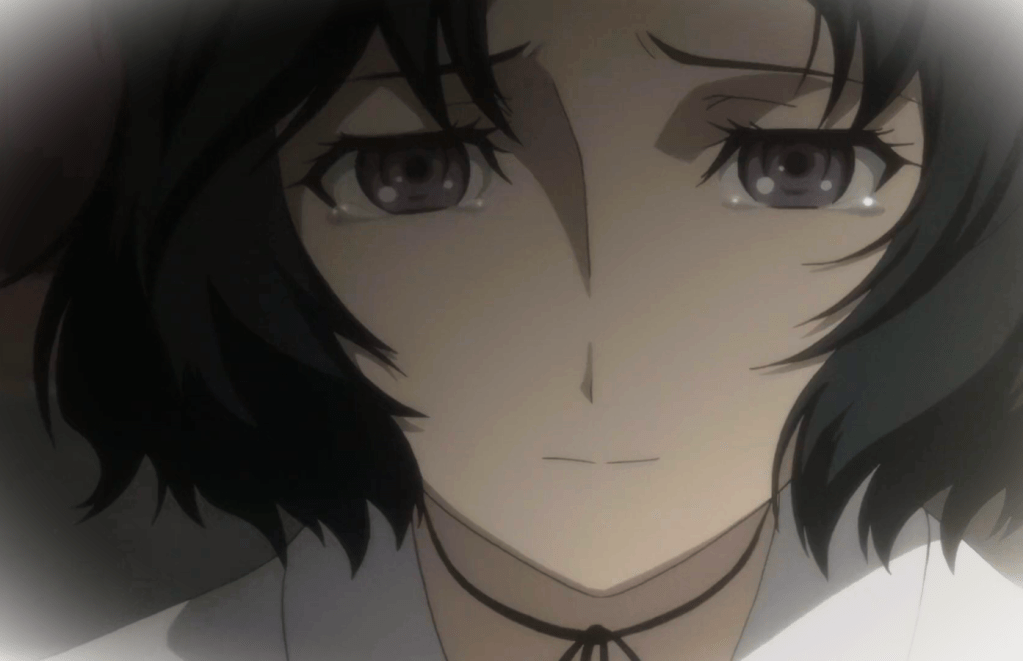
Steins;Gate Episode 19 (“Endless Apoptosis”) is one of the darkest episodes of the series. Okabe tries to make Moeka undo her text that changed the timeline previously. The trouble is that Moeka is extremely mentally unstable and refuses to cooperate. If Okabe doesn’t act quickly, Moeka kills herself in the majority of timelines. The most intense parts of the episode are when Okabe comes to Moeka’s apartment at night to take her cell phone.

I will detail exactly what happened in these troubling scenes, but first there is one piece of important context to go over. Moeka Kiryuin (nickname Shining Finger) is the agent directly responsible for murdering Mayuri in many different timelines. As a result, Okabe hates Moeka. Even in the world lines where she hasn’t killed Mayuri, Okabe can’t forgive what he’s seen in other worlds. That’s why he’s so infuriated when he comes to her apartment.
When Moeka fails to respond to Okabe’s presence in anyway, he simply tries to grab the cellphone out of her hands. She resists, and it becomes a tug-of-war for the phone. Okabe then punches Moeka in the head and kicks her roughly across the room. With the cellphone in hand, Okabe quickly leaves, closing the door behind him. Seconds later, Moeka gets up and starts beating on the door, screaming loudly for her phone.

If only that were the end of the distressing situation. Unfortunately, the worst is yet to come. Okabe tries to change the timeline using Moeka’s phone, but it doesn’t work. He can’t change the timeline without knowing exactly what Moeka’s original text said. There was no choice but to go back into the apartment with the screaming, wailing young woman.
When he opened the door, Moeka charged at Okabe angrily. He wrestled her to the floor and, after a brief struggle, succeeded in holding her down. Just then, a neighbor came by, annoyed by all the screaming. Moeka was going to scream or ask the neighbor for help, but Okabe prevented it by sealing her mouth with his. He force-kissed her for several seconds while holding her down so she couldn’t cry for help or move. The neighbor assumed she was intruding on sex and quickly left again.
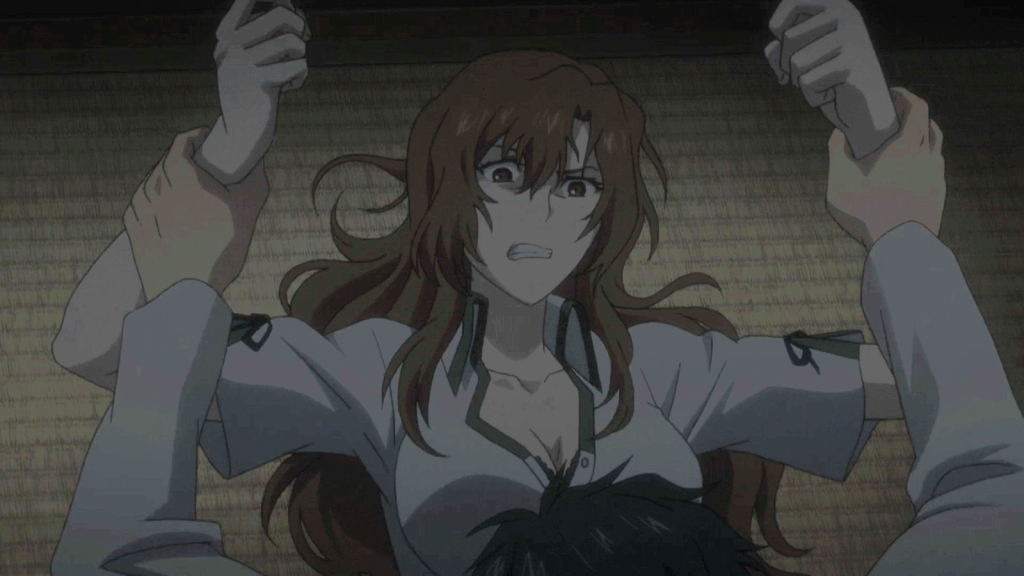
Moeka bit Okabe to make him stop kissing her, but she was still unable to move or get up. Okabe started questioning her after that, saying he will give back her cellphone if she answers his questions. Moeka calms down somewhat, and that’s the end of the violence. This scene was clearly framed in such a way to resemble a case of rape. Even though it was not literally rape, Okabe still used physical and sexual violence against his enemy. Was all this necessary? Was it justified? Remember, Moeka killed Okabe’s best friend.
At the end of the day, we can all form our own opinions about when and if violence is justified and whether it ever includes any kind of sexual element. I’m of the opinion that what’s harmful is harmful, and that harming others should be avoided in most cases. Even if a person has committed a great wrong, that does not justify harming them necessarily. Okabe was desperate, but there were surely other courses of action he might have taken, even if they were more painstaking and less direct.

I don’t think it was moral for Okabe to physically dominate Moeka in the way we saw. However, I do think it was understandable. I have no idea what I’d do if I saw someone murder a dear companion. I might truly wish to hurt them in return, even in an alternate world. There’s a big difference between morally right and emotionally understandable. I still consider this one of Okabe’s darkest moments in which he did not act like a good person.
Okabe’s Love For Mayuri
It’s finally time to discuss the positive sides of Rintarou Okabe. His motivation in Steins;Gate is to save Mayuri, whose life is destined to end early and tragically in almost every universe. Okabe struggles to move the world toward the “Steins Gate” universe, wherein Mayuri lives a happy life. He doesn’t care what mental trauma or physical danger he must go through; he will always try to protect her. I think this kind of powerful love can be a virtue. It’s a quality I greatly admire. Okabe’s love and dedication to his childhood friend is truly incredible, and speaks to his propensity to care for others.

Before we move on to some of Okabe’s other good points, let’s explore his relationship with Mayuri a little more. There’s a lot we don’t know about the families of Okabe and Mayuri, but due to their apparent absence, many fans suspect they had no functional parents. It’s possible that Okabe was in the foster care system. Whatever the reason, we know that he never mentions his parents and has always been a loner and an oddball.
We also know that Mayuri was taken care of by her grandmother when she was a kid. However, when Okabe and Mayuri were still young teenagers, Mayuri’s grandma died, leaving her devastated. Shortly after the old lady’s passing, Okabe couldn’t find Mayuri. He panicked and ran around looking for her. When he found her, Mayuri was in a graveyard, staring up at the sky, which was a strange mix of sun and rain. She was reaching one hand out toward the sun. According to Okabe, it looked like she might just fade into the brightness, led away to Heaven like a lonely angel.

Okabe ran to Mayuri and embraced her. Even at that age, he was a weird boy who liked to pretend to be a “mad scientist.” So he told Mayuri that he, the evil researcher, would take her hostage and never let her go. It was his way of saying that he would always be there for her from that day onward. Thanks to this emotional moment, Mayuri came back from the brink of despair. This is one of the most heartfelt scenes in Steins;Gate.
There are probably a number of times when Okabe tried to prevent Mayuri’s death by taking the fall for her. One such case happened in Episode 21 (“Paradox Meltdown”). Mayuri was about to be run over by a car (driven by Moeka, by the way). Every bit of evidence suggested that it would be useless to try to save Mayuri in this world line. Nevertheless, Okabe attempted to put himself in the way of the car in Mayuri’s place. It didn’t work, but he fully intended to die for his friend in that moment.

Some might argue that Okabe’s powerful love for Mayuri doesn’t last. In episode 22 (“Being Meltdown”), fellow lab member Kurisu tells Okabe that his heart will be destroyed if he has to keep watching Mayuri die. Okabe then explains that he’s already seen it happen over and over again. As a result, he’s become desensitized. He claims that Mayuri’s deaths have stopped affecting him after countless iterations.
Just looking at his expression and hearing his cracking voice in that moment, I don’t think he’s telling the truth. It also doesn’t seem true based on the way he tried to sacrifice himself for Mayuri in the previous episode. Finally, the truth of his claim is called into question by the fact that he doesn’t give up on saving Mayuri. He has moments of indecision, but ultimately, he never ceases in his quest.
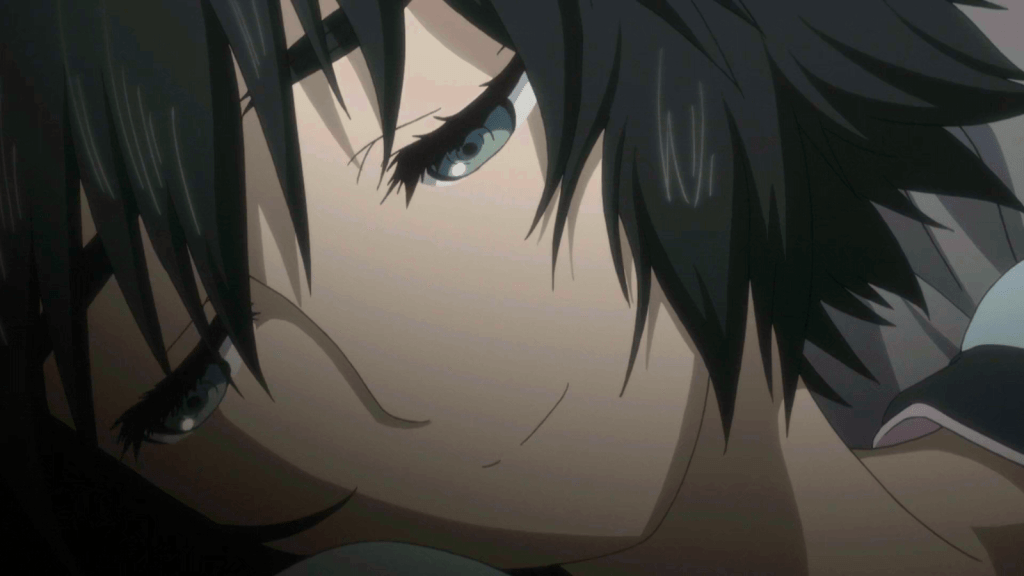
I believe Okabe’s words were partly true. He was horrified at himself because he realized he was somewhat desensitized. But that doesn’t mean Mayuri’s deaths were no longer affecting him at all. Okabe was also trying to put on a brave face for Kurisu in that moment. He wanted her to believe that he wasn’t going to fall into despair. At the end of the day, Okabe’s actions speak louder than his words, and his love for Mayuri is endless.
Okabe’s Other Good Points
Okabe has a few other positive traits that are worth mentioning. For example, he is always welcoming and accepting toward the other lab members. Of course, it’s apparently too difficult for him to correctly gender Ruka, but he did give her a place to hang out and be treated like one of the girls with Mayuri and her cosplay friends. An open trans person in that culture might be hard-pressed to find an accepting social group.

I still don’t think that makes it okay for Okabe to misgender Ruka, so we must acknowledge that he’s not equally supportive of everyone. Nevertheless, he’s more accepting than not. All his friends at the lab (a run-down apartment where they hang out) are social outcasts or weirdos. There’s Daru, an obese nerd who isn’t shy about how much he enjoys erotic content. There’s Mayuri, a girl who isn’t too bright. She spends all her time cosplaying or making strange outfits. Kurisu is a science savant who, despite her societal success, is awkward and unsocialized.
The list goes on. As you can see, Okabe is the sort of person who loves to adopt fellow weirdos and bring them back “to the lab” where they do nothing of consequence. There, over time, they form strong bonds. Everyone at the lab knows this is where they belong. Okabe succeeded in creating a community for those who were unlikely to be socially successful.
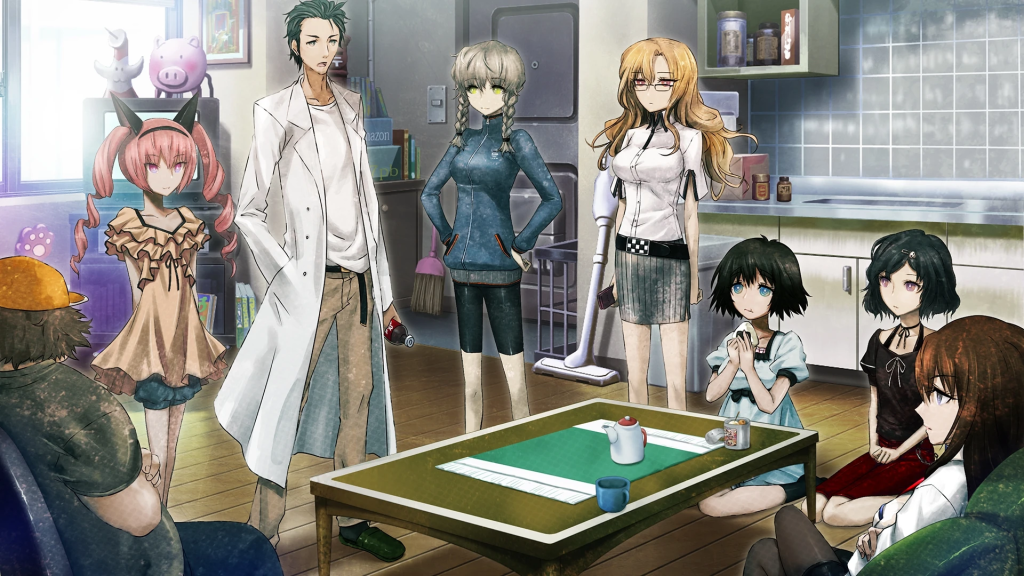
Okabe is pretty weird himself. He fancies himself a “mad scientist,” giving himself the pseudonym Hououin Kyouma. He spends time inventing useless gadgets, and he believes in time travel enough to argue with an actual scientist. He’s always a little out of it, caught up in his head, wherein he is being pursued by an evil organization that controls the world from the shadows. He sometimes acts straight-up delusional.
So long as we’re thinking of positive character traits, I believe self-esteem counts for something. Okabe knows he’s weird and plays into as much as possible. He’s always being an over-the-top caricature of himself. Despite not being the most socially intelligent person, Okabe is highly confident. It’s clear that he accepts himself as he is, regardless of what society may say. This is another trait I admire immensely.
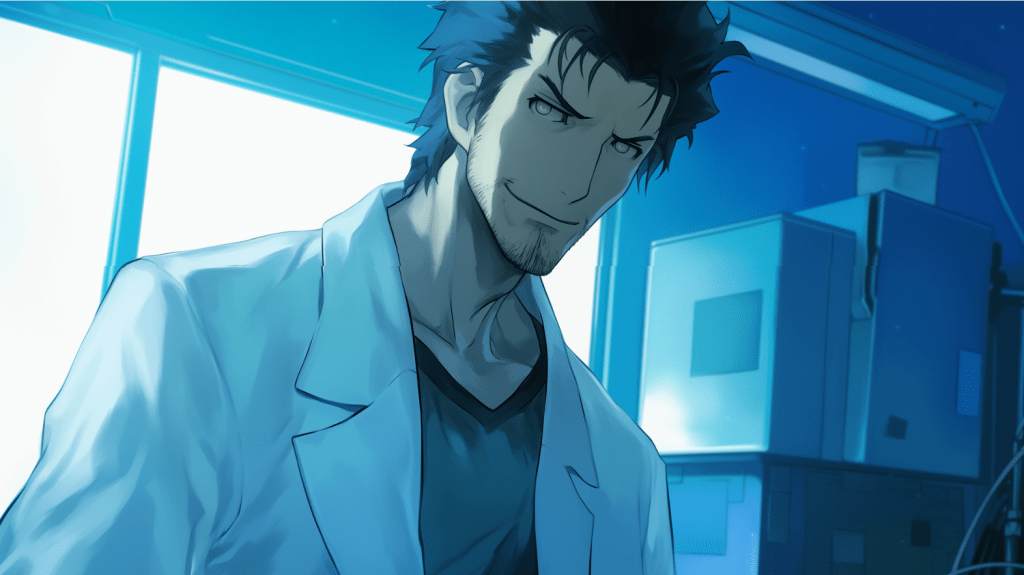
Another positive trait that Okabe shows is determination. Few of us can imagine the psychological trauma he endured while repeating time loops, desperately trying to save his dearest companion. I’m not sure if I could do what Okabe did. He is an extremely strong-willed and resilient person. Again, there were times where he floundered or wanted to give up – but in the end, he pressed onward with the fierce determination that makes him who he is.
For a final example of Okabe’s good points, consider his self-sacrificial tendencies. He is not overly eager to throw his life away, but if he thinks a sacrifice on his part will work, he’s going to try it. We already went over the example of jumping in front of a car to save Mayuri, but there is another great instance to mention.

In episode 24 (“Achievement Point”), Okabe allows himself to be stabbed in order to pour his blood on Kurisu. He even made the wound worse with his hand to make it bleed faster. This was necessary to convince his past self that Kurisu was dead and soaked in her own blood. As you can see, Okabe is perfectly willing to stab himself if it helps with the greater cause of saving Kurisu. This proves that he is capable of selfless altruism.
Revisiting the Question: Is Okabe a Good Person?
We’ve reviewed some problematic actions and some virtues of Okabe. Now, it’s time to revisit the initial question. Is Rintarou Okabe, in fact, a good person? It’s still a difficult question to answer because the definition of a “good person” is subjective. At the end of the day, despite preferring objective measures, I can only give my own personal answer.
You’ll notice Okabe rarely has anything “evil” in mind. If we judge him only by his intentions and motivations, he seems almost entirely “good.” But when you look at his actions in addition to his general good intentions, the picture becomes muddier. Okabe has some highly immoral actions on his record, such as assaulting Ruka. We can’t just forget that.

The real question to consider here is whether people can be put into such simple categories as evil or good. Aren’t people much more complex than that? I think people are both evil and good depending on the specific situation. Another thing to bear in mind is this: perhaps good and evil describe actions, not people. Actions can be harmful or helpful (or neutral/amoral). So perhaps this question – is he a good person? – is meaningless.
In case that sounded like a cop-out, I’ll make my stance clear. I don’t consider Okabe an ethically upstanding protagonist – not one of the “moral heroes” from classics. However, he is not “evil” enough to be an anti-hero by my definition. Okabe is a realistically morally gray character. So, is he a good person? Sometimes, yes. Other times, certainly not.
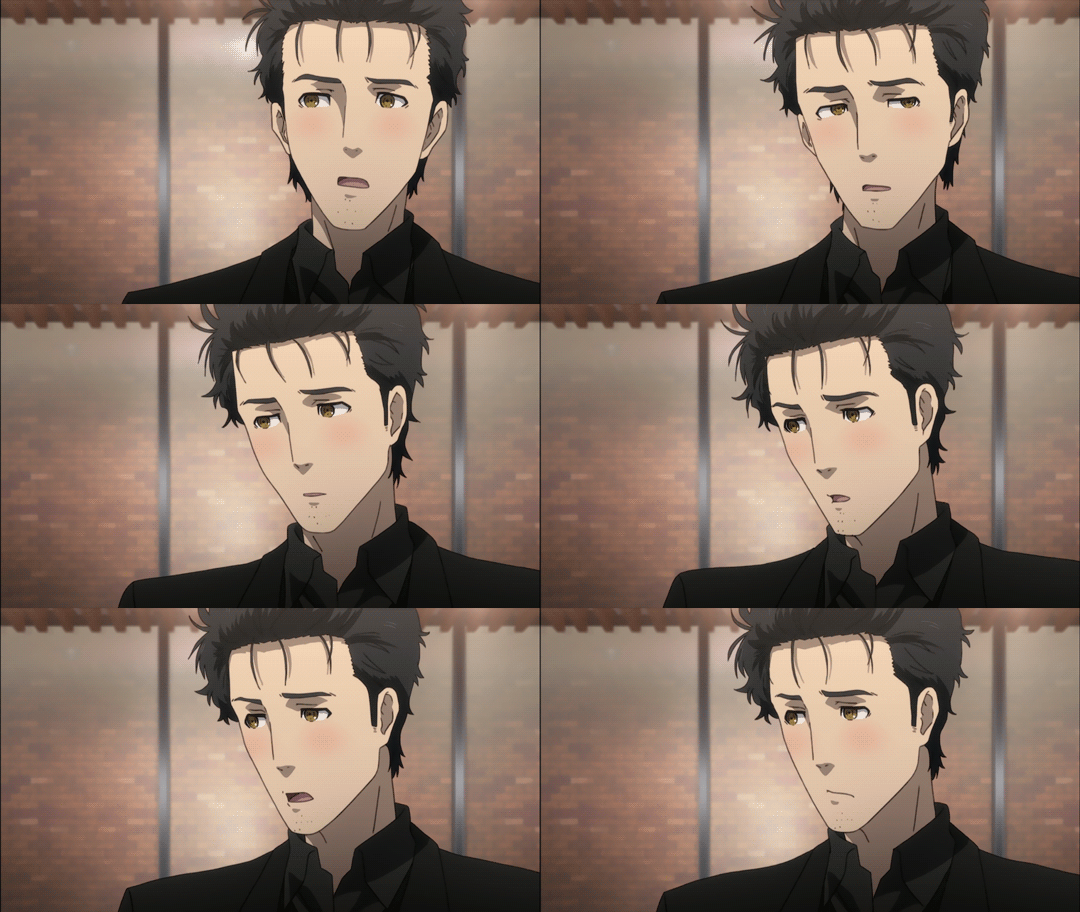
Regardless of whether he meets certain criteria to be a good person, Okabe is a well-written and unusual protagonist. Part of his appeal is his how his character has good and bad sides, making many mistakes in his journey like any human. I hope this article provided some insight into Rintarou Okabe. What do you think about him?
~Thanks for reading~
~

 Anime Rants
Great post! When I think back to the show I tend to land on the side of him being basically a bad guy who can still do good things.
LikeLiked by 1 person
That is a very valid perspective. Thanks for your comment. ❤
LikeLiked by 1 person
A very well made article. He is my fav character becasue of this points. To Be Honest, he is just a normal person like anyone just little werid who does stuff without even thinking. but if we see whenver he gave up on time looping and tries to change inside the world line, he is a hero technically for a lot of ppl in both timelines. He has learnt a lot of things during his journey and experiences . This okabe yes he has that intention but his main tention will always be to care about his closest ppl which makes this okabe morally grey and very well writtern which littrally makes it my fav mc
LikeLiked by 1 person