
Article Contents
Introduction and General Notes
Welcome! Yesterday, the first two episodes of Orb: On the Movement of the Earth were released. Unfortunately, I still can’t find a legal platform for streaming it. Given the premise of this anime, though, there was no way I wasn’t going to watch it. I expected to like Orb, and I was correct. In fact, I absolutely love it so far. It’s the anime I’m most excited about in Fall 2024.
I have a bunch of notes and thoughts on these episodes, but I didn’t really discuss the audio-visual components in those sections. So, very quickly, I’ll tell you that both are fairly high quality. The music was composed by Kensuke Ushio, an extremely talented composer who wrote the music for A Silent Voice, Devilman Crybaby, Chainsaw Man, and more. So far, I’ve loved what little music I noticed in Orb. I also love the opening song, “Kaiju” by Sakanaction. (The ending song, “Aporia” by Yorushika, was nice as well.)

The voice-acting cast for Orb is amazing, though we’ve only heard a few of the main stars so far. I do mention a few of them in the sections below. As for the visuals, they are not exactly stunning, but they’re certainly creative and stylized enough to entertain me. The studio that made this anime was Madhouse, which typically has decent production value. Now, without any further rambling, let’s get into the episode reviews.
(Note: These reviews do not contain detailed recaps of events, but rather, my thoughts and responses to certain moments, characters, and themes in these episodes.)
Episode 1 Notes
Episode Rating: 10/10
The opening of the pilot is grim, showing a man of the church torturing a heretic. He is using a “pear of anguish” device to split open the victim’s jaws. Afterward, there’s a second torture scene at a different time with the same character: Nowak, a church inquisitor voiced by Kenjiro Tsuda. (And what a good casting choice! Tsuda’s voice can be very sexy or very creepy, depending on what type of character he’s bringing to life.)
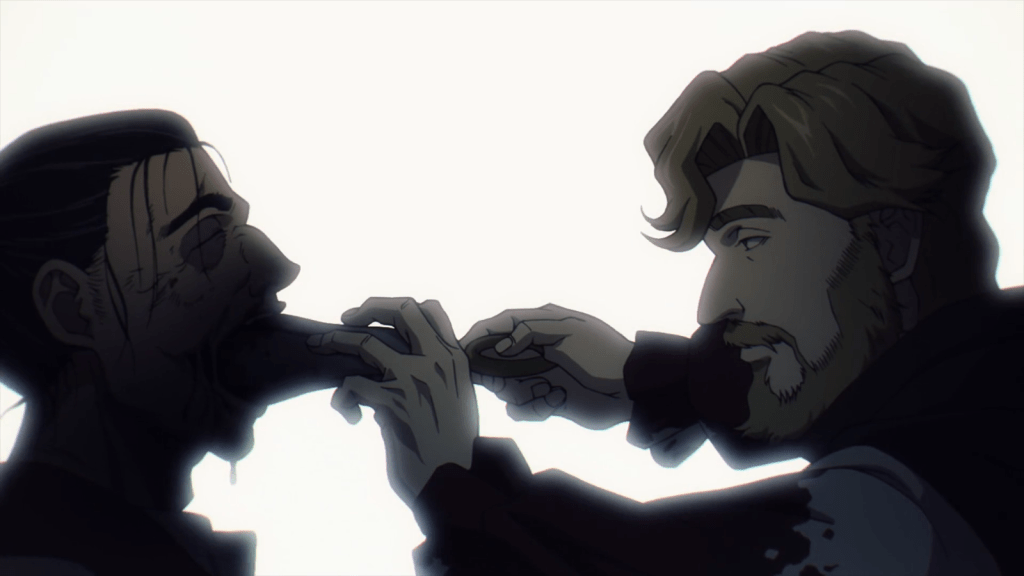
Nowak begins removing the nails of a scientist whose research materials go against church teachings. We learn from this scene that Nowak is insanely serious about torture. He won’t just slowly remove all ten of your nails. He’ll also keep you long enough for your nails to regrow in order to remove them again. Rinse and repeat. All the while, Nowak is either enjoying himself or complaining about wanting to go home early.

This depiction of the church is very historically accurate. Christians terrorized and slaughtered inquisitive minds for centuries, keeping science and progress at a standstill. As if the torture scene wasn’t enough, there is also a brief execution scene later. Our main character Rafal sees a man being burned at the stake. It’s a disturbing sight. The man’s face is mostly burned off, and I assume his throat has already burned so he’s so longer screaming. But one of his eyes is still there, and it meets Rafal’s gaze.
(October 13th 2024 Edit: If you go to the comment section, you will see a discussion wherein a religiously indoctrinated person denies the academic consensus of historians regarding the Church’s historical violence and oppression of independent thought. I recommend reading the discussion to see the weak arguments, poor-quality sources, and levels of denial for yourself. The moral of the story is that critical thinking is just as important as ever.)

Speaking of our young protagonist, Rafal is an interesting and unusual boy right off the bat. I like his personal philosophy that his belief that “rationality equals beauty.” Despite being twelve, he knows and that one must be extremely pragmatic to survive. Since he’s naturally a practical and rational thinker, survival has been easy for quite some time. He got himself adopted by a good man. He’s well cared for and well-educated. He’ll even have the chance to study at a university.

Rafal’s nearly idyllic life comes to an abrupt end when he meets Hubert, a heretic researcher who was allowed to live after he publicly recanted his “sin.” Hubert is huge and intimidating, with keen senses that immediately identify Rafal as a bright and capable boy. Like Hubert himself, Rafal is a great student of astronomy. But nobody in their right mind would risk life and limb to help a heretic continue his forbidden studies. Thus, Hubert uses force and threatens to kill Rafal if he refuses to help.

It’s only natural for a rational and clever boy to agree to Hubert’s demands long enough to escape and report him to the church. But despite his own better judgement, Rafal doesn’t report Hubert. He loves astronomy. Like a true scientist, he was eager to see the stars from the new vantage point that Hubert promised. And wow! That location did not disappoint. The starry skies were gorgeously clear and vivid on that mountain plateau. Rafal couldn’t hide his enthusiasm if he tried.

I absolutely loved the scene that follows, as Hubert tells Rafal about the rotation of earth as well as heliocentrism. It was a beautiful moment when Rafal suddenly realized that the idea might be valid. The boy is stunned, and as the weird old man continues, he becomes enthralled. The music was great for this scene. Also, the casting for Hubert and Rafal is fucking perfect. Nobody else could have done this dialogue quite so well.

(Maaya Sakamoto, voice of Rafal, has been my favorite female seiyuu for many years. Although she has voiced many female and male characters since the 90s, she is probably most famous for voicing Ciel Phantomhive in Black Butler. Hubert is voiced by Show Hayami, a man with a very deep and somber voice. He’s been in many different series, but I know him best as Tokiomi from the Fate /Type Moon franchise.)
While we’re on the subject of Hubert, I want to stress the fact that he’s strange and unnerving. He’s not necessarily a morally good person, since he’s willing to threaten a child with death just to continue his own personal dream. I definitely don’t love everything about Hubert, but I like him much more than any church sycophant. Characters who are a bit unhinged and obsessive are usually right up my alley. And if they are scientifically inclined, that’s even better.
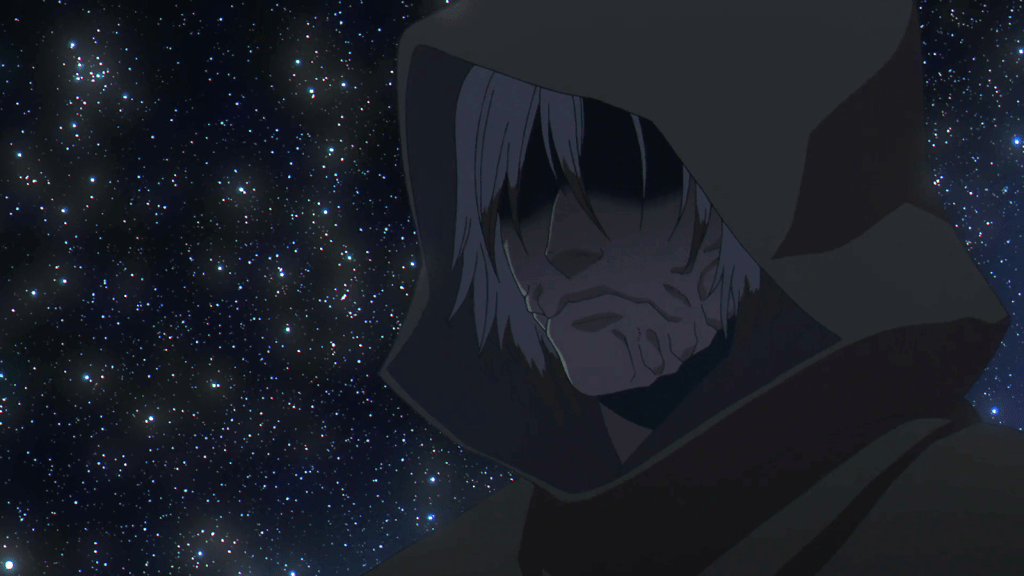
The character of Hubert brings to light an interesting idea: In the fifteenth century, to be a good scientist, you had to be at least a little bit crazy. Some people think of scientists today as hyper-logical. They are seen as people who follow very rational paths. But before the Enlightenment era, it was anything but rational to think for yourself. It could get you killed. People like Hubert were insane, and I’m glad they were. Thanks to them, science survived and humanity improved.

Rafal also has the makings of a great – and slightly insane – scientist. Despite his pragmatic attitude and love of pure rationality, he can’t stop his mind from chasing after new knowledge and experiences. Both Rafal and Hubert are extremely promising characters. I’m so excited to see more of them!

Episode 2 Notes
Episode Score: 10/10
I found it appropriate that Rafal didn’t immediately accept Hubert’s model. Believing that it defied common sense and Christianity, Rafal sought to prove the model wrong by working on the math and physics of it all night. Any true scientific endeavor starts with the idea of trying to disprove a hypothesis. Also, let’s take a moment to appreciate how fucking smart Rafal is as a student. He’s twelve, but he’s doing at least highschool-level calculations, if not university level. Impressive!

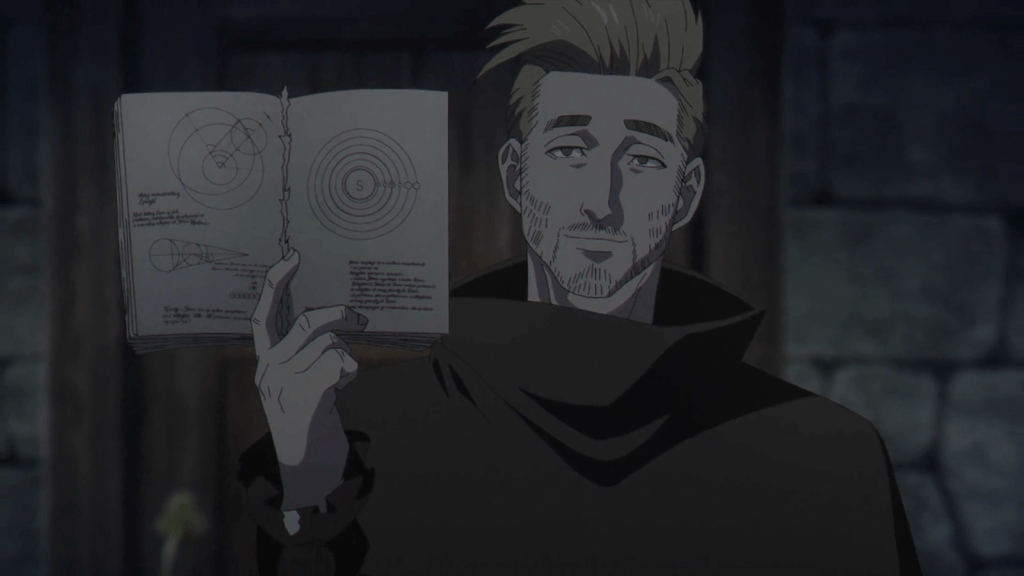
Now let’s get to the depressing part of the second episode. After all that gushing about Hubert I did in the previous episode review, he went and got himself killed. Damn it! That’s so frustrating! However, I see his death as a critical turning point in the story of Rafal. I had assumed that Hubert was morally grey, but in the end, he gave up his life to cover for Rafal. I doubt he ever had any serious intention of killing a child, if he’s the kind of person to give away his life like that. Rest in peace, Hubert. (:sob:)

Before we review what happened after Hubert’s death, I want to discuss the old man’s beliefs. He clearly rejected Christianity and its foundations of scripture, believing instead in a God of Nature who poured its essence into the natural world. Whether Hubert’s God was interactive or deistic is unclear, but either way, his thinking was progressive and far ahead of his time. This is just another reason why I love Hubert and grieve his passing.
Quick tangent here. In case anyone remembers or cares, I am an atheist. (The majority of scientists in today’s age are secular and/or atheistic as well, for what it’s worth.) So, wouldn’t I have liked Hubert even better if he was an atheist? And if he was an atheist, would that have been accurate to the times? No and no. I don’t have to agree with a character to love them and their personality. Moreover, there’s a very good reason that Hubert wouldn’t realistically be an atheist. Let me explain.

Atheists have always existed in every age. However, people involved in early academics were traditionally well-off and successful. In order to rise to this level, they had to be approved by the Church. Therefore, they were almost entirely theistic. If they were studying the natural world in the 1400s, they were of course indoctrinated to believe in the Christian God. But if they could conquer the fear and brainwashing, they might end up with something more like Hubert’s God.
Either way, early scientists were likely to maintain some kind of god-belief for two reasons. Firstly, it’s because they had to stay in the Church’s good graces. Secondly, it’s because they simply didn’t have the same knowledge and logical arguments back then that we do now. This was before the scientific revolution. It was much more reasonable 600 years ago to be a theist. That’s why it makes the most historical sense for Hubert to believe in God.

After Hubert’s death, Rafal discovered the hidden trove of his research materials and the letter asking him to burn it. At first, Rafal did what was the safest and practical thing: he obeyed the letter and set the documents on fire. But as he stared at the flames and remembered Hubert, he decided to trust in his intuition that heliocentrism could be correct. So, Rafal saved what was left of the research materials.

It was a truly beautiful scene, but I do have a slight issue with part of it. This anime keeps bringing up the idea of “pragmatism versus intuition.” It’s an important theme that represents the changing mindset of Rafal. However, I want to point out that neither option is “good science” in the technical sense. Science does not rely on common sense or staying safe from criticism, even if that’s the most rational thing for a person to do in order to stay alive. Rafal’s “pragmatism” is based on fear and not truth.
Hubert’s “intuition” is also not scientific or geared toward truth. It’s closer to what some call faith. Science does not rely on “gut feelings” or strong hunches. Strictly speaking, neither Rafal nor Hubert are being scientific. But that’s okay with me. No scientist is perfect – least of all astronomers from the 15th century. What’s important here is Rafal’s character psychology and how he’s deciding to embrace uncertainty over safety. While this isn’t really science, it’s an important ability for a researcher to possess.

I love how determined Rafal becomes now that he’s made his decision. But he quickly discovers that he can’t be too bold and still get the future he wants. He is forced to lie in order to further his goals and keep himself safe. This may sound wrong, but I strongly identified with Rafal when he was lying to his guardian. Like him, I had to live a lie to stay safe in my family of origin. If we were honest, we would never have progressed or escaped. So, neither Rafal nor myself feel guilty about our necessary lies.

My final notes for this episode are about Nowak the Inquisitor. Episode 2 taught us more about him, his psychology, and his motivations. I’m pleased that he’s got some kind of reason instead of just being evil for evil’s sake. Nowak seeks to protect the peace so his daughter can have a good life. Heretics and their accomplices are people who threaten the peace, so it’s acceptable in his mind to torture, arrest, and execute them.
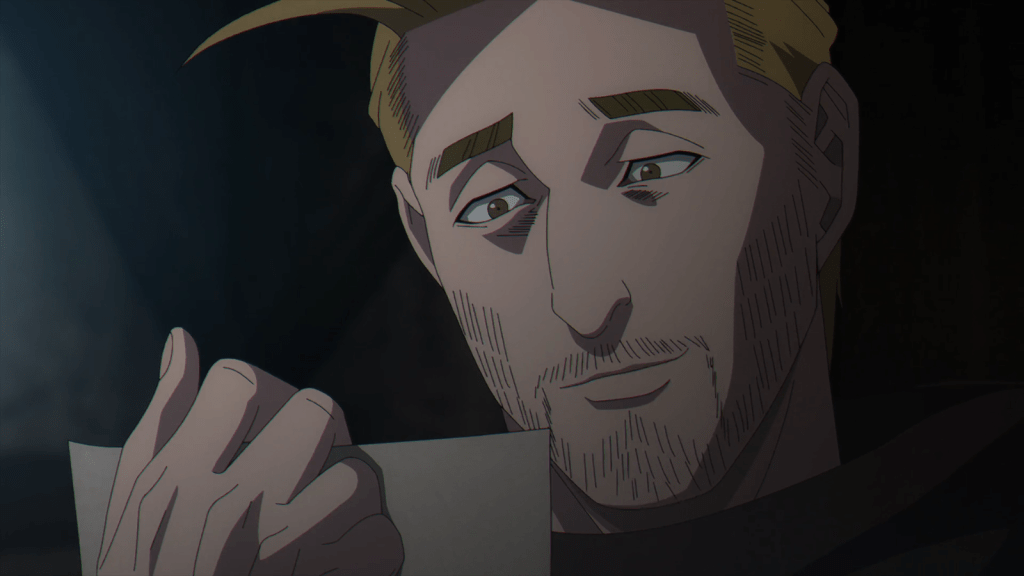
Despite having “a reason,” Nowak is clearly a sociopath without much ability to empathize. The fact that he can torture people and feel nothing is proof. And if he was a rogue mercenary before being hired by the bishop, this makes even more sense. Even Nowak’s love for his daughter sounds like a sociopath’s love for his most treasured possession. I’m fascinated by this terrifying character and I look forward to even more intense moments with him. That concludes my thoughts and responses for now.
~Thank You for Reading~
~

 Anime Rants
“This depiction of the church is very historically accurate. Christians terrorized and slaughtered inquisitive minds for centuries, keeping science and progress at a standstill”
You don’t know anything about history. And atheism has been more bloodthirsty than any religion
https://en.wikipedia.org/wiki/Red_Terror_(Spain)
LikeLike
I considered deleting this comment for misinformation, but I don’t believe my readers are foolish enough to fall for this falsehood. I also decided to keep this comment because it made me laugh. Thanks, clown. 🙂
Edit: To be clear, the falsehoods are your statements, not the wikipedia article. Your conclusions are hilariously errant. But the red terror did indeed happen, and I don’t condone violence. If a few supposed atheists were violent, while that is not justified, it certainly pales in comparison to 2000 years of violent oppression by religious institutions.
LikeLike
A “few” fellow atheists that killed millions in 2 centuries. And talk about misinformation the guy that repeats like a parrot the religion “bad” argument.
https://en.wikipedia.org/wiki/Drownings_at_Nantes
LikeLike
I don’t recall making that argument. I personally am opposed to religion, but there are people out there who are good humanists despite their religion. For them, religion is something good for them to rely on when they can’t handle things otherwise. I wouldn’t try to take that away from them. “Religion bad” isn’t misinformation, but it is a projection of your simplistic thinking onto me.
Atheists have killed people. What I find interesting is that atheism itself does not say anything about promoting violence. Atheism is just a reponse to a claim. Religion, on the other hand, is full of calls to violence. It wasn’t atheism that led people to do bad things. It was them being cruel people. It takes religion to make a good person do bad things.
It’s also interesting to me that you cited historical happenings like the red terror while denying the academic consensus of historians when it suits you and your religious arguments. When you cite a YouTube Video that unironically says “Fake News,” I can only laugh in reponse. Pick up a history book. Orb’s portrayal of the Church in the 1400s was pretty accurate, and Christianity did indeed stop progress and commit atrocities for millennia. In many places in the world, it’s still happening. Education is just as important as ever to combat religious thinking. Thank you for giving me the opportunity to make my points.
LikeLike
“What I find interesting is that atheism itself does not say anything about promoting violence. Atheism is just a reponse to a claim. Religion, on the other hand, is full of calls to violence. It wasn’t atheism that led people to do bad things. It was them being cruel people. It takes religion to make a good person do bad things.”
Because anticlerical atheism doesn’t exist. In my country it was very common for atheists to kill religious people and burn down churches because of their atheist beliefs.
https://historyforatheists.com/2021/01/the-great-myths-10-soviet-atheism/
“Pick up a history book. Orb’s portrayal of the Church in the 1400s was pretty accurate, and Christianity did indeed stop progress and commit atrocities for millennia.”
No it isn’t, only militant atheists believe that. Not a single serious scholar do. And maybe you should look up the story of lavoisier.
https://historyforatheists.com/2024/09/the-great-myths-15-what-about-the-dark-ages/
https://churchlifejournal.nd.edu/articles/the-catholic-churchs-role-in-the-development-of-modern-science/
LikeLike
“In my country it was very common for atheists to kill religious people and burn down churches because of their atheist beliefs.”
I’m sorry there has been violence in your country. It’s just a weird hill to die on when there are hundreds more examples of religious violence than political violence by people who were probably atheistic. Anyway, your misunderstanding is that “atheism” is a worldview and that it could possibly lead to promoting violence. Atheism is a response to the claim of a god. Its only tenant is that you’re not convinced of said claim.
As for your assertion that only militant atheists believe in the global historical consensus of scholars, again, I can only laugh. It must be nice living in your alternate reality. I hope that you find a way to improve your critical thinking and sort through claims with more focus on finding the truth. Good luck.
LikeLike
“As for your assertion that only militant atheists believe in the global historical consensus of scholars, again, I can only laugh. It must be nice living in your alternate reality.”
Because it is. I ave you actual data and you keep parroting the same taking points. Not a single actual historian believes that religion is responsible for stopping progress. But you can believe your fairy tale all you want
LikeLike
Your data was made up of hilarious non acacdemic “Fake News” YouTube Videos and articles by highly biased sources like “Christian Journal.” This is what I meant about education and critical thinking being very important. It is also quite ironic to end with the fairy tale line when you’re the one who believes in Magic Sky Daddy. But again, thank you for the discussion, and good luck on your journey. If you can, I do recommend taking a college course or two in world history.
LikeLike
Because militant atheists like you are not biased. Most of the articles I put are from atheists. But even then you didn’t give an actual proof and only repeat the same lies.
“It is also quite ironic to end with the fairy tale line when you’re the one who believes in Magic Sky Daddy”
Says the guy who believes that people don’t kill in the name of atheism
“If you can, I do recommend taking a college course or two in world history.”
I am a history student so yeah I already had that cover.
LikeLike
Oof, I feel especially worried for you if you’re a history major. But hopefully you’ll learn. Good luck!
LikeLike
I learned a lot, especially of how militant atheists loke you don’t know anything about history.
LikeLike
😂
LikeLike
While the portrayal of the Church’s treatment of scientists in Orb: On the Movement of the Earth is highly dramatized and not fully historically accurate, I understand the creative liberties the author has taken to build tension and atmosphere. The reality of the Inquisition’s actions was more complex, with cases like Galileo’s house arrest being more typical than the extreme violence shown here. However, exaggerating the brutality creates a compelling narrative highlighting the fear and risks early scientists face. It may not be an exact reflection of history, but it effectively captures the struggle between knowledge and authority. The artistic choices make for a gripping story, even if they come at the expense of historical nuance.
LikeLike
“This depiction of the church is very historically accurate. Christians terrorized and slaughtered inquisitive minds for centuries, keeping science and progress at a standstill”
None of that has ever happen in Poland during medieval ages. The Church was actually supporting science and the discoveries. Throughout his lifetime, Copernicus was active in the religious community. Copernicus was born in 1473 in Torun, Poland, the youngest of four children. At age 10, his father died and he were sent to live with his uncle Lucas Watzenrode, who would later become the bishop of Warmia (Ermland).
Copernicus studied at St. John’s Church in Torun’s parochial school before going to Krakow Academy in 1491 to pursue astronomy and astrology. He became known as a skilled mathematical and astronomer, but he also maintained his ties to the church. He became a canon of the cathedral chapter of Frombork through his uncle, and he served the church of Warmia as a medical advisor.
Copernicus first outlined his ideas about the heliocentric theory in a manuscript titled “Commentariolus.” There he suggested a heliostatic system, where the sun was at the center of the universe and the earth made rotations.
The astronomer published “De revolutionibus” in March 1543, after more than a decade of revisions. The book included a letter to Pope Paul III arguing the legitimacy of the heliocentric theory. He died two months later.
After his death he was even buried beneath the altar of Frombork Cathedral in northern Poland.
LikeLike
Thank you for your comment. It has indeed come to my attention that we don’t know the specifics of heresy laws in Poland in the 1400s. Perhaps creative liberties were taken by the narrative in this specific instance. Also, Copernicus may not have been tortured or executed, but he still faced a lot of social danger from advocating for something so radical, in a way that scientists today can hardly relate to (which i good – let’s keep church and state separate!) I think the real point here though is history in a much broader sense. Historically, across time and different countries, the Church did shut down all sorts of lines of scientific questioning and investigation. Even outside of science, innocent people were tormented just for having a different view of god. And atheists were full blown heretics who had best keep a low profile if they want to live in society. Long story short, yes, Copernicus was one of the luckier earlier scientists who wasn’t openly punished by the Church, but the historical pattern remains.
LikeLike