
This episode hit me hard and left me feeling bitter and unsatisfied, but I’m still in love with this series. Regardless of its bleakness, Orb speaks to me. Now, I don’t have a thought-provoking introduction today. If you’re interested in the topic of glorified suicide, that will be mentioned in the actual article. Also, I have a quick note to make before getting started.
I’m simultaneously excited and afraid as Orb, my current favorite anime, draws closer to its conclusion. I’m too scared to look up whether the manga is complete or whether we can expect more seasons because I don’t want to run into any spoilers. If anyone knows, please inform me without spoiling future events. Without further ado, let’s talk about this episode and the fate it had it store for Jolenta.

Episode 20: I Love Heliocentrism
Episode Rating: 8/10
Together with several knights and other inquisitors, Nowak headed toward the barn where Jolenta and company were hiding. Before they knew they were being pursued, Schmit and his men were not in a hurry. Frie brought food from town and there was time to talk and eat as the day went on. Draka had an interesting conversation with Lewandlowski while they munched on bread. It taught us about the character and beliefs of Lewandlowski.
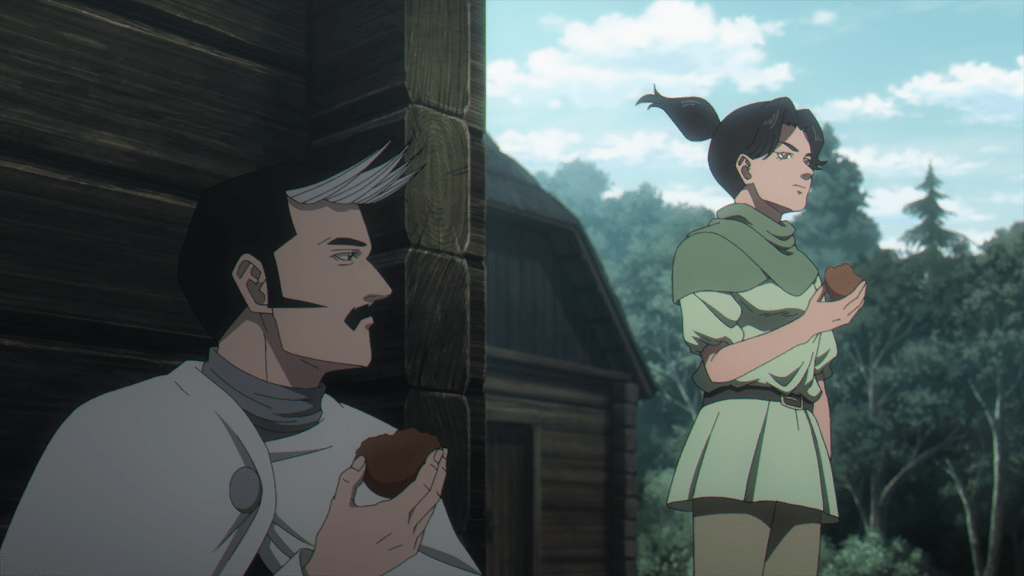
What stood out to me the most was his defense of religion. Lewandlowski had a little sister who died very young due to illness and starvation. Before she died, she asked why she was born. In Lewandlowski’s opinion, this kind of question can only be answered by religion. Although he disagrees with the tyrannical Orthodox Catholic Church, he sees religion in general as having great social utility. People are not strong enough to face the bleakness of existence, he believes, without relying on comfortable myths. Religion provides a comforting narrative, so it’s useful.
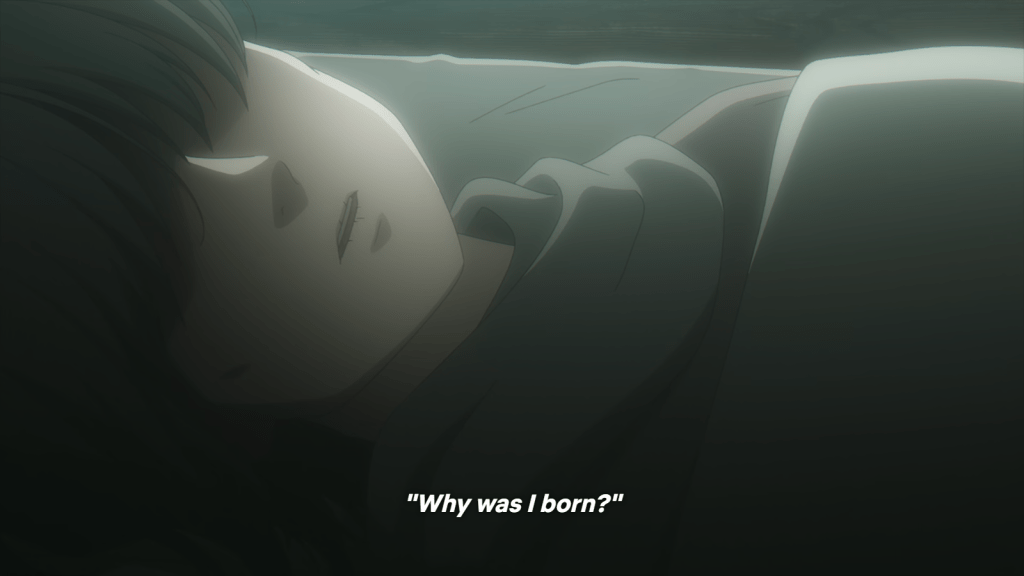
Lewandlowski’s argument for religion is better than some, and I understand that religion sometimes benefits society (though it’s equally often something damaging). Personally, I don’t care much about the utility of a belief at the end of the day. I care more whether or not it’s actually true. That’s why the traditional social usefulness of religion is not a good reason to believe in its tenants. I love stories about dragons, and I would feel more much inspired in life if there were dragons. That doesn’t mean I should believe that dragons exist.

Later that day, Draka talked with Schmit while he polished his sword. They discussed their views of nature and technology. Schmit believed that nature is beautiful and godly, while manmade things are ugly imitations at best. He also rejected Draka’s argument that technology itself is natural, as it reflects human nature and our instinct to build and improve. Draka embraced technology and material items – both for personal gain and for the sake of human progress. She even quoted Aristotle to back it up.

That night, Jolenta gave the manuscript of Oczy’s book and the printing press letters to Schmit and his men. She told them to go with Draka and publish books that would help make more knowledge available to people. Jolenta also gave Draka the task of keeping a certain letter. As for Jolenta herself, she would stay behind and distract any pursuers. Before long, Schmit arrived with the news that the knights were on their way. However, in the moments leading up to that, Draka and Jolenta had a memorable talk.

We already knew Jolenta was a theist, but we didn’t know any particulars about her god-belief until this conversation. Jolenta seems to have an abstract and deeply personal idea of god. In that way, she is most similar to Schmit. But unlike him, she isn’t opposed to technology. Furthermore, she seems to believe wisdom and truth can be found in the Holy Bible, which Schmit completely rejects. It’s possible that Jolenta is still some flavor of Christian, but her particular god is not Biblical in the way she described it.
How did she describe it? Jolenta’s God is the force of goodness within humanity. She believes God’s will is for the human race to progress toward humanism, education, and better lives. Jolenta thinks everything is connected by the slow, underlying crawl of human progress. In her view, “God” works through the actions of humans to bring about a better world for everyone.
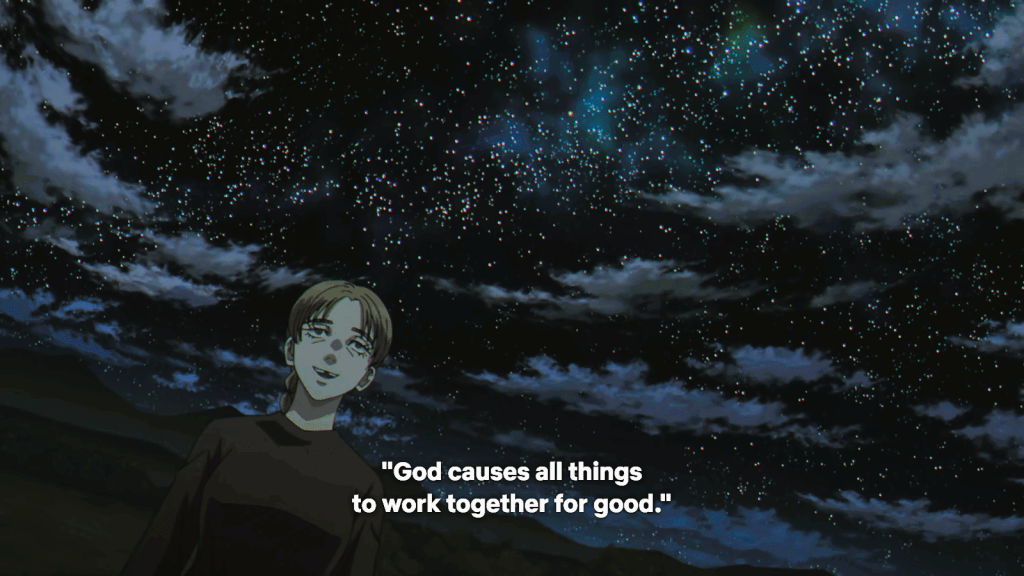
(Side Note: This deity isn’t the same as the Christian God, but Jolenta tries to back it up with scripture regardless. The verse is Romans 8:28. The correct quote is, “And we know that all things work together for good to them that love God, to them who are called according to his purpose.” This is quite different from what Jolenta said, and the meaning is not what she had in mind. Rather than saying that God works toward human progress, it only promises goodness for those who love the Christian God.)
On its face, Jolenta’s belief is not problematic. It’s a fine way for a progressive, moral thinker to comfortably keep a god-belief. But I can see at least two issues in this relatively harmless theology. Firstly, it prioritizes personal comfort over following the evidence. Is there actually an invisible force of good in humans, and if so, why call it “God” and not instinct? Secondly, people have made progress by fighting and giving everything they have to make change. It’s dismissive to give the credit for progress to a supernatural spirit when real humans worked hard for real results.

That’s more than enough on that conversation for now. Let’s get on to the main event, the plot twist that left me as angry as a wet wasp. Jolenta used gunpowder and blew herself up in front of Nowak and the knights. The barn was reduced to smoldering debris, and all that remained of Jolenta was one charred forearm. It isn’t completely clear if Nowak realized this was his daughter, but I think Jolenta realized who the old man was in that second when she dropped the torch. We’ll now discuss why Jolenta did this and why it pissed me off.

Schmit explained that Jolenta intended to die for several reasons. Firstly, the inquisitors were only sent to capture the leader. If they saw the Heretic Liberation commander die, they would temporarily be at a loss for how to proceed. Secondly, Jolenta blew herself up in spectacular fashion to make sure that Schmit and Draka escaped with the printing press. Thirdly, the Reformationist faction would be more likely to accept the requests of the Heretic Liberation Front if their leader was a martyr for religious freedom.

The death of Jolenta frustrated me immensely. She was my favorite character, so part of me hoped she would survive. If she had to die, I didn’t want her to die in such a bleak way. What Jolenta did was glorified suicide. I wish she would have valued her own life more highly. People like Jolenta are far more useful to the world alive and vocal than silent in the grave. Of course, I support Jolenta’s freedom to make this choice, and I rationally understand her strategy. It just sucks to lose this character.

There was one other reason why this episode left me salty. I got tricked by the narrative, which implied that Jolenta would have an epic reunion with her father. I thought it might even be the climax of the anime later down the road. Well, that didn’t happen. We don’t even know if Jolenta and Nowak recognized each other. I feel so cheated. So it goes with subversive narratives, I suppose.

In this episode’s last scene, Schmit’s carriage got pulled over by knights on patrol. (Are you serious? Did Jolenta die for nothing after all?) Schmit quickly hid the printing press supplies. As Draka anxiously peered out the carriage window, the knights demanded everyone come out. To be continued.
~Thanks for reading~
Written by 7Mononoke at Anime Rants
Click for more posts about Orb

 Anime Rants
If Nowak possessed a single piece of information, it would change what he sees and maybe what he does, just like the world will be changed when it learns of heliocentrism. It is quite frustrating to see the delay in both pieces of information being properly communicated, especially when both have come so very close to being revealed. About the only way left, that I see, for Nowak to learn of the truth is by way of Draka, should their paths cross as I fear they will.
I can see the sense… of a sort… in Jolenta’s plan. If the Inquisitors got her, as they did once in her youth, it would be quite a bit worse than a quick and thorough death, and if she escaped with the rest of them, they would be quickly hunted down. In one act, she bought precious time, lent weight to their legitimacy in the eyes of the Reformation, and defied the corrupt church officials one last time, including supposedly sending herself to Hell via suicide while simultaneously eluding their grip forever. Not the worst way to go, but… well.
I also want to comment, a number of people in this show have had notions of the Christian God which touch on truth without necessarily being the truth.
For one instance, Nowak mentioned awhile back how they burn heretics so they can never rise again come the day of resurrection, a notion I laugh at as this *is* the deity who healed lepers, the lame, the blind, the deaf, and sent fire from the heavens, and parted the Red Sea, and extended a single loaf’s worth of grain into a year’s worth of food, and fed thousands with a meager amount of food that grew beyond the original supply of such, and created the world, and, oh, right, created man from the dust of the Earth… and they think a particular man’s body being reduced to ash – especially when the bodies of so many faithful are already naught but dust – would be even the mildest inconvenience to Him? Are they *sure* that they god they worship is the one they *claim* to worship?
So now Jolenta states her belief that God causes all things to work together for good. This is true and consistent with Christian theology, as He calls upon us to improve our world ourselves, so I’m not sure what you mean by it not being the same deity. Many people do not understand God enough to think of Him as anything more than a “force.” It might not be accurate in some ways, but it’s not entirely wrong, either, as His influence touches upon us in many ways.
Also, I don’t see how it dismisses or diminishes what each person does and what they sacrifice. It just acknowledges how He directs and supports them, and grants them peace in the end, as we have seen happen many times in this anime.
LikeLike
Thanks for the comment Merlin. Always nice to hear from an active reader. I understand that orthodox Christianity has changed a lot as the centuries went on. They used to believe some weird stuff that wasn’t in the Bible – like what Nowak mentioned with the burning of heretic bodies. That probably happened because relatively few people had access to what we now consider the complete and canon Bible. Generally, before the Protestant Reformation, only clergy had access to the scriptures. The mythology around burning bodies definitely seems absurd. Though it’s worth saying that, as a non religious and skeptical thinker, all of Christianity sounds equally unsupported and fantastical to me.
While I’m rambling, I can try to explain what I meant by “not the same deity.” I could be interpreting it incorrectly, but Jolenta sounds like she defines goodness as the progress of the human race. This is in conflict with the definition of goodness according to the Christian God, which is whatever God says (Divine Command Theory. (Not every Christian believes that tho, so I’m sorry if I assumed wrong and you have a different idea of goodness.) Also, I did state this in the post, but the verse promises “good to them that love God.” Not “good to all humanity.”
Also, if you don’t mind, could you give me some examples of the Biblical God advocating for improving the human world? I talk to Christians quite a bit but have seen few back up this argument. The general consensus is that “this life is like dirty rags” and the afterlife is all that truly matters. But for improving my discussions with Christians, I’d love to know a strong example verse or two that supports what you said.
LikeLiked by 1 person
Heh, it is one thing to sound “unsupported and fantastical” to an outsider. It is quite another to be so within the very same system of beliefs which one claims to have. And you are absolutely right, a huge part of the Catholic church’s dominance was simply because they monopolized the Bible itself. I thank God for such brave souls of the Reformation as William Tyndale, who suffered the wrath of the Church for daring to translate the Bible into English.
Hmm, ok, I think I see what you mean about goodness and God, now. To make myself clear in turn, I believe that all goodness flows from God, and everything which encourages us towards it is of Him, and He knows what He speaks of, but it’s not like just some kind of random little whim. What He says is good, is good, because He knows it, not because He simply decides it. Thus, I do not see any kind of good which runs counter to Him. If it *seems* good and *seems* to run counter to Him, then there is something that we are misunderstanding about the one, the other, or both. That make sense?
As for the improvement of this world, this may come partially out of the tenets of my faith, in particular, but this life matters very much. It’s like the seasons: talk to any farmer and they can tell you that while each season is used to prepare for the next one, that preparation is exactly why each season matters just as much as what follows after. So, yeah, “this like is like dirty rags,” but the existence of an afterlife at all makes this one matter a whole lot, if for no other reason than because we’ll be living forever with what we’ve done or haven’t done. Whether we build joy or misery for ourselves in this life, that will continue on.
As for specific scriptures about improving the world… that could get fairly long and comprehensive, especially since I have a bit more than just the Bible to work with, but, even then. Still, might we agree that the world would be most improved if people were more kind and compassionate with one another? Other forms of improvement, through just laws and the restraining of ill behaviors and our worse impulses, through the development of our way of our civilization and our way of life, and more, these are not to be ignored, but the kindness of unselfish service, I think, is the key to improving any society, regardless of all the other details of circumstance.
In that, we have (off the top of my head) all the acts of service which Christ himself performed throughout his ministry, how he counseled us to strive to serve instead of rule each other (Matthew 20: 25 – 28), the parable of the Good Samaritan (Luke 10: 25 – 37), counsel to love even our enemies (Matthew 5: 44), the commandment to love one another (John 13: 34 – 35), and the most basic division of the righteous and the wicked being that of who did kindness to others and who did not (Matthew 25: 31 – 46).
LikeLiked by 1 person
Thank you for the informative reply, I appreciate it
LikeLiked by 1 person
I think the historical reason for burning heretics was than nobody could grab body parts and make a martyred saint out of them. (The relics craze went on for centuries).
One thing that bothers me, and they’ve done it several times- “The inquisitors are on their way!” “OK, let’s stand around and jaw for a while and continue our philosophical argument instead of… escaping?” At least try to put the burning brand close to the gunpowder, so it might explode when the building gets raided!
I’m glad that they’ve made this a pass-the-torch story instead of one person proceeding to victory.
LikeLiked by 1 person
Thanks for the reply and sorry for the mess-up I had with the comment section a few days ago. Yes I’m also glad this a pass the torch story.
LikeLike