- Introduction
- Story and Themes
- Art and Animation
- Music and Sound
- Character Writing
- Personal Enjoyment
- Overall Score
Spoiler Warning: This review contains spoilers.
Disclaimer #1: This review is subject to future edits and revisions.
Disclaimer #2: Sorry for the absurdly unbalanced length of the sections. I always have way more to say about the story category than anything else.
Introduction
If there’s one thing that’s clear about Beastars, it’s that the setting is dark, depicting a society with possibly even more and worse problems than the ones humans deal with in reality. This is a world where predisposition to cannibalism is programmed into a significant portion of the population. These carnivores also have biological advantages denied to the smaller, more fragile herbivore portion of society. As I explained in a recent anime rant, I am assuming this is not supposed to be any kind of analogy applied to humans. I may be wrong about that, but as of now, I do not see the story as doing more harm than good. That doesn’t mean Beastars is immune to criticism, or to people taking it the wrong way – but it means people can still enjoy the series and not take away any untrue or damaging sexual allegories or problematic meanings.
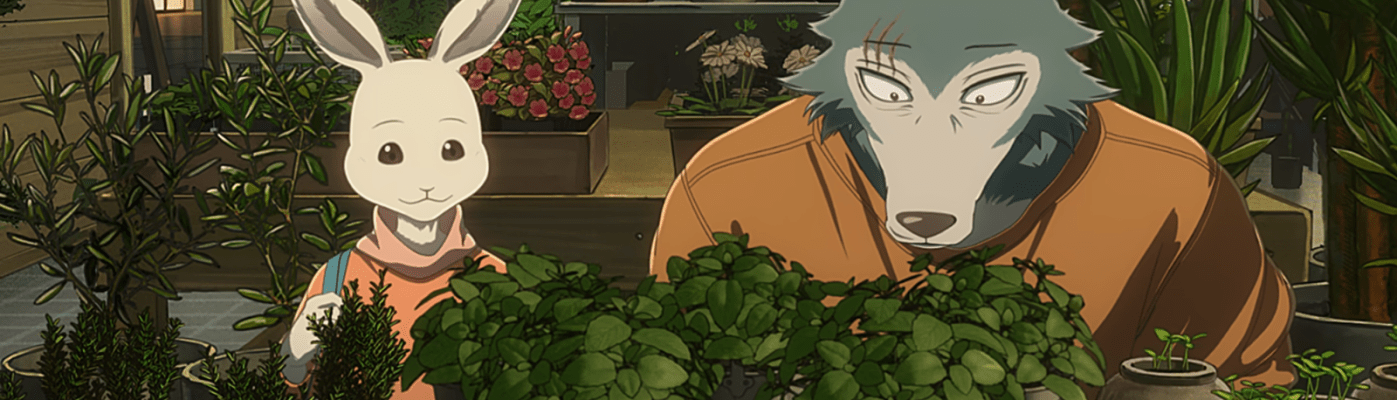
Assuming Beastars isn’t trying to communicate any direct analogy, what is the show about? Broadly speaking, it’s a romance story. Legoshi the wolf is in love with Haru the rabbit despite all their differences and the pressures that keep them apart. In this third season, we learned that interspecies couples face terrible societal discrimination and so do their children, which are called “mixes,” in the extremely rare instance that they are born. Can Legoshi and Haru find a way in this darkness to love each other? Beyond just Legoshi and Haru, can the other characters find a way to exist with reasonable content in this world? Maybe it’s naive of me, but I think Beastars is a story of following one’s heart even when society, instincts, and everything else tells one otherwise. With that in mind, please enjoy this review of Beastars Final Season – Part 1.
Story and Themes
Score: 7/10
I used to think the storytelling in this series was extremely good. However, I’ve recently started to realize otherwise. It’s been a while since I re-watched the first two seasons, and I’ve never watched them with an especially critical eye. Whether or not the writing was truly proficient in seasons one and two, it definitely started to go downhill in the final season. That’s why the highest I can give this story is a 7 out of 10.
The issues with the story category included the following: twists or information that feels out of nowhere; plot threads that are not followed through on or properly developed; events that are easily predictable from a long way off; and confusing messaging. There is also the “WTF Factor” – the tendency of Beastars to be freakishly weird all of a sudden. There will be more on that point in the personal enjoyment section. Now, let me provide a few examples of weak points before reviewing the strengths of the story category.
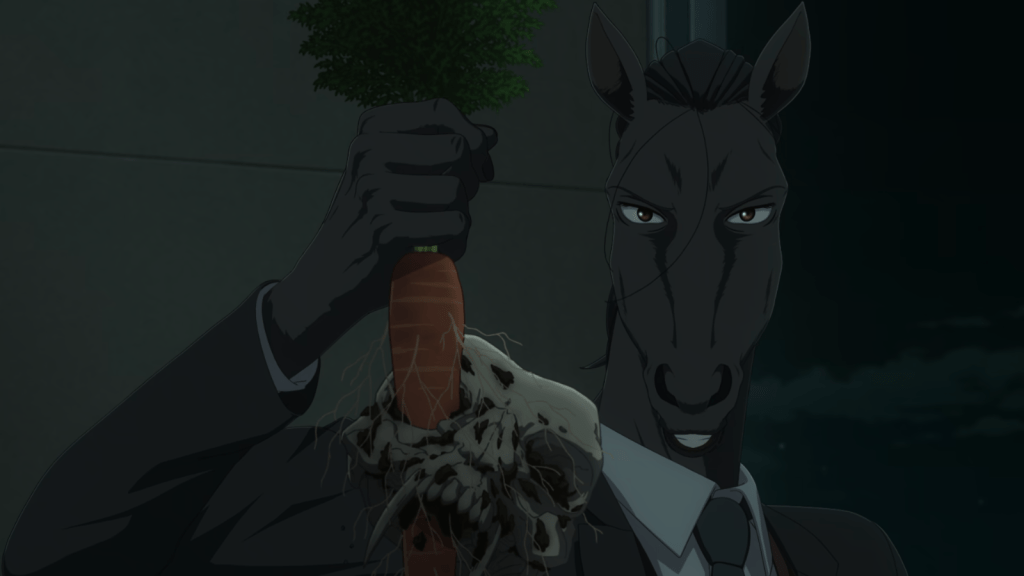
As for elements that feel out of nowhere (or just come across as dumb), one example would be the “carnivorous carrots” developed by Yahya the horse. Due to his hatred of carnivores, he sometimes takes the bodies of criminal carnivores and uses them as fertilizer for his special carrots. The mature carrots give Yahya super strength like meat does for carnivores. This felt like a weak plot point that came out of nowhere. It should have been possible to show Yahya’s hatred and hypocrisy in a better way.
Next, we have story threads that are never followed through on or flushed out to the degree they deserved. The best example is the character of Kyun the rabbit. Despite setting up this bad-ass bunny in both halves of the final season, we never even meet this character. It felt like there was supposed to be room for Kyun in the story, but she was forgotten or left out somehow. (Of course, knowing anime’s misogyny problem, it’s probably better that these writers didn’t try to present a strong female character who makes a living off fighting. You just know they would make her pathetic.)
Some aspects of Beastars are predictable from metaphorical miles away. For instance, at the end of the final season’s first half, the narrative leaves us with the “cliffhanger” of Melon throwing Legoshi into the ocean. The main point of Sagwan the seal was to set things up so that Legoshi easily survives. Granted, you need to watch the final season part 2 to verify it; but surely, anybody watching picked up on this obvious setup. It was so easy to see coming that I felt annoyed by the story playing up the cliffhanger so hard.
Continuing with story weaknesses, I believe the messaging of Beastars is sometimes unclear. If the whole point of the story is that love conquers prejudice and other obstacles, then why do we see only stories where love ends in tragedy? Legoshi’s mother killed herself due to the society’s treatment of “mixes” – hybrid animals born from parents of two different species. There was also the upsetting scene in episode 6 where Eado the lion lost control and violently mauled Ako, his rabbit girlfriend. Why did Beastars need to show us this repetitive misfortune? I think we got the idea in the second season from the story of Tem the alpaca being devoured by his classmate/love interest Riz. The story focuses too much on the darkness, leaving viewers to think it’s only a matter of time before the same fate befalls Legoshi and Haru. It throws the entire message into doubt.
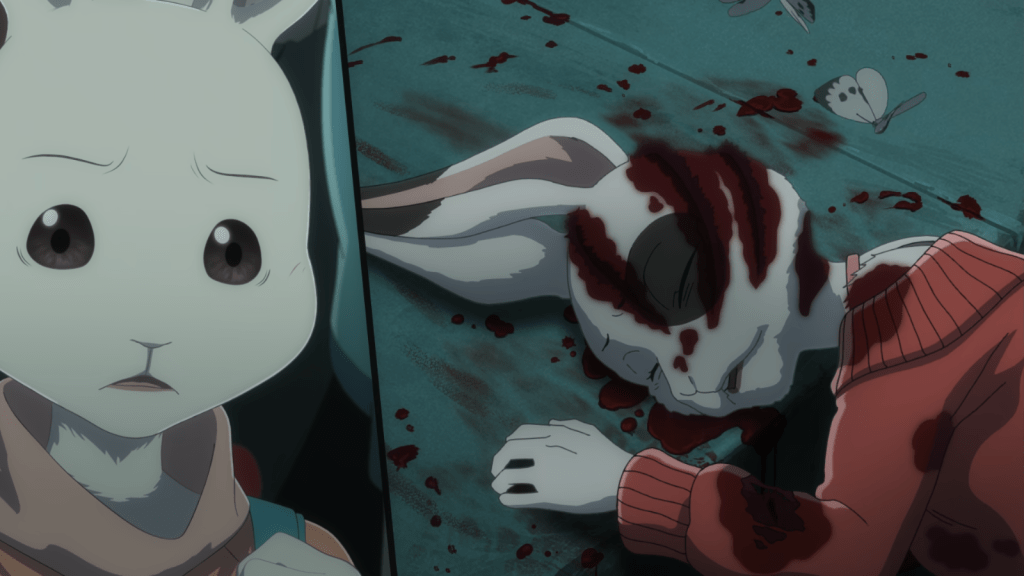
Despite the fact that I’m starting to see the narrative problems in Beastars, I still think it is overall a well-written story at this point in the series. I didn’t give it a 5 or 6 score because Beastars has a number of story strengths. Firstly, it does well with sociological storytelling and world-building. The society in Beastars is fascinating, complex, and relatively intricate. One random detail that I liked in this season was when Yahya saved a factory full of cows that were being overworked by a carnivore headmaster. We now know that milk is provided by cows in exchange for wages in this society.
Besides world-building, Beastars does a great job with creating psychological tension. (Even though I didn’t think Legoshi would give in to his meat craving, for instance, it was nerve-racking when he pounced on Seven the sheep.) Also, the interpersonal drama and dialogue between the characters is rich and entertaining. Occasionally, this show successfully subverts expectations. I complained earlier that some aspects were too predictable, but some others were surprising. For example, I wasn’t expecting the good execution of the plot point that Louis is sexually attracted to carnivores. The scene of him being unable to make love to his herbivore fiancé was powerful. I think it reads a lot like a gay man’s experience with a woman, making it meaningful on multiple levels.
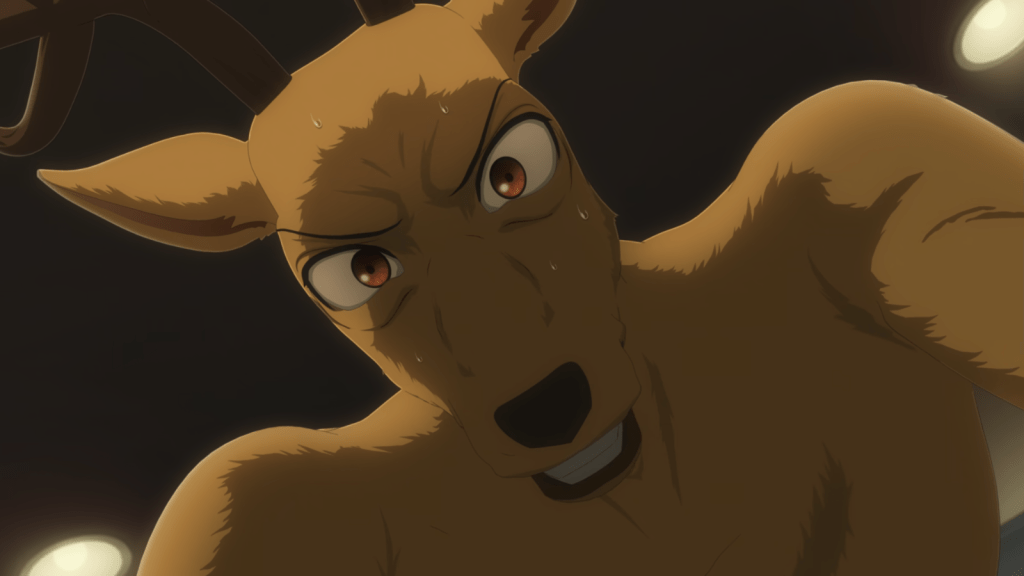
Though the writing can be weak, weird, or vague, I still enjoyed the story of Beastars Final Season Part 1. I hold that it’s well-written enough to earn a score of 7/10. At the end of the day, I view Beastars as a story of creatures overcoming challenges to express their unique love. Final note: I’m sorry that this section was so long and that the other sections after this will not be as detailed in terms of discussion. If you read all that – wow! Thanks! 😀
Art and Animation
Score: 8/10
The first season of Beastars was widely praised for its unique and creative visuals. It was made by Orange Studio with an unusual style of 3D CG. There are several videos and even a book about the visual making of Beastars, so if you want more information, the research is there. I simply don’t have the energy to watch those videos or read that book at the present time, so you’ll have to make do with nothing but the basics in this review. Though I don’t usually like 3D in anime (including Berserk 2016), Beastars is an exception because it’s more stylized and carefully crafted than most of what you see in this medium. I have always enjoyed the emotive face expressions, realistic character movements, and dramatic shots used in this one-of-a-kind anime.
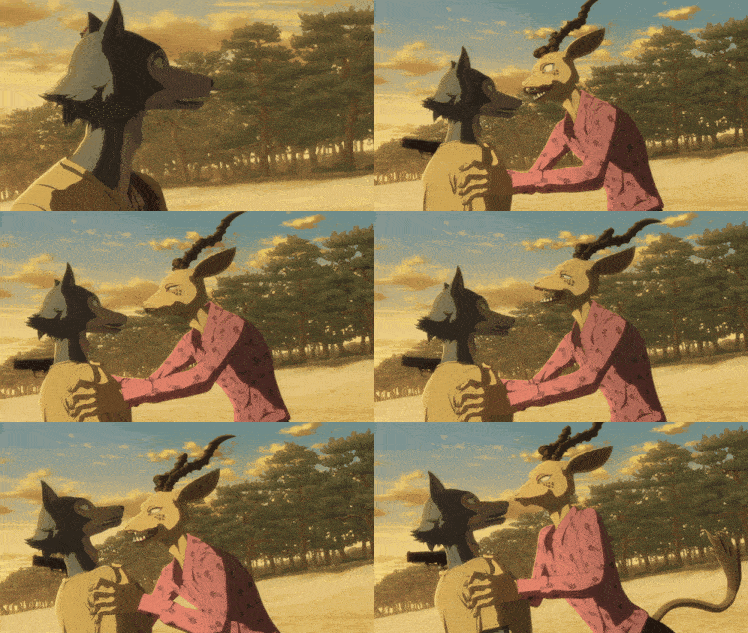
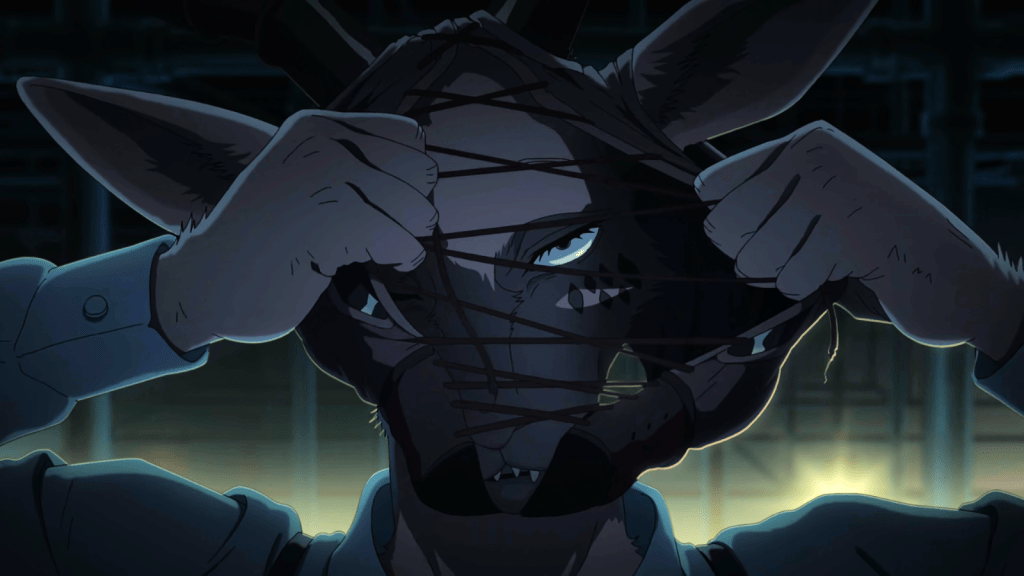
As far as I currently know, the visuals are basically the same as ever in the final season. The only “issue” I noticed is that too many supporting characters have the same or very similar models, leading to some slight confusion. The male black panthers, for instance (and most of the female leopards), all look like each other. Besides that, there just seemed to be fewer amazing shots in this installment compared to the first and second seasons. Nevertheless, I was definitely impressed with the art and animation. I think it’s one of the major draws of Beastars. In this season, I especially loved the design and animated fruity antics of Melon. He was a major highlight of this season. In addition, Seven’s design was adorable and Yahya’s was hot. That’s all I have for visuals.
Music and Sound
Score: 9/10
The music for most of Beastars was written by Satoru Kousaki, a composer that’s most famous for working on the Monogatari series and The Apothecary Diaries. He is the individual responsible for the awesome instrumental music of Beastars, which often includes unusual jazzy elements. The final season part 1 featured more excellent music, keeping the same original composer and adding another as well. Some tracks were composed by Ryuichi Takada, at least according to YouTube. Since he isn’t credited on MyAnimeList.net, I don’t know what this second composer is known for, but his additions to the OST were great. Some of my favorite tracks from this season were “Bizarre Melon,” “Yahya and Gosha,” “Holger,” and “The Black Market.”
The opening song was quite as unique or memorable as those from previous seasons, but it was still a good song. It’s called “Into the World” by Issei. The song is fast-paced, with a catchy beat, and I love the trumpets or whatever instrument is used in the main tune. (Sorry, I’m bad at describing music.) As for the ending song, the main one was “Feel Like This” by Yu-Ka. The melody of this ballad is so beautiful even if the English isn’t perfect. For episode three, there was also a special ending song in honor of Gosha the komodo dragon. That song was “Rock’n’roll Dragon” by Risa Uesaka. It is an absolute banger of a hard rock song! Definitely give it a listen if you like J-rock. I thoroughly enjoyed all the music and songs in this season of Beastars.
Now I’ll mention some of the voice actors, since the voice-acting is one of the most awesome and enjoyable aspects of the series to me. I’ve heard the English Dub is alright, but as usual for this blog, I am only talking about the Japanese seiyuus. Chikahiro Kobayashi is the one-of-a-kind voice of Legoshi. His deep and quiet yet expressive voice continued to be iconic. Yuuki Ono did an amazing job as always playing Louis. I love how bold his voice can be.
It was the first time I remember hearing the VA who played Melon, Kouji Okino. He may a be newer voice actor, but he brought the character of Melon to life perfectly. The women were also extremely talented. That includes Atsumi Tanezaki as Juno and Sayaka Senbogi as Haru. I have recently learned to recognize the voice of Shigeru Chiba, the older man who voiced Gosha. (He is probably most known for playing Jougo in JJK.) It was great to hear so many cool voices!

Character Writing
Score: 7/10
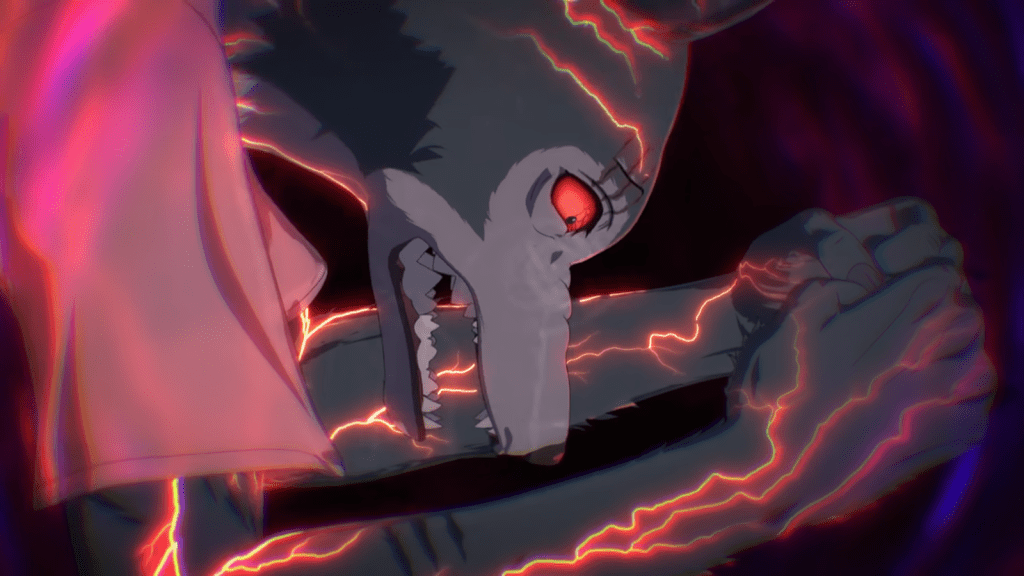
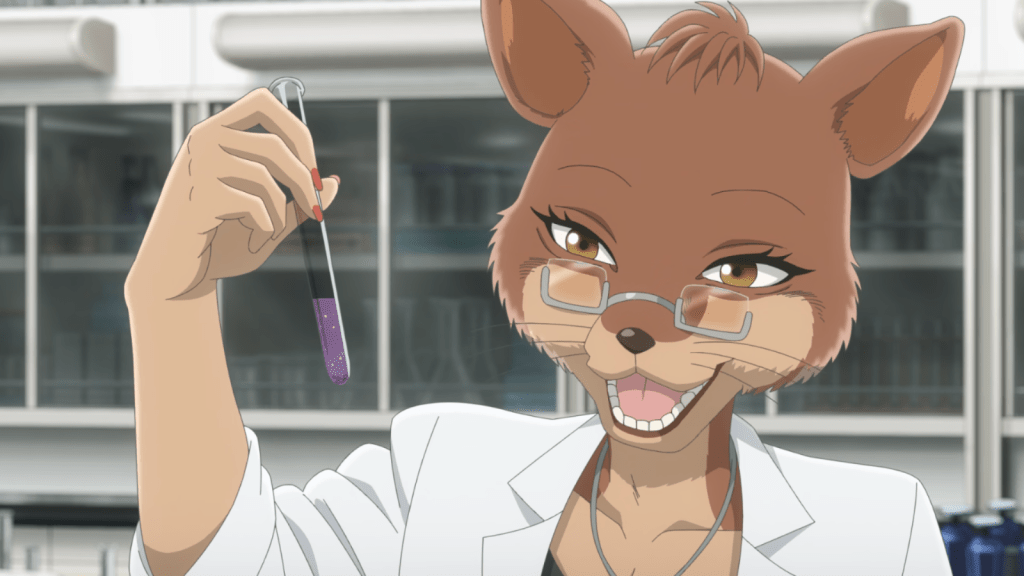
The character writing in Beastars is generally good. Much like with the central story writing, I’m starting to have doubts that it was ever “great” – but I still think it deserved a solid seven for a score. There is excellent ongoing character development for the main characters. For example, Louis deals with a lot this season as he meets his fiancé and struggles with his attraction to carnivores. Legoshi contemplates the existence of “mixes,” as well as maturing through meeting others like Seven and Sagwan. Several new characters were introduced in this season. From Deshico the civet to Yahya the horse Beastar, the new characters were fantastic. Some of the supporting characters from previous seasons also saw solid character development and/or interesting moments in this season. That included Juno, who fell for Louis. There was even enough time to show how the drama club was doing. It was great seeing Bill, Kibi, Tao, and the others.
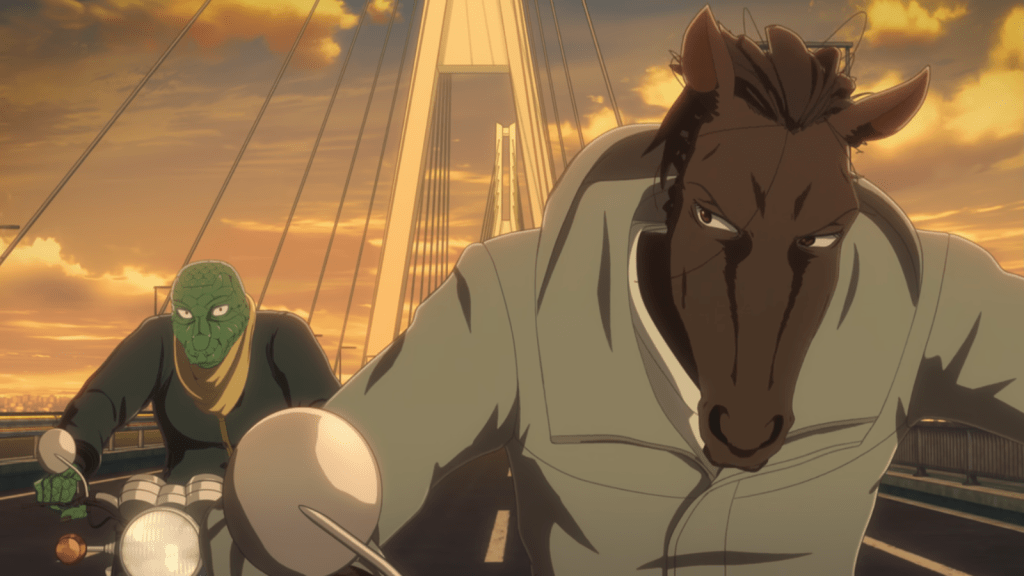
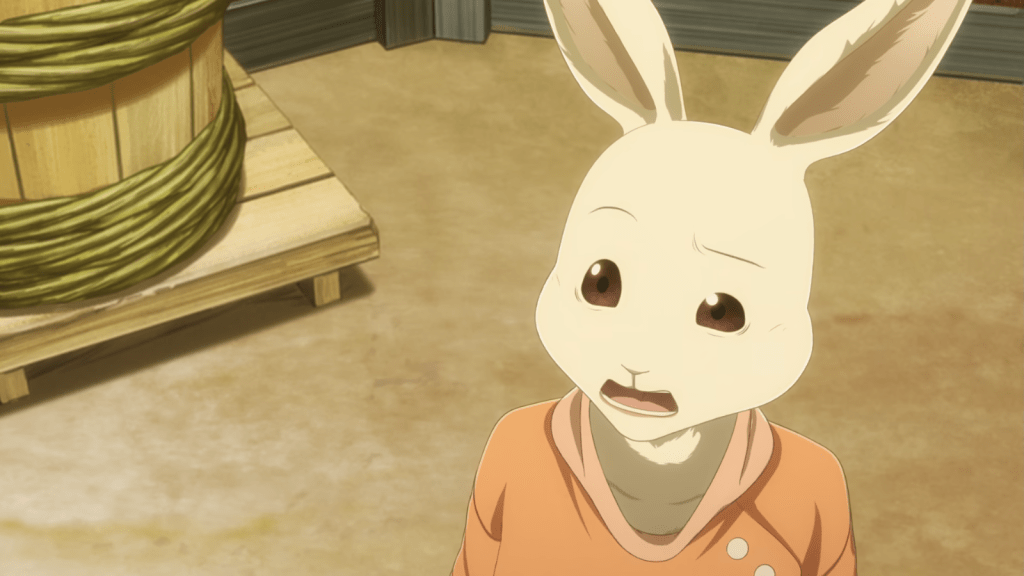
Beastars has always featured compelling and entertaining characters, and that didn’t change. In the final season, the character writing for the new antagonist, Melon, was outright genius. I loved this psychopathic and flamboyant cross between a gazelle and a leopard. The character of Melon was truly a highlight of this season. From how I’ve been going on, I would normally give the character category an 8/10, but there were also a few issues that made me go down to 7/10. By way of example, I have two problems with the character writing for Haru. Firstly, she was most likely written by a man with conservative and/or misogynistic values. That shows in her character arc, where she regrets her previous sexual empowerment and moves toward tradition to stay safe. The second issue is Haru’s absurd, nonsensical desire to go to the Black Market in episode 7.
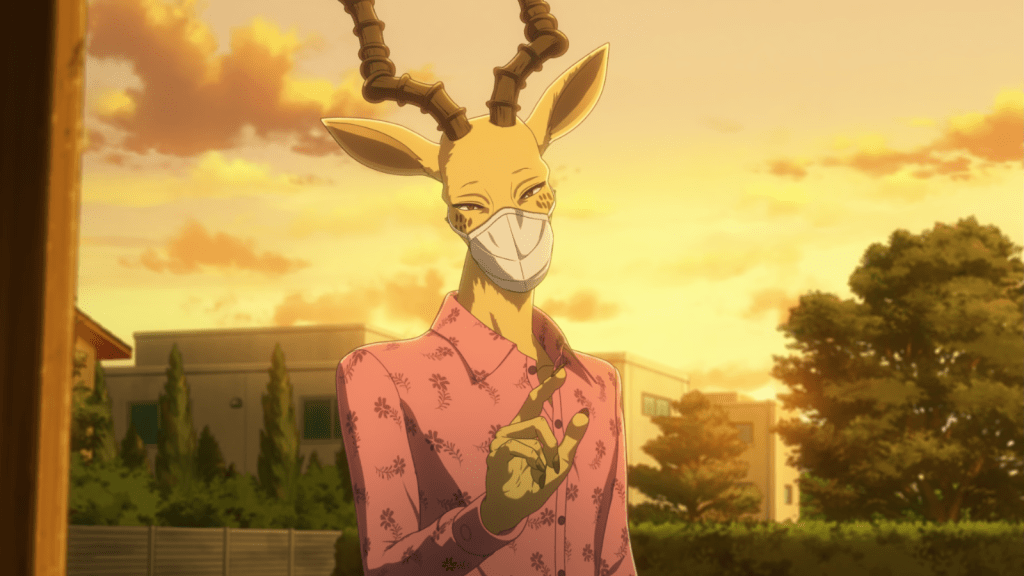
Regarding the first issue, it may be possible to argue that Haru’s character arc was not meant to be misogynistic, but it would take a lot to convince me. Anime’s problem with “men writing women” is just too common and runs too deep. Too many men want to restrict women and write female characters that stay submissively in line. Haru’s character is sadly no exception. As for the second point, I can’t make heads or tails of Haru’s sudden desire to put herself and Legoshi through unpleasant experiences at the Black Market. There’s no way she thought it would be romantic, right? Whatever she was meant to be thinking, it was not clear and still makes no sense. There were a few other small problems I had with the character writing, but Haru was the best example of why the character category didn’t get a higher score from me this time.
Personal Enjoyment
Score: 8/10
After I first watched Beastars Final Season Part 1 in Fall 2024, I would have ranked my personal enjoyment at 8/10 or perhaps even 9/10. I really loved watching it and I hoped it was leading up to an even more powerful second half. (Boy, that was wrong!) When I re-watched the season for the purposes of this review, my enjoyment was significantly lower, but I wanted to keep the score of 8 to reflect how much fun I initially had with it. Despite the issues that I keep realizing about Beastars in recent weeks, I will probably always love the series on some level, even if it’s only for the animated animal designs and occasional zoology facts. (I studied wildlife biology in university and I love animals!) Even now, however, I think Beastars has more to offer than just that.
Here are some other reasons why I enjoyed Beastars – including Final Season Part 1. The instrumental music is memorable and emotive. The Japanese voice-acting is top-notch. I am fond of the characters Legoshi and Haru, even though the latter isn’t as believable or commendably written as the former. The relationship between these two characters is fun to watch and analyze. I’m grateful to Beastars for helping to slowly normalize “furry culture” among anime watchers. Additionally, I appreciate much of the character writing and world-building in this series. Also enjoyable is the theme that love and cooperation conquer prejudice. Similarly, I like the theme that society is complex and most things are not black-and-white. These reasons hopefully show why I’m still so enamored with this show.
(Side Note: The idea that these characters are sometimes overtaken by their instincts is interesting, but potentially problematic if made into an analogy for humans. For example, let’s say that devouring is an analogy for sexual assault. There is never an excuse for sexual assault, even if the perpetrator is mentally unwell and believes they were driven by some “instinct.” Some people are bound to interpret Beastars in a harmful way, but I don’t think this was the true intent of the show. Even if was, that’s not a part of it that I enjoy.)
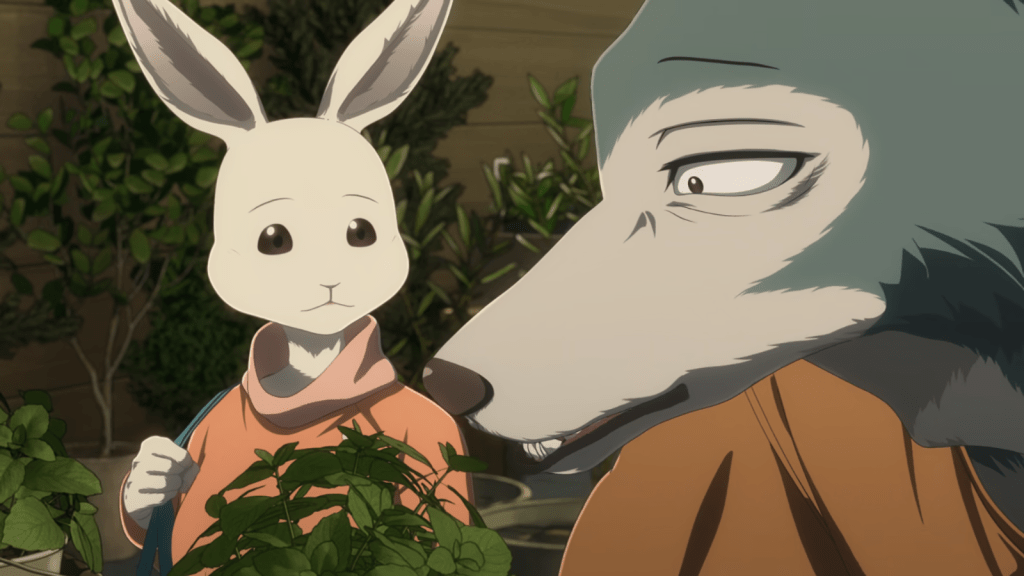
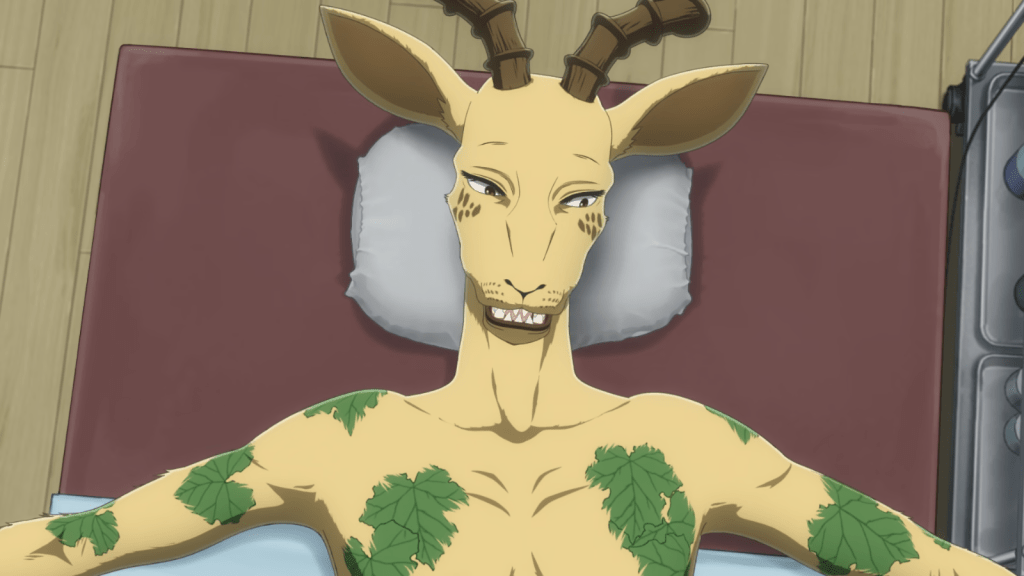
On a final note for this section, Beastars has what I call the “WTF Factor.” This is when the show is extra weird, usually in a sensual way. The “WTF Factor” can be a positive or negative – for me, it’s usually the latter. In this season, the biggest WTF moment was probably when Melon got his new tattoos from Holger. That scene highlighted the fact that Melon gets sensual pleasure from physical pain. It did make me go “WTF” and feel a bit uncomfortable at first, but it wasn’t a major issue. Melon is an adult character, so if the makers want to show him moaning, squirming, and naked, then whatever. Beastars can be so damn weird, but for me, that’s sometimes part of its unique appeal.
Overall Score
Score: 7.8 out of 10.0 – “Good”
As always, the overall score is the mean or average of the five scores discussed in the categories above. Until now, I’ve always given Beastars a full 8/10 or higher. This marks the beginning of the downhill slope for Beastars. Nevertheless, 7.8 is still a good score – especially for any anime with so many potential problems. Currently, Beastars Final Season Part 1 has a score of 7.79 on My Anime List (as of May 2026). The voter base was small (less than 50k people), but the season was fairly well-received by those who watched it. Like I’ve said before, it may be riddled with weird moments, and it may be too problematic for some to enjoy, but I still think Beastars is a good anime.
~Thanks for Reading~
Written by 7Mononoke from Anime Rants


One thought on “Beastars Final Season (Part 1) – Embracing Love in a Corrupt Society”